The platform’s ‘Flexible Checkout’ option could shift money, patient data and patient control away from the PMS platforms and GP practices while creating significant practice accounting and tax headaches at the same time.
HotDoc’s new private equity owners have only had the keys to their shiny new sports car for a couple of weeks, but they already seem to be driving it at top speed to shift the power dynamic between themselves and their customer base – GP practices, GPs, patients and the major patient management system platforms.
A new Flexible Checkout option introduced recently advertises itself as making life easier for patients by asking patients if they would like to pay for their consults via HotDoc now for every consultation type.
The notice defaults to asking patients to change.
Practices who don’t want this payment workflow have to actively find out where to turn off this patient notification so payments stay with the practice.
The obvious problem for practices and the PMS vendors here is that if patients start migrating en masse to paying for everything via HotDoc and not at the practice, then HotDoc will end up as the major payment platform for patients as well as their major booking platform.
It would make HotDoc a significant financial intermediary, and as such HotDoc would benefit from controlling payment timing, being able to capture and analyse large volumes of transaction data, and it could introduce new and bundle existing products with its tighter patient lock on.
In this situation, patient-switching costs would be higher, PMS vendors would have less bargaining leverage on their integration deals, and it would open up other opportunities to monetise patients at scale, outside the practice and the PMS.
HotDoc stepping far more powerfully into the patient workflow and relationship, via payments, is something which strategically makes sense given the long-term access block that the PMS companies have had on patient data over the years, given the imminent threat that the new patient-side AI engines such as ChatGPT Health and the AI clinical platform engines such as Heidi are starting to present to all the existing medical software platforms.
But, unlike the PMS vendors, HotDoc has a high-wire balancing act to perform now between patient-facing convenience and lock on, and being a service to GPs through their integration to the major PMS platforms.
In other words, who should HotDoc be serving – the patients to whom they offer more and more convenience, or the GPs and practices who pay them for looking after their patients?
A key issue for both practices and the PMS vendors is likely to be that the payment option was set as defaulting the payment option to the patient and HotDoc, that is, away from payment at the practice.
A lot of practices are maintaining that HotDoc didn’t warn them about this change.
HotDoc maintains it notified all its customers and points out that in its notice it told customers they could reset the default to the practice if they wanted.
That notice would have been pretty easy to miss. It’s on an email notification in full below:
“Patients can now also choose to pay with Apple and Google Pay when booking an appointment online where payment settings aren’t already enabled, thanks to Flexible Checkout. Alternatively, they can continue to pay directly via your practice, as they do today.”
At least there is a link to the product, but HotDoc would probably have been better served by putting this notice in giant red type and saying: “We’ve defaulted your patients to paying with us!!!”
A lot of practices either didn’t get or didn’t see the notice when it came through. Notably, some have opted out of HotDoc email notifications so they would not have seen the notice at all.
Regardless of what happened, a lot of practices have been caught off guard and once patients choose to default to payment via HotDoc, away from a practice, it’s not going to be easy for those practices to drag them back to a practice payment workflow.
None of the patient management systems who have HotDoc as an integration were notified of the change, although by shifting the payment option to HotDoc from the practice, all these platforms stand to lose a lot of revenue from those transactions now taking place outside the PMS.
When contacted for comment, a HotDoc spokesperson told HSD that the change is “in line with industry best practice, and from our research on patients’ [their] preferred way to pay”.
“At the beginning of this year, we rolled out our flexible checkout feature to our active payments clinics,” the spokesperson said.
“This feature added Apple Pay and Google Pay, as well as giving patients additional secure payment options when completing a payment request.”
Hmm …that last bit of the sentence is the big change – not exactly what you’d call telegraphing your clients that you’re going to try to switch all their customers over to a major payment workflow from them to you.
“The flexible checkout feature was enabled for clinics that use our payments product only, as part of a product release.
“Practices were notified of the feature upgrade, and any practice can turn the enhanced feature off at any time if they choose not to offer it.”
On the socials in the past week a lot of practices have been expressing anger that the default setting was to change the payment flow to HotDoc away from the practice rather than making the new payment option to HotDoc a patient “opt-in” choice.
One practice manager, who did not want to be identified, told HSD, “surely if we are paying for and using HotDoc as our booking platform, HotDoc shouldn’t just insert themselves and start defaulting a lot of payment flows to them away from the practice”.
But the problem might be a lot worse for practice owners than just losing some of the lock on their patients via a shift in where they actually pay for their consults.
This week one significantly influential GP advisory firm, HealthAndLife, the founder of which first alerted the sector to the huge payroll tax mess more than six years ago, felt the move was so potentially problematic in terms of practice accounting and tax obligations that they put out a special Advisory Note to their clients on the matter.
The note identifies 10 potential compliance issues across tax, AML/CTF, privacy, and regulatory frameworks, for practices to be careful of including:
Update to Story : HotDoc has responded to this advisory note and we have included the response to the note at the end of the article.
- A requirement to check if the new flow is compliant with upcoming changes (July 26) to money laundering and anti-terrorism financing laws;
- Possible privacy breaches, where practices did not end up being alerted properly, so were in effect opted in to the new payment regime without the permission of the practice or PMS;
- Potential tax compliance issues – HotDoc’s payment confirmation emails are not valid tax invoices for the ATO according to HealthAndLife or health fund purposes, meaning practices must properly reconcile the payment with the right timing to their PMS;
- Possible payroll tax and ATO liability if a practice entity is putting itself out as a “tenant doctor” medical centre entity;
- Accounts reconciliation – the new workflow, depending on payment timing between HotDoc and the practice, can significantly add to the burden a practice has of reconciling all patient payments within their systems for tax purposes;
- And more …
PMS vendors are obviously unhappy with the initiative because the new workflow shifts payment revenue that would have otherwise have gone to the PMS vendor payment integration.
One vendor, who did not want to be identified, told HSD, “the new option is clearly designed to get as many patients to pay up-front through HotDoc [as possible] … there is a pay-at-reception option, but it’s not very prominent”.
Related



This vendor’s gripe puts into sharp focus an emerging problem for the overall strategy of HotDoc as a platform: does it serve the patient, or does it serve the doctor’s practice?
HotDoc is saying its research says the patient prefers the new method of payment, which would be serving the patient.
But the GPs and the practices are the entities that pay for HotDoc, not the patient.
That is, so far in HotDoc’s evolution as a platform.
In making this play HotDoc may well have been looking over its shoulder and worrying a fair bit about two significant market disruptions heading towards them: the powerful new patient-side AI engines, such as ChatGPT Health, which soft launched a few weeks back in Australia, and, the rise and rise of the AI clinical layer for doctors, the main charge of which is being led by Heidi.
Both disruptions threaten HotDoc’s current moat, it’s tight relationship to our patient population through its widely downloaded and used booking app.
So, can anyone blame HotDoc for trying to go further upstream with its patient “lock on” by trying to move into the payments layer of patient workflow?
The dilemma for HotDoc is balancing the need to be building a wider moat to protect itself from ChatGPT Health and Heidi eventually, and not upsetting the mouths that have always fed it – the practices and doctors. The practices are not happy campers at all. Here’s a couple of social posts, paraphrased so they can’t be sourced, on the topic from this week:
“Our patients are really confused…they are assuming this is how we want to collect the payments now…HotDoc should have made this optional from the start not opted everyone in automatically, it’s caused a lot of staff and patient problems.”
“HotDoc seemed to have joined that growing group of businesses that take their money from GPs and use it to turn the patients into their direct customers by bypassing us…”
GPs individually (owners or not) aren’t likely to be happy either. They’ve clearly expressed over the past few years that the patient data they generate all day consult by consult, which then gets stored in their PMS data, is owned ultimately by them and/or their practice.
They see a lot of people coming for that data to realise its profit and value in shaping the system but they don’t see many people or companies willing to pay them properly for access to this data.
The government, through their ePIP scheme, at least pay GP practices for the use of some of that data.
But the GP posts above suggest GPs see HotDoc as being paid for by the GPs and then HotDoc is turning around and using the money to establish a more powerful data position without appropriate recompense to the GPs or their practices.
This incident comes not long after HotDoc got into a lot of trouble with GPs for launching a telehealth service which, initially at least, GPs felt was a new revenue stream for HotDoc in which the core design feature was diverting patients from their practices.
HotDoc CEO Ben Hurst had to quickly apologise to practices for running what he then called “a pilot” without broader customer consultation.
The full story can be read HERE and HERE.
Sound familiar?
It certainly feels like HotDoc hasn’t got its customer consultation settings right this time either.
Or, is the group, now under private equity control, naturally racing just a bit harder to broaden its patient access moat before the inevitable challenge to its patient-side lock from ChatGPT Health and Claude Health, both of which are promising to harvest huge numbers of patients to their platform with their significant patient decision support offering.
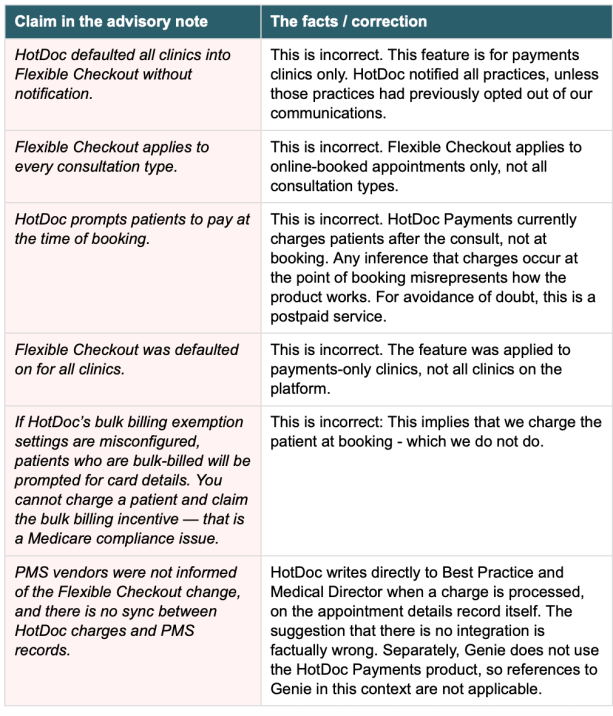
Article Update: HotDoc have responded to the HealthAndLife Advisory note with the following table pointing out that in their view some of the points in the note are incorrect. The table of their response is below. We asked HealthAndLife to respond to the HotDoc response and they noted that their advisory note was in response to what they been told directly by their clients and had themselves been reading on social media posts, that the note was put together based on this input not on discussions with HotDoc, in order to address the issues raised by their clients and on social media. HealthAndLife had supplied TMR with the advisory note on background and they did not intend it to be published to anyone else other than their own clients.