

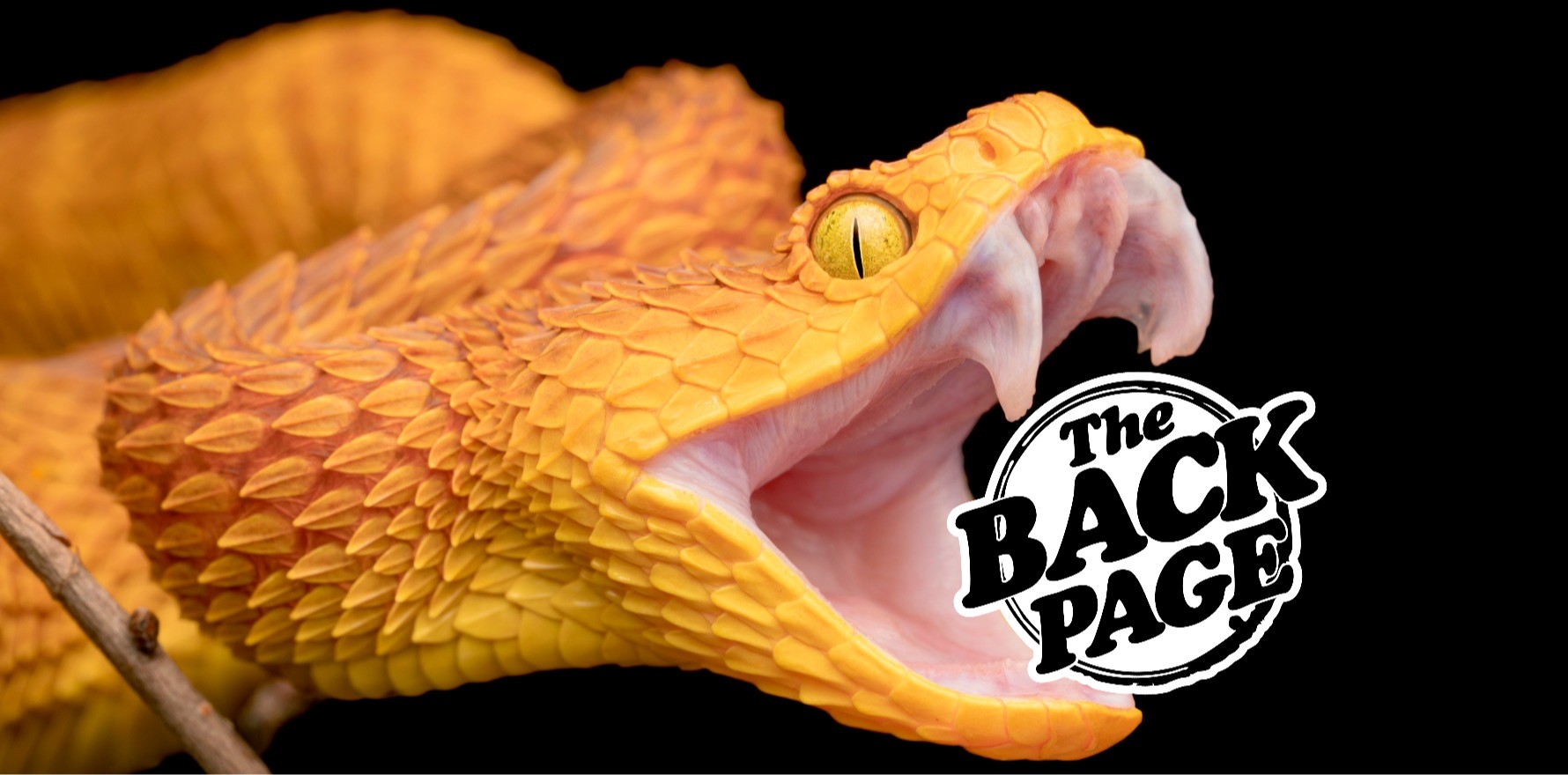
Our lizard brains still perceive ‘ancestral threats’ like heights and snakes to be worth sweating over.
Human bodies may have evolved to wear shoes and eat food which comes from a packet, but the brain’s fear centre remains locked in on threats from the past.
Our ancestral nemeses – snakes and heights – still produce a bigger stress response than more immediate modern threats, like firearms and communicable diseases.
So say the boffins at the Czech Republic’s Charles University, who published findings from an experiment measuring psychophysiological fear responses to four sets of stimuli in PLOS One last week.
They rounded up 119 hapless participants and hooked them up to extradermal sensors, which measure reactions like sweat, and showed them a series of photographs for around 15 minutes.
Half of the photographs were control images like leaves, designed to elicit no particular response.
Between the nice leaf pictures, each participant was exposed to one specific type of fear stimulus – either a venomous snake, a height, a firearm or a sick person.
But while people generally rated their fear of snakes as high, this did not necessarily correlate with sweat responses.
Photographs of heights, it turned out, evoked the strongest response from viewers.
“We suggest that this is due to the necessary involvement of conscious processing and emotional and cognitive experience engaged in assessment of the threat posed by heights,” the authors wrote.
Snakes, guns and sickness followed, in that order.
Previous studies have shown snake stimuli to activate areas of the brain associated with memory retrieval and context representation, making it likely that the ancestral fear of snakes represents an entirely different type of fear than the ancestral fear of heights.
“This leads us to conclude that even all ancestral threats need not to be processed the same in terms of fear circuit,” the researchers wrote.
“Moreover, the assumption that stimuli from certain categories, such as snakes, should consistently evoke the strongest responses across all tasks and physiological measures, followed by a predictable hierarchy of other stimuli seems to be an oversimplification.”
The authors also suggested that personal experience represented a second key factor in fear.
While it’s likely that most people have had some sort of experience with falling from a height, firearms are relatively uncommon in the Czech Republic, meaning that participants were mostly relying on broad cues and general categorisation when it came to processing this threat.
Of course, one may deduce from this study that the scariest possible image is one of a snake with a runny nose waving around a gun while atop a skyscraper.
Whatever you do, don’t send this picture to Holly@medicalrepublic.com.au.
