

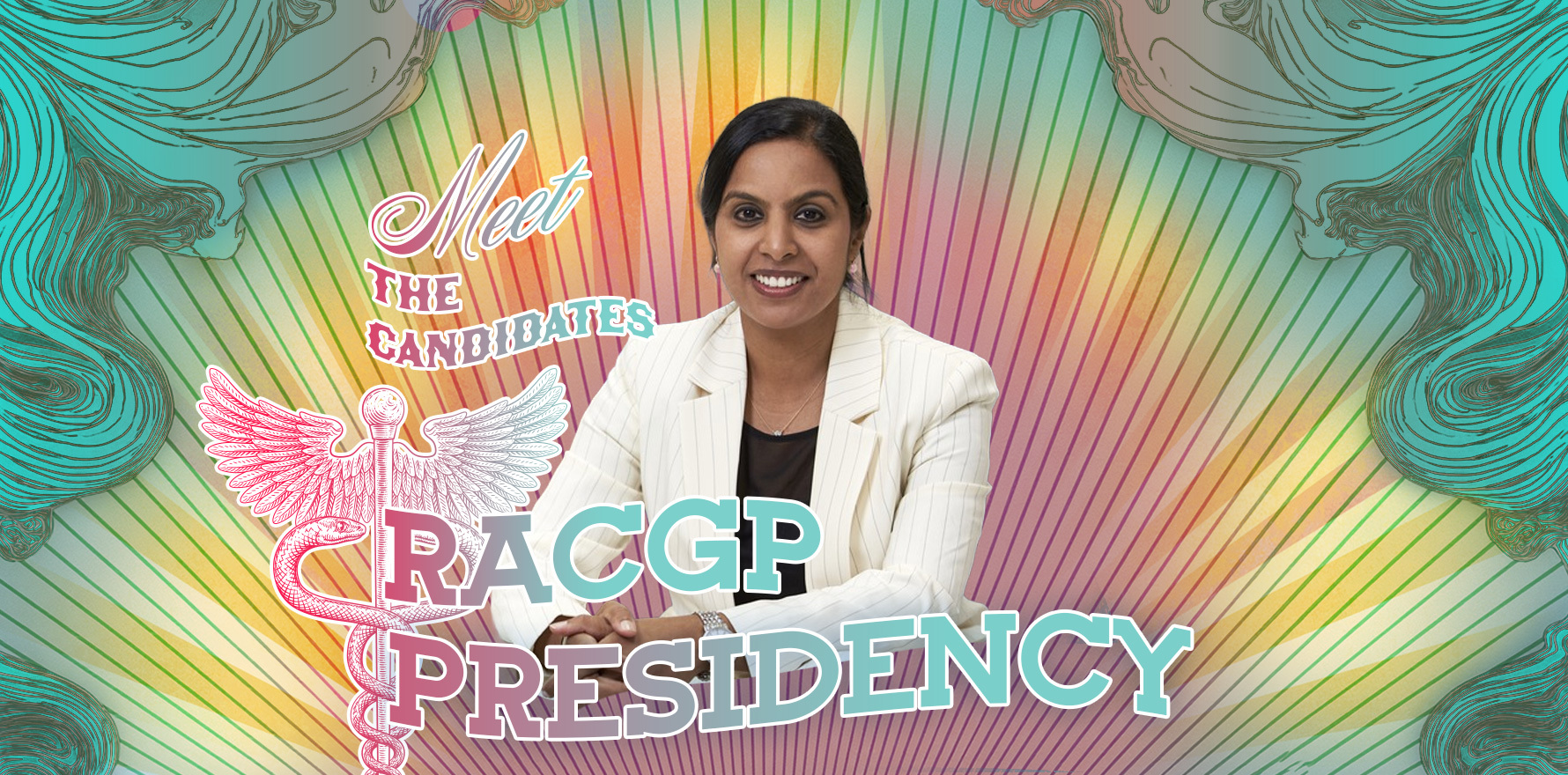
Dr Ramya Raman is president-elect of the RACGP.
Long-time WA faculty chair and RACGP presidential-elect Dr Ramya Raman pledges to deliver credible evidence and clear solutions that reflect GPs’ realities and will cap member fee increases at the MBS rebate indexation.
Shortly before the election, the Perth-based doctor dialled in for a chat with The Medical Republic.
TMR: What interested you in general practice?
Dr Raman: I grew up in the country, in Orange in regional New South Wales. That’s where I lived for a long time, about 15 to 18 years.
I understand what it means to have limited access to healthcare, and more importantly, my interest in general practice came about when I started working in Canowindra, initially as a medical receptionist for a remote and regional doctor there.
I saw firsthand what the local GPs were capable of.
They were diagnosing, treating, performing procedures, and caring for families over many years, and that firsthand experience of seeing the breadth of their skills and the trust the community placed in them was a true inspiration for me.
I moved to Western Australia for medical school, and I’ve now lived there for another 18 to 19 years.
I went back to Canowindra to complete all my rural electives during medical school because I enjoyed learning about that work and understanding what it means, and I also went back to work there for a short period of time.
TMR: A lot of registrars aren’t getting to the regional areas where they’re most often needed, and you’ve talked about advocating for fairer fellowship pathways. Can you tell me what that would look like?
Dr Raman: When we are talking about GPs in training, or registrars, or colleagues going through a training pathway, it includes AGPT registrars and the doctors who are undertaking the FSP, the PEP specialist pathway, and the challenges around that.
For the AGPT registrars, I’ll advocate for properly funded supervision and teaching practices.
I know there are challenges in securing appropriate funding for supervisors, and supervision is a really important component.
We must support practices and supervisors carrying the training workload, which means adequate funding, protected teaching time, and practical support, particularly in our rural communities.
In addition, [the need for] greater training flexibility is something I’ve heard from GPs in training.
Stronger rural and remote pathways, including opportunities for sustainable remote supervision. That way, it enables the GP in training to feel supported when they are managing acute or chronic disease, or needing to get that support.
There is still a lot of administrative burden and overhead, and that needs to be reduced as well.
So this really focuses on registrars being able to become excellent specialist general practitioners without needing to navigate bureaucracy.
For colleagues who are going through the FSP and the PIP pathway, they spend an enormous amount of money to enter this program, and I’ve heard this on the ground, listening to members over the last five to six years.
I’ll push the government to fund training and supervision costs, improve transparency in that process, recognise prior experience appropriately, and provide structured mentorship and exam support.
One of the challenges in rural and remote areas that we are seeing is ensuring that GPs, [practice staff, allied health], and registrars working in those areas have access to housing and childcare services.
You asked me about doctors not necessarily going into rural or regional areas.
The thing about that, is there is a lot of interest. In terms of training places being subscribed, we have filled all the places in remote and rural areas, as well as in metropolitan outer metro.
However, what I am hearing on the ground is about access to housing, and examples of that include when I travelled recently to Karratha, Kalgoorlie, Denmark, and Albany in Western Australia, as well as what I have heard from my travels to Cairns, Wagga Wagga, the Riverina region, and the Central West.
TMR: You’ve been a senior lecturer and clinical examiner; you’re an Associate Professor at The University of Notre Dame. You’ve also been a regional medical educator in Perth. Tell me about your experiences with your registrars and what you enjoy most about teaching the next generation.
Dr Raman: It’s been a great privilege to support doctors as they develop their clinical judgement and confidence, and to support them in the career that they have chosen.
What I value most in teaching is that it’s never one-directional.
Registrars as well as students bring fresh perspectives, challenge established assumptions, and ask questions that make me examine why we practise in a particular way.
The process has made me a more reflective clinician and a stronger leader as well.
It’s taught me to listen before acting, to explain the reasoning behind decisions, and to adapt my approach to the individual in front of me, and that translates to my clinical practice with my patients as well.
And I say this often: my clinical practice and my teaching keep me grounded because people perform at their best when expectations are clear, feedback is honest, and they feel safe to raise those concerns.
Supporting students and registrars, as well as my patients, enables all of this.
So, leadership is not simply about directing people or having the loudest voice. It’s creating clarity, bringing people along with you, and being able to learn.
If I were elected president, I would bring those front-line insights into decisions about supervision, assessment, training, reform, and my communication style as well.
TMR: What do you see as perhaps the three biggest threats facing general practice right now?
Dr Raman: The greatest threat is the cumulative devaluing and the fragmentation of general practice.
As a practising GP caring for patients with more chronic disease and mental illness complexity, the funding model continues to reward speed and volume rather than time, continuity, and quality.
Governments are dividing care into isolated transactions, without recognising the value of general practice, which lies in seeing the whole person.
The uncoordinated prescribing expansion, standalone clinics, and siloed programs create the appearance of access, while actually they’re weakening diagnosis, follow-up, and clinical accountability.
We’re facing mounting pressure to adopt funding models that shift financial risk onto GPs and increase government control over clinical care.
My position on this is that reform must strengthen comprehensive specialist GP care, not progressively dismantle it.
AI is disrupting the delivery of healthcare, and general practice must turn AI threats into opportunities and strongly advocate for the value of GP care.
The most important thing is to keep more funding in general practice.
TMR: We’ve just discussed your leadership style when it comes to education and providing clarity and honest feedback. What do you envision your leadership style being when you present arguments to the government and interact with other stakeholders?
Dr Raman: I would say firm, but authentic. I believe in constructive approaches, but not compliance.
So engaging early, bringing credible evidence, presenting a clear solution, and understanding the political environment in which decisions are being made.
Engagement is only worthwhile when it produces outcomes, and my track record should speak for that.
In Western Australia, I led advocacy to secure written government confirmation to protect general practices from payroll tax changes, and we also turned sustained ADHD advocacy into a government-funded program with a 1.3 million investment to train and support GPs to diagnose and manage ADHD.
These outcomes required relationships, persistence, and a willingness to be very clear about what patients and GPs need, whilst understanding the political environment and the environment in which we are operating, including the geographic environment.
So it’s important for me to negotiate seriously but collaboratively when interests align, and to stand firm when patient safety or the future of our profession is at stake.
For me, if I had to put it in a statement, a president must know the difference between being at the table and having influence at the table.
TMR: You’ve talked about making membership more united, better managing members’ fees, and minimising administrative burden. Can you tell me a little bit about some of the other changes you would make and what this would look like if you were president?
Dr Raman: Spending member fees wisely is an important priority, and I understand that every dollar has an opportunity cost.
Firstly, members should be able to clearly see where their fees are being spent, and communications around that should be improved.
I also want to say that, if I were elected as president, I would cap any member fee increase at the indexation percentage applied to MBS rebates.
I’m proposing this because members can’t absorb fee increases that are disconnected from the financial reality of general practice.
Related


TMR: You’ve now been the WA faculty chair for almost five years and vice president for over 18 months. What have you learned during this time that would make you a strong candidate for president?
Dr Raman: I have seen what works, and I’ve also what doesn’t.
I’ve worked across advocacy, governance, training, member engagement, and health system reform, and I’ve learned how to turn members’ concerns into clear policy asks, build coalitions, engage decision-makers, and sustain that pressure until there is a result.
That approach helped deliver practice support and stronger engagement, particularly with regional and remote GPs, including support for after-hours funding in regional and remote areas of Western Australia and for securing grant funding for practices within WA.
It’s also taught me that, as a college, we need to understand the realities of what it means to practise, or to have a practice, in a metropolitan, regional, remote, or rural area. It’s very different.
I guess the benefit of all of this is that I understand the machinery of the college, so I remain firmly grounded in my clinical practice, and I am a practice owner as well. I know where change is possible and how to drive it.
TMR: You’re a host of the Good GP podcast, and you’re a guest presenter for ABC Radio in Perth. How have those experiences, in talking to both a GP and a more general audience, provided you with transferable skills in how to discuss policy and challenges facing GPs in a presidential role?
Dr Raman: Media is not simply about answering the questions.
It’s about ensuring the audience understands the real issues. I’ve been presenting on ABC with a regular segment for quite some time, and it actually started during covid.
One of the key components of our clinical practice is being able to communicate and break down the messaging for patients.
Part of our role as GPs, which is a core part of a consultation, is preventive healthcare, and that falls under public health.
So this opportunity helps me translate some of those issues to the broader community without making it overly complicated, and that’s a skill set.
It’s a way to bring conversations that matter back to patients. But it’s also about educating patients about how health systems work and how they impact them on a day-to-day basis.
Because as GPs, we’re the front line. It’s the most accessed part of the healthcare system.
Being a host on the Good GP allows me to speak directly about clinical topics relevant to general practice, and it reaches GPs in training, GPs, and others, no matter where they are in Australia and some overseas as well.
It’s about presenting evidence and the realities of practice in an evidence-based way.
And that comes back to my passion for medical education and teaching, and it’s a different method of communication that is quite effective.
All of this brings together for me a critical component, which is that we need to change the public narrative from seeing GPs as another healthcare cost to recognising that specialist general practice is an essential national health infrastructure. For me, that’s really critical for a president.
TMR: You were also a volunteer at Soroptimist International of the Southwest Pacific, and you’re currently a director at Ishar Multicultural Women’s Health Services. What inspired you to be part of these organisations, and why is women’s empowerment and health important to you?
Dr Raman: For me, as a clinician and a doctor, I’ve seen how cultural expectations, language, financial dependence, and caring responsibilities can sometimes delay women from seeking care or prevent them from participating fully in decisions about their own lives.
My roles reflect my interest in moving beyond discussing inequity and in contributing to practical solutions.
At Ishar multicultural women’s health service, we work with culturally diverse women; in particular, in healthcare, it must be clinically excellent and culturally safe and accessible.
Women’s empowerment is not about symbolism; it’s about ensuring women have the health, safety, and the opportunity to shape their futures. It’s my small way of contributing to that.
TMR: Now for a more light-hearted question, what’s something that brings you joy outside of medicine?
Dr Raman: I love painting watercolours; it just gives me a lot of Zen. It just sits in various corners of the house.
My husband and I also really enjoy travelling. Seeing new places, meeting new people, enjoying new foods, and really understanding new cultures.
I think it brings a breath of fresh knowledge and experience, and we really enjoy that.
We travel a fair bit around the regional and remote areas of WA as well, and, of course, the rest of the country.
During covid, we travelled up to the Kimberley. It was absolutely amazing. The Horizontal Falls – it’s one of the most phenomenal places.
I would really recommend everyone to go and visit the northern area of Western Australia.
And one of my other places is Sigiriya in Sri Lanka, an ancient fifth-century rock fortress. It’s an absolutely stunning place.
It’s an absolute engineering marvel, with ancient frescoes and an iconic lion-shaped entrance.
It’s one of the places that’s really very much stuck in my mind as a beautiful location.
This interview has been edited for length and clarity.
Voting for the 2026 RACGP elections begins on Tuesday 11 August and ends on Friday 21 August.
TMR has published long-form interviews with all candidates. Read Dr Anita Muñoz’s profile here, and Dr Gavin Colthart’s profile here.
Interviews were published in alphabetical order of the candidates’ first names.
