

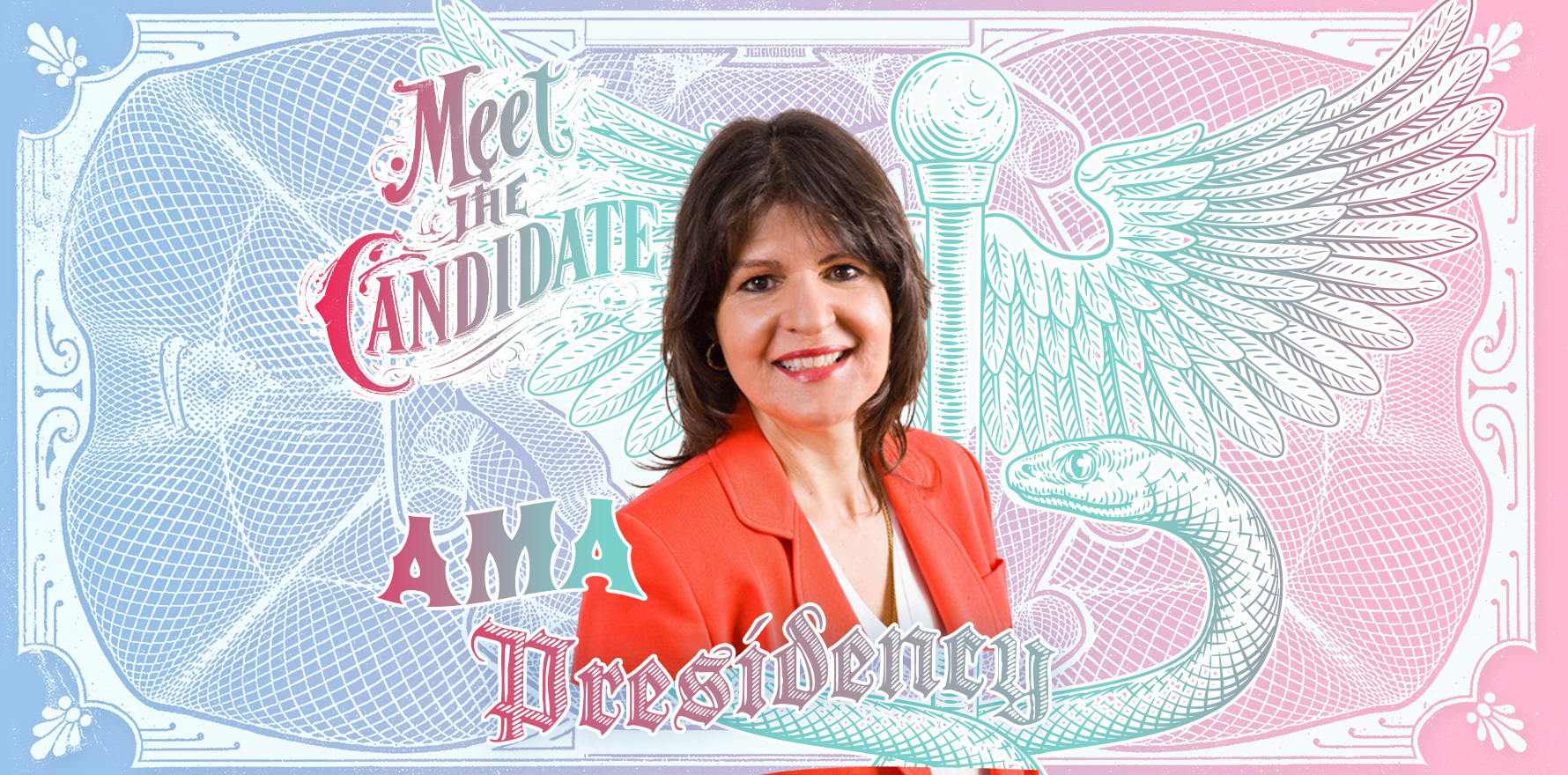
Dr Magdalena Simonis is one of three doctors in the running for AMA president.
Dr Magdalena Simonis – a Member of the Order of Australia – has undertaken the gamut of healthcare – from the consultation room to a clinical associate professorship at the university where it all began, to health columns and expert advisory groups.
With voting set to open at the end of the month, the Victorian-based doctor vying for the AMA presidency sat down for a chat with The Medical Republic.
TMR: You’re calling for a united AMA, a sentiment that other candidates have also expressed. What about your approach would be different?
Dr Simonis: Strengthening the AMA around all of Australia is essential. When members see the AMA as representing them, membership will follow. That’s the core issue.
Right now, decisions often come from the top down, creating a communication lag with state-level associations.
Queensland splintering off is our clearest signal that AMA has drifted.
Bringing the AMA together will require involvement from all states in decision-making, so they all feel they’re genuine partners in setting national priorities – not just distribution channels for federal decisions.
We need to close the gap where advocacy fails to deliver outcomes; members need to see successes that improve their working lives and promote rebate adequacy, ramping relief, and PBS reform.
Structurally, it begins with rebuilding listening infrastructure, establishing regular feedback loops with state divisions and members, not just top-down comms, and consolidating the committee structure.
We’ve got 15 committees; they’re being cut down to seven. This should help consolidate overlapping policy areas instead of addressing them in silos.
Mental health, for instance, has traditionally had its own committees, separate from general practice and specialist doctors.
But mental health cuts across everything. It affects every aspect of practice. Grouping people with shared skill sets across policy, mental health, and general practice will be far more effective.
We also need to make membership values tangible and visible. If you look at our website and see what you get for your membership, it’s rather bleak. It doesn’t come across as very attractive.
Certainly, the National Conference isn’t a drawcard for membership, but it’s listed as a membership bonus. But it’s expensive, and very few members can afford to go.
Our membership fees are on top of our college membership, CPD, accreditation and AHRPA fees, and insurance.
AMA membership fees are costly, but we pay because we believe this organisation uniquely represents our voice – it’s a faith-based commitment that it will support us when we are down professionally.
Medical students are not our paying members, but they are our future, and we should stand alongside them.
What does a doctor-in-training do when they can’t secure an accredited position after five or six years?
I have patients who are doctors. They come in, cry, and say, “I have not got an accredited position secured. I’m losing another year of my life.”
The government sees them as fodder for the hospital system – they can work long hours and do the grind, “hang in there, you’re supporting the nation”.
But in fact, they’ve invested their lives in this. Being a doctor is a major commitment – a profound emotional and spiritual one.
We do this because we have a sense of purpose, and not being able to progress is very frustrating and difficult, which is why I think we have so many health and mental health issues among our doctors-in-training.
There’s a substantial oversight happening: medical students are perceived as being born into wealth, feeding into the broader “doctors are wealthy and greedy” narrative – one the government is reinforcing through policies such as forcing specialists to advertise their fees.
We also need to bring IMGs and doctors from culturally and linguistically diverse backgrounds into the tent.
We have so many wonderfully diverse doctors in our community, yet we’re not taking advantage of that opportunity to improve our communities’ health literacy.
I’ve done a lot of this within my Greek community. During covid, we got vaccine-hesitant elderly community members on board by working with local churches, the local community, local MPs, and ethnic media, who helped explain vaccination information in a way people trusted.
We at AMA could be doing more to set those examples and create those models.
I’m a coalition builder. I bring people together, and I listen.
TMR: As AMA president, what would your top three priorities be?
Dr Simonis:
1. Strengthening AMA.
2. Delivering real value to our members, especially to our doctors in training, our IMGs and our students.
3. Fighting for the investment our health system needs and protecting the workforce that holds this system up.
We need a tiered Medicare that reflects the real cost of all services, accountability for ambulance ramping and waiting lists, secure, interoperable systems, a PBS built for this new era, and an end to insurers shifting costs onto patients while blaming doctors.
We need to protect the workforce, which means avoiding fragmentation, doctor burnout, and rural shortages – they’re all the result of systemic failures, not personal failings.
Related


TMR: Can you tell me a bit about what led you into medicine?
Dr Simonis: By the age of seven, I’d already decided I wanted to be a doctor.
Now, I don’t know where that came from, as there’s no doctor in my family. No one had gone to university, as far as the horizon goes in my genetic pool.
I loved animals. I used to play in the backyard, collecting insects and all the stray cats. And I got flea-infested and very sick and caught hepatitis from eating things from the backyard.
But I also saw my mum get very sick when I was very young. And I think that all really made me want to fix things; I wanted to help people.
At seven, I decided to be a doctor, and that never changed. The happiest day of my life was when I received my acceptance to Melbourne Uni as a medical student.
I don’t know that I’ve experienced any greater joy, except for getting married and having children, which were also very meaningful.
I’ve never forgotten my roots and take nothing for granted.
I was teased at school – I was the migrant, and it was all the awful things that existed back in those days, which we’re still facing, unfortunately, in the racism we see in our community.
So, my thread is that, and that’s what makes me really passionate about achieving outcomes, because I see how much of a change education makes for people.
I see how empowering it is to have access to health information and make good decisions for yourself and your family.
That taught me how important it is to have good community representation in everything you do, because the community produces people like me, the next generation working to make things better for the generation after.
And that’s the role our health system should also play, because without health, you don’t get any economic growth, and nothing else can function without healthy people.
For me, being a doctor has always been that way. It’s not just about taking away disease. It’s about preventing disease, knowing people in the context of their lives, and supporting them through their lives, the true GP thing.
Working across areas from women’s health to how climate change affects people – both gender and health – is all tied to my belief that you can’t ignore health, you can’t underfund health, and you need to support doctors.
Good doctors make the world a better place.
TMR: You’ve got a very interesting and broad history.
You’ve volunteered as a GP with asylum seekers and refugee services and served on the Breast Cancer Network Australia committee.
As a health columnist and advocate, you have a deep interest in the Australian Greek community and are a director of the Climate and Health Alliance.
You’ve raised awareness of the health effects of domestic violence and abuse.
You’ve also extensively researched endometriosis, asthma, obstetrics, and gynaecology.
Why are these topics and areas special to you, and what unique perspective have they brought you?
Dr Simonis: The unique perspective that it’s brought me is that everything is connected.
Health includes socio-economic and socio-demographic factors. As a GP, I frequently observe the impact of social determinants of health.
People can’t access health services or achieve the health they need because they lack health literacy or don’t live in the right suburbs; maybe they were born into a dysfunctional or single-parent family.
That’s enabled me to see the broad picture of how the environment impacts the individual, having grown up as the offspring of a migrant family who didn’t speak English and had to assimilate and make myself understood.
I’ve also been a GP all my life, so when I see my patients, what they bring into my room affects me.
I’ve driven research based on issues that came through my room, where no research existed. I researched, produced evidence, informed policy, and changed MBS item numbers because of one experience that concerned me.
In turn, that’s affecting the health and improving the health outcomes for other women who come down the track.
That also led to the cosmetic surgery review, which led to the next thing.
I’ve been invited to a lot of the organisations I’m on.
With my breast cancer network clinical advisory work, that was through a patient of mine who worked for the Breast Cancer Network Australia, who said, “You’d be fantastic to have in our organisation. I’d love to introduce you. Could you come to the National Action Plan for Endometriosis?’
I actually wrote to the minister and said, hang on a minute – you’ve got this team there. You need a GP, a straight-down-the-road GP, someone who’s not a researcher, someone who’s not affiliated with the university, someone who’s not a representative of a large organisation, but someone who represents the women out there.
So that’s how I ended up on that, through my initiative.
As for my teaching at university, I’ve never left that family.
There’s one thing to have evidence sitting on a shelf, and there’s another to develop modules to educate doctors.
But there’s another skill required to take the evidence, look at the gaps in the system, and assess how this evidence can impact outcomes to improve things for people and the economy.
The government doesn’t understand a story unless you add an economic angle or a political win. So those are the different tags you must embed in that discussion.
Much of our conversation, though scientifically sound, can be dry and less effective than that of someone who has a clear endpoint from the start.
I have extensive experience in driving policy change outside AMA and am comfortable as a spokesperson for a large organisation dealing with government, using clear, non-combative, yet determined communication.
With the research depth and insights as a GP, advocate, and policy developer, I bring that endpoint up front.
TMR: You joined Honeysuckle Health’s board in 2022 as an independent director, just as the AMA was intervening against Honeysuckle Health before the Australian Competition Tribunal over its long-standing opposition to insurer-led managed care in Australian general practice.
Honeysuckle Health, now fully owned by nib private health insurance, applied to the ACCC this year for a decade-long extension of its buying group authorisation.
Organisations, including the AMA, have warned that any re-authorisation increases the managed care risks the 2022 Tribunal settlement was intended to guard against.
Can you explain what that experience was like, what brought you there, and whether it changed how you thought about insurer involvement in clinical care?
Dr Simonis: I was headhunted. In fact, I was recommended by someone who’s very well known in the digital health space here in Australia.
I declined for the first few months. Then I thought, if there isn’t someone like me there, who’s going to be there?
I don’t think doctors should be absent from that table while insurers build architecture around us.
They’re a contracting and data analytics company for private health insurers, and that is where decisions are made about specialist fees, value-based care models, and how insurers try to shape clinical practice.
I really do think that’s what we keep missing out on because we’re at odds with these organisations.
As an independent director, I followed standard governance, declared my interests to AMA, RACGP, and everywhere I went, and was recused from any AMA or general practice matters, which I took seriously.
I didn’t come away at all compromised. I came away very well informed, and I see how insurers model risk, how they push on scope, and how they use language such as value-based care to justify cost control.
It was really interesting, and that’s exactly the kind of insight AMA needs from its leadership.
My term ended in 2024. I wasn’t reappointed, and I’ve always maintained that, for any health startup, a doctor, ideally a GP, should be on the board.
This interview has been edited for length and clarity.
Voting for the 2026 AMA elections will be held at the AMA26 national conference on Saturday 29 August.
TMR will be publishing long-form interviews with all candidates. Read Dr Anchita Karmakar’s profile here. Dr Michael Bonning’s will be published on Monday. Interviews are being published in alphabetical order of the candidates’ first names.
