Psychiatrists and dermatologists are the biggest culprits, says the Grattan Institute, which called on governments to do more.
Specialist fees are out of control and the problem is only getting worse, the Grattan Institute says in a new analysis of specialist fees, calling on the government to make a concrete plan with tougher reforms to stop rising fees and long wait times.
There is almost nothing to restrain specialist fees in a market that’s been “left on autopilot for far too long”, the authors said in a new report published today.
“Each year, more Australians pay far too much,” the authors said in their new report, Out of control: How to rein in runaway specialist fees.
“Well over two million Australians pay at least one extreme fee a year, and the number is rising by about 250,000 each year.”
The authors said patients who needed specialist care faced a difficult choice: pay high private fees or face long public waitlists.
“The choice is only getting harder as specialist fees keep surging higher.”
Specialist fees have gone up by 4% on top of inflation in the past year, with the median fee for an initial dermatology consultation rising by 7% and for psychiatry, by more than 20% – equal to $50 a year.
Fees for the most expensive 5% of specialists were rising even faster, the authors said.
Last year, a Grattan Institute report found that average out-of-pocket costs for specialist consultations grew by 73% in real terms between 2010 and 2025 – that’s about three times faster than inflation, wages or other Medicare fees.
In the new analysis, the authors said costs continued rising over the past year by 4% in real terms, “well above an unusually high rate of inflation”, while out-of-pocket costs for GP appointments and other Medicare services had “hardly moved”.
The authors named specialties such as psychiatry and dermatology as those with the sharpest increases in the costs of initial consultations, with annual rises of 16% and 7% respectively.
Lead author Peter Breadon said specialist prices “just keep rising”.
“None of the normal constraints on price are prevalent in this market,” he told The Medical Republic.
“There’s no real competition because we have shortages of some specialties nationally and most specialties in at least some parts of Australia.
“That means people are caught between a really high, sometimes unaffordable fee, and a really long, sometimes unsafe wait for free public care.
“The good news is the government knows this is a problem.”
Mr Breadon said the federal government had launched consultations and a parliamentary inquiry, and had made some reforms regarding information for consumers on how much individual specialists typically charge.
“State governments have done some investment in specialist care and some other reforms too.
“But the fee growth is continuing, and there are some big missing reforms that are needed.”
Doctors stuck in training pipeline
Australia has long-term shortages for some specialties and training for specialists with stagnant, the authors said.
The Department of Health, Disability and Ageing predicts long-term shortages of some specialties, with the dearth of psychiatrists rising from around 760 to almost 1300 FTE by 2033.
Too few training places leave junior doctors “stuck at the start of the pipeline”. In 2024, only around a third of prevocational hospital doctors moved into registrar roles.
The authors suggested that the government set training targets for specialties that dictate where training funding goes, and to hold colleges to account for expanding training.
Mr Breadon said that while specialist colleges needed to do more, “the real culprit is a policy vacuum”.
“If you don’t have a workforce plan for how many specialists we need trained, it’s unlikely that the colleges and the public hospitals and the other players are going to spontaneously coordinate to achieve a level of training that no one has requested,” he said.
“The government is not investing more in funding the colleges as we recommended to do more training, particularly in areas where we want to have doctors training.
“The colleges need to do more, but they haven’t been given a target and they haven’t been given more funding.”
Related



Public hospitals prioritised training based on their day-to-day operational needs and had training places that aligned with their clinical demand for services, Mr Breadon said.
“The current funding that goes to training mostly just goes to the hospitals’ bottom line.
“There’s certainly no accountability for how many specialists or what kind you train, and that training funding should be tied to making sure those places are available.
“There are areas where many of the colleges need to improve.
“There are some gratuitous requirements that applicants have to go through. There are some accreditation practices that need to be streamlined and standardised to make it easier to set up a training place.
“But the bigger picture is, if you don’t put the policy settings in place, it’s no surprise that these diffuse players, all with their own interests, don’t spontaneously coordinate and align to get us the pipeline we need.”
Will thresholds become targets?
The authors acknowledged that there was a risk that a threshold becomes a target, with specialists raising their fees to meet those thresholds.
“The government should still make it clear that the threshold is not a recommended fee, and monitor whether regulation encourages fees to rise among specialists below it,” they said.
The authors said establishing a threshold of three times the Schedule Fee would target only a small minority of specialists, with fewer than 2000 specialists – or around 6% – affected by the threshold.
Mr Breadon said there were three strategies that would reduce the risk of a threshold becoming a target:
- setting a conservative rule that only applied to a small minority of outlier doctors charging very high prices;
- clarity from the government about what “extreme fees” will be targeted with regulation without penalising other doctors;
- and monitoring specialists’ fee patterns to ensure that costs do not drift up after the rule is introduced.
“All those things will reduce the risk,” he said.
“While there’s a risk of some perverse outcomes, they’re nowhere near the risk of inaction.
“If we don’t take action, we can be very confident that what’s gone on for the last few decades will keep going – that fees will just keep rising.
“All policy carries risks, but inaction carries a much higher risk of continuing deterioration in affordability.”
The rise and rise of ‘extreme fees’
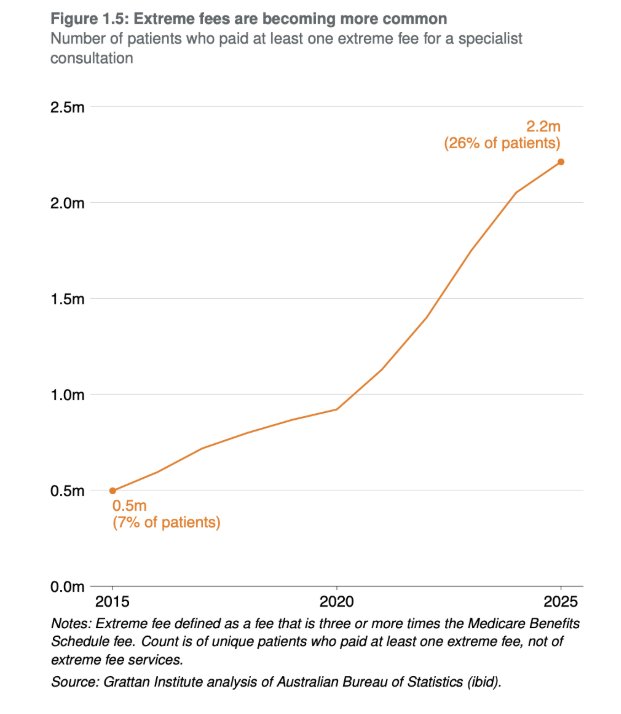
The authors said “extreme fees” – defined as triple the schedule fee – were becoming more common.
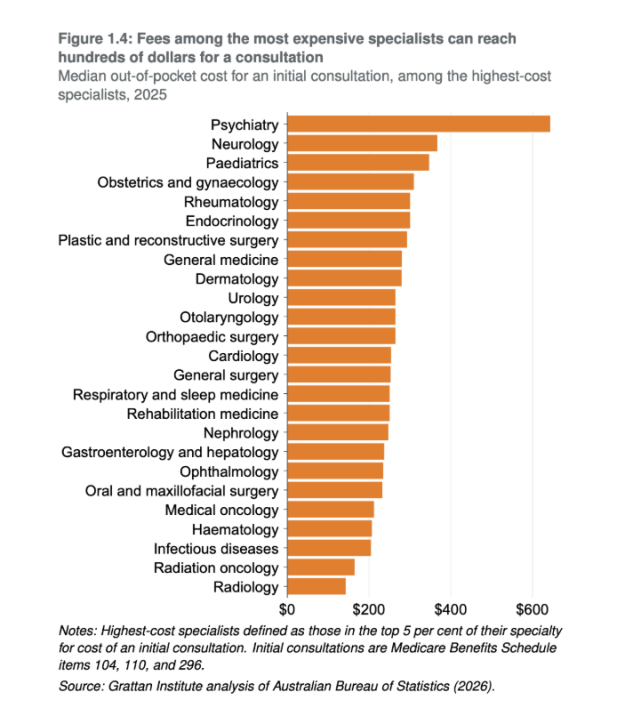
For example, the most expensive 5% of psychiatrists charged a median out-of-pocket fee of $669 for an initial consultation, while high-cost paediatricians charge $362 and high-cost cardiologists charge $265.
Those costs were 104%, 212% and 203%, respectively, more than their peers, the authors said.
“In 2025, more than a quarter of patients who saw a specialist out of hospital paid an extreme fee, up from less than one in 10 in 2015,” the authors said.
“Today, more than 2.2 million Australians pay at least one extreme fee each year. That number is rising by about 250,000 each year.”
Why fees are rising
The Grattan authors said that while doctors’ groups blamed government funding for not keeping up with the cost of care, that did not explain the rise in fees.
“The real problem is a market with almost nothing to restrain fees, which has been left on autopilot for far too long,” they said.
“To make sure Australians can get the care they need, governments must fix those structural problems, not just spend more.”
The rise in fees could not be explained by slow indexation of Medicare rebates or the rising costs of providing care, but was a symptom of a broken market, the authors said.
“The problem is a market with almost none of the usual restraints on price.
“There are long-standing local and national specialist shortages. There are dangerously long waits for free public care in many communities.
“Patients rarely choose their specialist, cannot easily judge the quality of care, and often cannot find out the price they will pay until they have booked their appointment, or even until they get the bill.
“For all those reasons, it is often impossible for patients to compare and choose care, or refuse a high fee, without delaying care and putting their health at risk.
“In this broken market, rising and wildly varied fees are driven far more by differences between doctors than by the clinical complexity of their patients.”
Government reforms are ‘a start’
The federal government had started on some easy, low-impact reforms, but it needed to make bigger, tougher reforms to rein in specialist fees, the authors said.
The authors said the federal government had “made a start” through potential reforms including a parliamentary inquiry into specialist access and affordability, the 2026 budget funding for policy work on specialist care, and the consultation on reforms by the Department of Health, Disability and Ageing’s (DoHDA).
But the hardest reforms are still to come, the authors said.
“Rising fees and wait times won’t be reversed by cheap and easy reforms. Bigger and more comprehensive changes are needed.
“No single reform will fix specialist care.
“High fees, long waits, and patchy availability share the same roots: local and national workforce shortages, too little fee-free public care, and no limits on what specialists can charge. Each problem makes the others worse.”
There was still no concrete plan to ensure adequate training of specialists, and new public clinic capacity investments were a fraction of what was needed, they said.
“Only some states have set up specialist advice services for GPs, while
regulation of excessive fees has only been discussed, not delivered.”
Five missing reforms
The authors suggested five missing reforms that will “make the biggest difference”:
Train the specialists Australia needs: Establish a national workforce planning body to set training targets, including for rural areas, and tie federal training funding to the targets.
Expand public clinics in areas with too little care: Invest $500 million a year to fund more appointments, focused on communities with the least care.
Modernise public clinics: Use National Health Reform Agreement funding to reward and spread the best models of care, and report nationally consistent wait-time measures.
Give every GP easy access to specialist advice: Establish a national secondary consultation system to give GPs quick and convenient advice.
Rein in extreme fees: Require specialists who charge extreme fees to repay Medicare rebates; review Schedule Fees for items with the highest fees.