

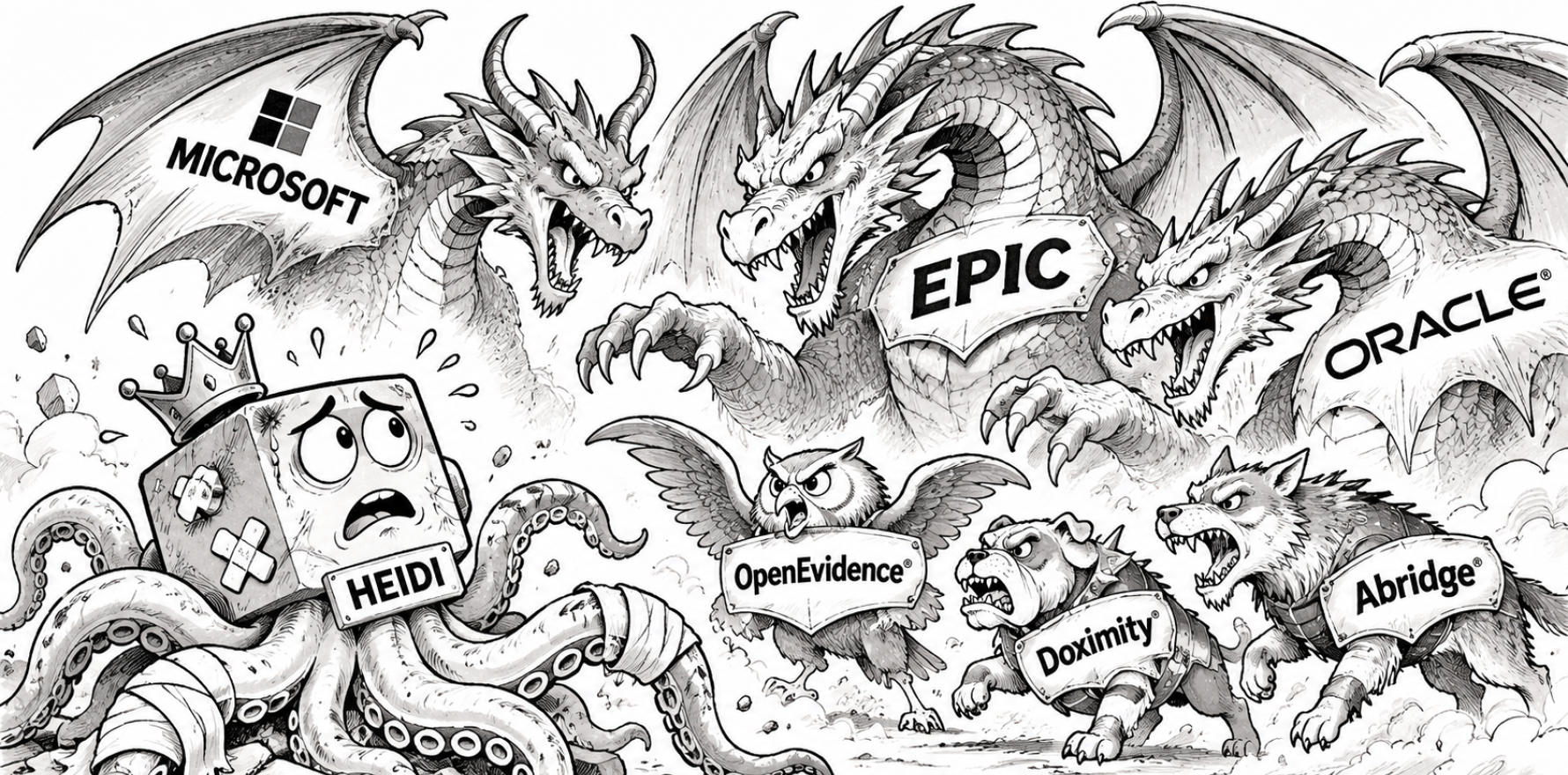
A prominent US VC AI healthcare report released earlier this week reveals a series of market numbers that feel ominous for our recently crowned local AI unicorn, Heidi.
According to California-based VC firm Menlo Ventures’ 2026 State of AI in Healthcare report, released earlier this week, healthcare should be the place to be if you’re an AI start-up.
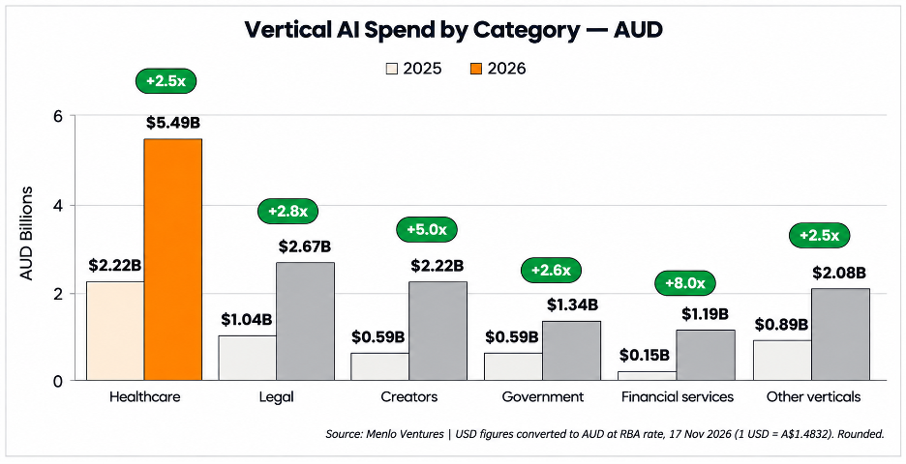
In the US, which is the biggest global AI market, healthcare AI was the largest vertical AI market by far in 2026, growing a whopping 2.5 times to $5.5 billion and leaving the next biggest vertical, legal, in the dust (see chart below).
A good chunk of that was AI drug discovery, but clinical AI – the sort that local start-up champions Heidi and Lyrebird are chasing – is still larger by itself than the next vertical market.
But big isn’t always beautiful. Big means competitive, and the US AI healthcare market is currently in a state of hyper competition.
Six weeks after raising AUD $500 million in investment and debt funding, Heidi Health has cut about 18% of its staff and lost two of its three cofounders.
CEO Dr Tom Kelly says the company was “too optimistic” about how quickly large health systems would buy. His main problem was that big market above, the US. And customers buying wasn’t the biggest issue.
The behemoth competitors are.
The reason US healthcare AI spending reached AUD $5.5 billion in 2026 is specificity. Half of healthcare’s AI spend goes on healthcare-specific applications, against 24% across enterprises generally.
Health systems aren’t buying generic chatbots; they are buying tools built for clinical workflows. Providers account for AUD $4.4 billion, or 77%, of the total.
That is the market Heidi raised its money against.
The trouble is what is happening inside it.
Incumbents strike back
The US scribe market slowed down considerably in 2026 to grow only 1.6 times from AUD $890m to AUD $1.4 billion.
But incumbents, led by Microsoft’s Dragon Copilot and Epic’s Art, captured 68% of the new dollars and lifted their market share to 46%, from 33%, according to Menlo. So, it was the year the incumbents came right back into the picture (i.e. caught up significantly to the native plays like Heidi).
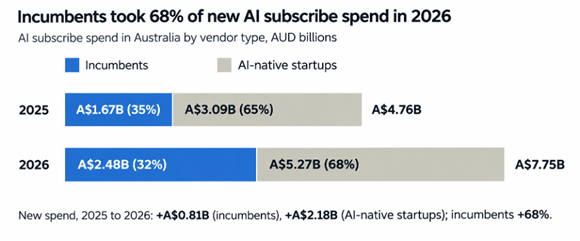
Incumbent scribe revenue grew 120%; AI-native scribes grew 28%.
Every major EHR now offers its own scribe, and most buyers told Menlo they would rather buy AI from their incumbent. Provider procurement cycles have stretched to 10 to 11 months, from five to seven.
That is a part of Kelly’s “too optimistic”, put as a number.
The money is moving off scribes
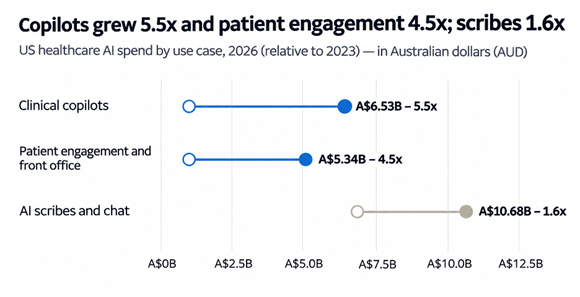
Scribes were the breakout category of 2025, but in 2026 they were among the slowest-growing, at 1.6 times.
Clinical copilots (a combination of scribe, decision support and agentic admin in one clinical assistant product) grew 5.5 times to AUD $550 million and patient engagement 4.5 times to US$450 million.
HotDoc and HealthEngine take note on the patient engagement front. If they don’t invest a lot more in AI here soon, someone else likely will, and their pretty impressive app download moats may start to feel the heat. Heidi is rumoured to be planning a move into this space.
Notably, hospital coding and billing grew 1.3 times.
The winners are cashed up a lot more than Heidi, and focused.
In clinical copilots, Menlo estimates OpenEvidence commands 64% of revenue, from one tool that does one job well.
Related



Meanwhile, the report says AI-native scribes are pushing into adjacent work such as prior authorisation to find growth.
Heidi: what would it take?
Heidi’s US hospital book is thin. Its flagship is Beth Israel Lahey Health, which is rolling Heidi out to all its physicians.
Franciscan and MaineGeneral are the other US names it cites.
Next to Abridge, valued at US$5.3 billion and in more than 150 health systems, and to Microsoft, Oracle and Epic’s distribution, that is hanging-on-by-your-fingernails stuff as far as the US market is concerned.
Heidi’s ARR hit US$50 million in April 2026, up from US$1 million two years earlier (IT Brief). That is fast growth, but its revenue is still a fraction of that of the US leaders. It also has no deep integration deal with a major global hospital EMR vendor.
The Menlo data points to four ways that native AI groups like Heidi might survive 2027:
• Stop fighting in Epic’s and Oracle’s heartland. Menlo believes these buyers are switching to the scribe in their EHR. It says target independent practices, specialists and non-Epic systems, where clinicians still pick tools for themselves. That’s not going to be an easy decision for the Heidi management to make because they would be retreating from the biggest part of the market.
• Follow the money off the scribe. Heidi has at least started doing that with products like Heidi and now its new agentic offering. But both new products face very stiff competition from focused and cashed-up US competitors like Doximity and OpenEvidence. It might be that Heidi is trying to do too much in too many markets.
• Pick one beachhead and own it. OpenEvidence’s 64% share of copilots is an indication that focusing on one part of the workflow pays. Being in 190 countries and 110 languages shows reach for Heidi, but is such a broad footprint defensible, especially when it looks like you may not end up as a player in the biggest global market, the US? Heidi does have a deal with the NHS in the English Midlands but even that position is not as good as that of Lyrebird, which has four major hospital contracts in London where it will integrate with Oracle.
• Partner with an incumbent instead of fighting it. Menlo says buyers prefer their incumbent. A distribution deal with a large EHR vendor might turn that preference into a channel, but the problem Heidi has here is Epic doesn’t partner. And Oracle doesn’t like to do it.
Lyrebird and the incumbent partner model
Lyrebird has gone a different way.
Four South West London NHS trusts are deploying it to up to 20,000 clinicians over four years, in what has been described as the UK’s largest ambient voice deployment. It is slated to integrate with the trusts’ Oracle Cerner Millennium EPR.
At home it has Best Practice, which holds about 80% of the Australian GP software market and has invested A$3.378 million in Lyrebird. That is the incumbent-distribution play Menlo says is winning in the US, at Australian scale.
Lyrebird will probably survive whatever happens offshore. After all, the Australian market is so particular when it comes to things like Medicare and regulation that we don’t have any overseas PMS vendors. It’s not worth their while. So a local group of AI vendors focusing on servicing the particular needs of Australian providers feels like it could be a thing.
There’s irony here: incumbents bundling scribes is the force squeezing Heidi in the US, and it is the same force keeping Lyrebird alive at home.
If every records platform ends up owning its own scribe, Australia will have local scribe champions the way it has local PMS vendors: tied to a domestic platform, viable, and local.
Is going global a bridge too far even given Heidi’s spectacular first couple of years?
In the US, for now, it looks like it. And losing the US will cause all sorts of investor issues.
In the NHS and other markets without Epic and/or Oracle, the door might still be open.
But that’s going to require Heidi to make one hell of a pivot some time next year.
