

Heidi Health's move into evidence-based decision support confirms what many have suspected: no incumbent medical software vendor is safe.
Heidi’s announcement today that they would be introducing an evidence based decision support element to their offering called Heidi Evidence, acquire evidence led AI framework Automedica, and be integrating into Australian and New Zealand clinical pathways IP leader Streamliners, confirms what many have suspected about the group’s trajectory: they are rapidly moving from the thin AI scribe market into a much broader AI provider care offering.
Talking to Health Services Daily this morning, Heidi’s clinical director, Dr Ben Condon said:
“We’re moving from an AI scribe to what we’re calling an AI care partner. Scribe will be the first feature within that care partner platform, and evidence and comms and the acquisition of Automedica are kind of the next three acts, if you will, to that.”
Heidi is moving fast to leverage a user base that is rapidly beginning to trust its application as much as any of their core clinical software.
“We know that evidence underpins every decision that you make and every question that you ask. So being able to surface trusted evidence in bias free environment, in that consult environment, we think is going to be really valuable insupporting clinicians make the best decisions,” he said.
The speed of Heidi’s provider side support development has obvious ramifications for both the incumbent provider medical software market and for patients, especially in the light of the release a few weeks ago of the first of the patient side specific AI agents, such as ChatGPT health.
The threat to the big incumbents
Our major software platform incumbents, most of which already have Heidi as an integration, have to be asking themselves, at what point does the utility of what Heidi is building out and integrating into my platform become more attractive than my core offering?
The strategic peril for many incumbents, even those with until now seemingly impenetrable moats made up of complex safety protocols, UI, market share and functionality, such as Best Practice and Hotdoc, is that Heidi is now building a deep vertically integrated AI clinical platform, using the new medical platform provider super glue: AI driven provider intelligence and trust.
There’s a long way to go sure, as systems like Best Practice and even the big enterprise EMRs like EPIC have decades of coding that incorporate complex regulation and compliance for providers.
But there are a few big problems emerging for incumbents.
Heidi doesn’t have to do everything in one go.
It can just keep adding AI functionality on the outside of an existing platform and presumably do it much faster than most incumbents can do because they have more capital and AI focus.
The incumbent has a lot of legacy to deal with, less capital and it possibly can’t afford to be cutting away a partner adding so much needed and wanted functionality from their partner program.
AI software development changes the playing field
AI is driving the cost and efficiency of software development through the floor – the Anthropic AI coder release of a few weeks back is crashing the valuation of software platform companies globally – so replicating a lot of what the incumbents currently do, but integrated to its other neat AI functionality, and with a much more interoperable cloud enabled architecture, won’t be anywhere near as hard as it once might have seemed.
The only thing they’d need to walk backwards faster over most of what the incumbents are doing is a great relationship with their providers.
Ouch. They appear to be ticking that off pretty quickly.
Even though Best Practice, our major incumbent patient management system platform for GPs in this country owns nearly 80% of the share of the market, and pretty much has its own preferred AI play in its deal with Lyrebird, Heidi is boasting that they already have 50% of GPs using their product in Australia.
Lyrebird has maybe 60 employees, has raised about $12 million and is valued somewhere north of $50 million today.
Heidi has 383 employees and counting – it’s going up a lot every day now – has so far raised about $138 million (and definitely counting based on its rapid growth) and is valued at about $700 million. And that’s before today’s announcements.
Who’s likely to win this battle in Australia?
A couple of weeks back Best Practice and Lyrebird announced that they were introducing a free version of the Lyrebird product which was seen as a counter to what looked like rapid share gain by Heidi.
And then Heidi announces today that it’s firmly on a path to be every provider’s AI operating system – a clinical operating and intelligence platform.
One more possible problem for the incumbents
Heidi doesn’t actually have to do everything that the incumbents do, if it doesn’t see the need.
For instance, it could leave the patient management platforms with the functionality they originally started with, a prescribing platform that does billing, although probably at some point prescribing would be an important decision support point for Heidi to be thinking about.
But if it does see the need later Heidi should be able to code something clean and new on billing for the Australian market, as the cost of doing it today would be a fraction of what it has cost in the past.
What about the big enterprise EMRs like EPIC and Oracle (Cerner)?
Surely Heidi doesn’t think it can knock them off over time as well?
“Heidi’s already integrated with Epic, and we’re really excited that that’s going to open up the opportunity to work with all hospitals rolling out Epic, and our Cerner integration is not too far away,” said Dr Condon.
“We can’t control what those bigger EHR platforms do, but certainly to this point, they’ve been open to integrate with us, and that doesn’t look like it will change.”
But how will Heidi compete with the internal AI applications that the big EMRs will be incorporating, presumably far more deeply, with their core EMR functionality?
“Let the best product win, let our users and enterprise decide which products are for them, and those big EHRs will always win either way,” said Dr Condon.
“So it doesn’t really make sense for them to necessarily not have the current approach.”
So in essence Heidi sees a lot of opportunity across the whole spectrum of providers for being the provider’s AI clinical platform of choice.
Which leads to another important possibility.
If Heidi did start being a new and trusted clinical provider platform operating at scale across both the primary and tertiary sectors, we might then be looking at a much cleaner path to data interoperability across our healthcare system?
“Certainly we hope so,” said Dr Condon.
“And I think one of the things that we’re aware of is interoperability is such a buzzword, and for a really important reason at the moment, so we see a future where we can help solve that problem, and help solve those silos, in a way, at least.
“But we’re really excited by what that will do and look like in the future.”
What about the patient side AI agents?
Heidi seems to have carefully contemplated the disruptive capability of the new patient side AI agents and how the group might position itself against the likes of ChatGPT Health and Claude Health.
“We believe that for AI to be a true care partner, the integrity of its evidence must be non-negotiable,” said Dr Thomas Kelly, co-founder and CEO of Heidi.
“As we see more general-purpose AI platforms like OpenAI move toward ad-supported models, consumers are rightly concerned about hidden influence.
“In a healthcare setting, that concern becomes paramount.
“Bringing transparent, clinical-grade insights into the room makes it easier to deliver quality care, but that information must be free from the ambiguity of commercial influence.
“By committing to Evidence being ad-free and independent, we ensure clinicians can stay present with their patients, knowing their decision-making is built on pure clinical rigor, not a business model.”
In other words, Heidi seems to be offering to their providers the promise of additional expert information leverage – regulatory and governance approved, evidence based information, exclusive guidelines from the colleges, government sanctioned data, and so on.
So a provider fearing value degradation in the eyes of a patient as a result of ChatGGT Health may be able to lift themselves up the information value chain and provide their newly empowered patients another level of value provided to them by their provider AI platform.
What about the idea that clinical side AI platforms, which Heidi is attempting to build, talking to patient side AI platforms like ChatGPT Health in the patient-doctor consult context?
Dr Condon stressed that Heidi was focused on the clinician side and on being a trusted evidence layer.
“Unlike Claude or ChatGPT, what we have with Heidi Evidence is we have a curated, trusted kind of medical AI empowered search engine… with reference to trusted sources that the clinicians are familiar with and trust… we can remove this issue where you get references hallucinated by other… major commercial models and disinformation spread,” he said.
“On the whole, I think the fact that patients are more informed and more engaged in their healthcare is a really positive trend … but I think our focus has always been building something for clinicians that supports them in their workflows, and keeps them in the loop, and is building a product that supports clinicians rather than replaces them. So it’s not a focus for us at the moment.”
So that’s probably a “no”, for now at least.
Might this signal the beginning of completely new existential battle for patient empowerment, one where the fast-evolving new AI provider infrastructure platforms are positioning themselves somewhat as “protectors” of the providers traditional information power base by adding value to their side of the information fence?
Dr Kelly and Dr Condon appear to be positioning their platform play as offering far more evidence based and trusted information, but largely for doctors only…at least for now.
From workflow to intelligence and trusted data
Companies like Reed Elsevier and UpToDate that own high value data and information bases are closing ranks on some of these AI providers and keeping their data locked securely behind paywalls
Presumably, even Heidi is going to have to pay these incumbent owners of data and evidence-based information for the privilege of the value it could add to their offering.
But what if the big AI engines, who aren’t short of capital at the moment, do deals where they pay more and start making this data directly available to patients as well?
No matter what happens for incumbent software platforms it’s not enough to solve workflow, billing and information process issues now.
Now trusted intelligence combined with workflow as a platform is the significantly play.
Australian incumbent vendors outlook
What does this look like today in the Australian software vendor platform landscape?
Being in a relatively small , a little capital and a lack of competition has led a large proportion of our local medical software vendors to still be reliant on very old software architectures.
In that, we mean, most aren’t cloud architected for agility and data sharing from the ground up – in the US more than 90% of software vendors are these days.
Until now, being cloud architected from the ground up has probably been a disadvantage in Australia, because the incumbents are holding onto market protective moats which rely largely on the complexity and cost of switching. Our the government has been supportive of this dynamic so far.
While the base functionality of say Hotdoc on the consumer side, or Best Practice on the GP provider side is relatively simple, the additional functionality that is created by their many integrations, and then the compliance built into each over product over time makes for a fairly difficult moat to cross.
But as has been suggested, a group like Heidi doesn’t have to do it all at once. So long as they win provider trust along their journey they can step backwards bit by bit into the most important functionality as they need to.
They may never actually bother about billing or the core EMR functionality.
That would mean some of the incumbents would likely make it through this disruption without doing too much.
But in such a scenario each of these currently powerful vendors will be much diminished as businesses in the not too distant future. If they don’t move out into the open field – beyond their moats and old tech castles – and take on their new enemies head on with their own AI, they will likely one day be a shadow of their former selves.
What about acquisitions and alliances in this suddenly threatening environment for the current kings of access to providers and patients.
The most likely near-term partnership that might make for some defence against these new AI raiders is for Hotdoc to buy the controlling share of Best Practice that is currently held by founders, Frank and Lorraine Pyefinch.
That would combine the current king of access to general practice with the current king (or queen perhaps?) of access to patients and maybe provide the access to capital through PE that an Australian group would need to be able to defend against the AI hoards.
A note to readers:
Firstly, if you’re interested in this topic, then check out the program and buy a ticket to our upcoming Canberra Health Leaders Summit and Workshop on June 16 and 17 HERE with a 20% discount, using the promo code: HSDT1HCS-4f3o9W. We are going to be discussing it a lot in the context of this summit.
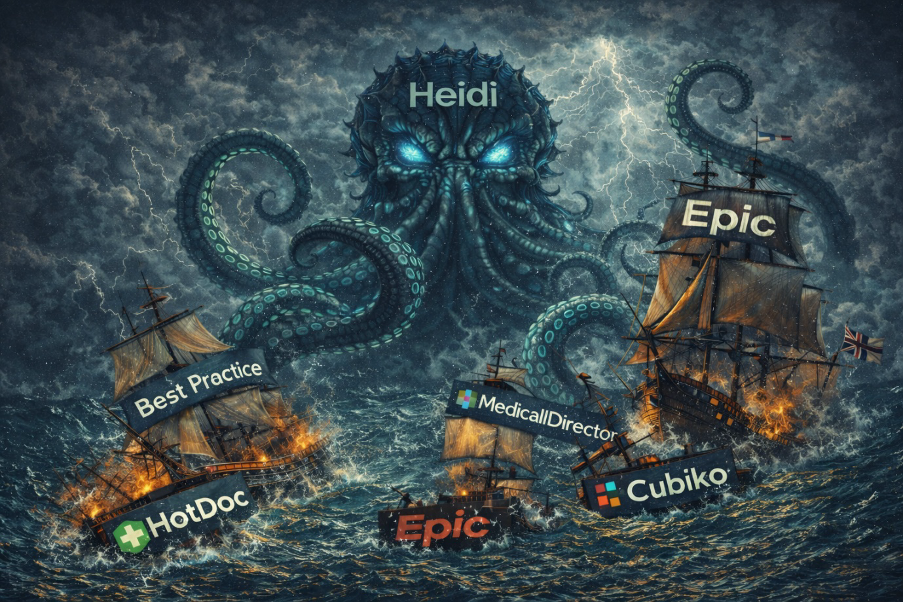
Secondly, you wouldn’t have to be too clever to recognise that the pictures in this story are AI generated. The first one I asked for was the above dark and stormy one.
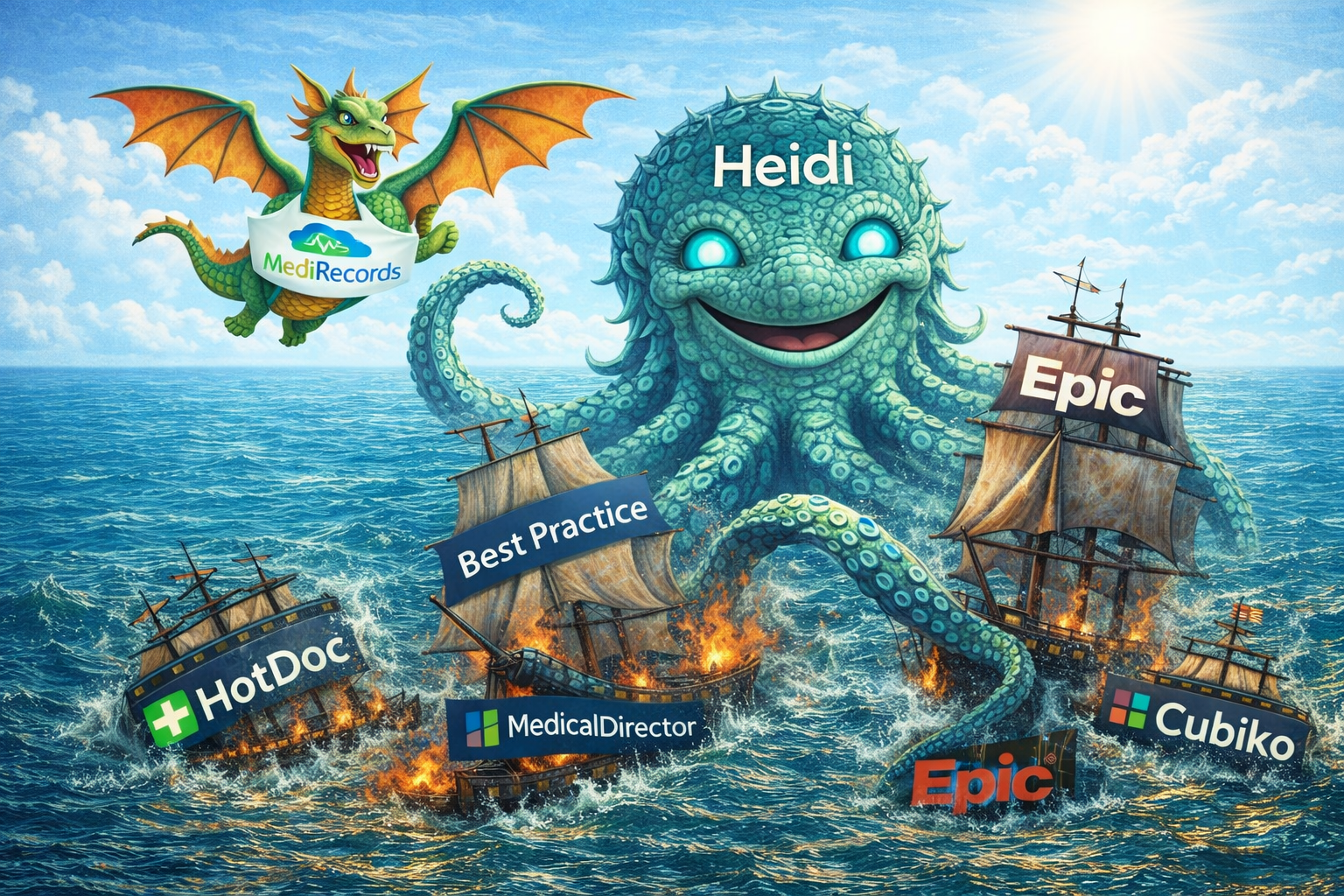
But after chatting away to my AI friend for a bit and suggesting that maybe Heidi wasn’t an evil dark Kraken but may well turn out to be a productive good Kraken, we both came up with the picture that leads the article.
Some more astute vendors might note the happy dragon in the air flying high above the happy Kraken. I’m the non-executive director of the company the dragon is labelled after and this was a bit of an inside joke on my part, so I’m letting everyone know I’m wholly conflicted by adding the happy dragon not getting hit by a tentacle because it is flying. MediRecords isn’t actually mentioned by name in the copy, but it is a fully cloud architected patient management system adding a lot of AI at speed, so it’s not all conflict.
Also, like a lot of people I know now, I worked with AI in putting this article together. The thoughts and especially the questions I asked AI to help on are all mine, as is the copy. But AI certainly makes for a productive research assistant, and sometimes a good entity to bounce some crazier ideas off.
