

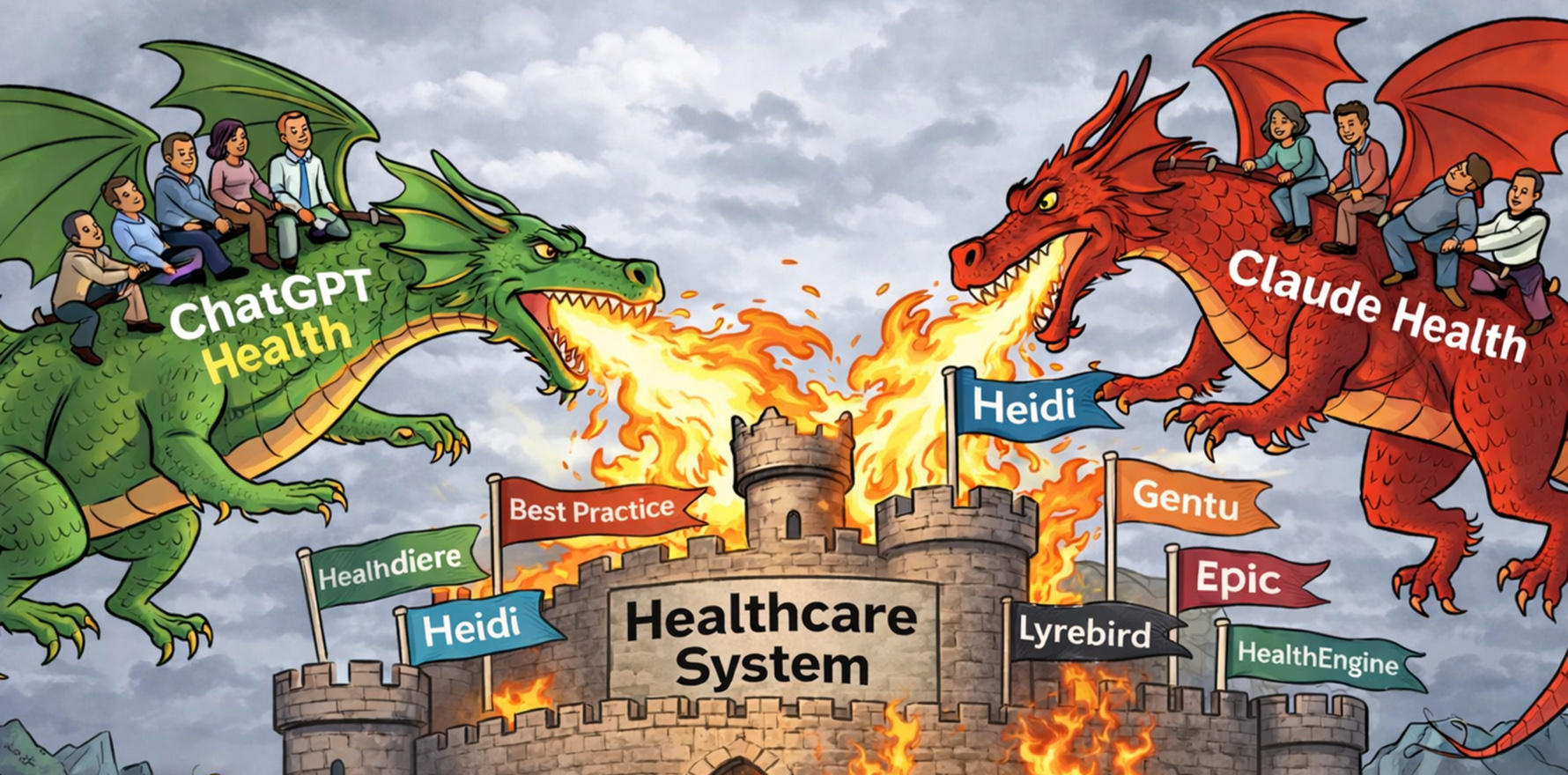
It doesn’t matter what part of health services you’re in, ChatGPT Health, Claude Health, Heidi and Lyrebird will fundamentally change our health system dynamic and how you see and do your work.
Register free for our patient-side AI dragons webinar here. If you’re not sure why, you might want to read this piece.
For decades, the structure of our healthcare system has been stable.
Patients have had a form of front door – their GP, a hospital, a pharmacist, even – going back a long way.
Today that front door is increasingly digital – a virtual GP, Healthdirect (now 1800Medicare), one of the new online GP platforms like InstantScripts or even a single indication platform like Eucalyptus’s Pilot and Juniper.
That structure, including all the new online stuff patients and doctors are hardly even used to yet is about to change, maybe at warp speed – not because of policy reform or funding changes, but because of something much faster moving: patient-side AI agents, mainly ChatGPT Health and Claude Health.
These new patient tools are already exploding in use overseas, particularly the UK, and they’ve only been there a couple of months. Already the NHS is panicking about how it should proceed with its front door – 111 – which has been the established triage front door for patients for over a decade.
But that’s not the only AI change coming fast.
On the clinician side, AI scribes such as Heidi and Lyrebird are rapidly altering how consultations are booked, documented and, increasingly, how care is coordinated, past the consult.
The clinician-side AI engines are moving upstream very fast in line with the patient-side changes. Lyrebird and Heidi both have evidence layers so they can both do decision support on the fly. Both have admin tools which talk to the EMRs they are integrated with.
In Australia, there is a race on for the single GP real-time care tool, and most existing software platforms are all in, with various AI partnerships.
What’s emerging is not just a new toolset for GPs and clinicians of all sorts, and a funky new app for patients. It’s a fundamental shift in who holds what information, when.
And that has implications for every part of the system, including funding, both hospital and primary care.
This Wednesday, The Medical Republic and Health Services Daily will host a webinar bringing together some key progressive thinkers from across the sector to unpack what that shift might actually mean in practice: for patients and for the professionals.
The panel includes Bettina McMahon, CEO of Healthdirect; Dan Stinton, CEO of Healthengine; Ben Keneally from Boston Consulting Group; and GP and AI consultant Dr Emily Kirkpatrick.
At the centre of the discussion is a simple but confronting question:
What happens when patients have access to the same information—or in some cases, more information—than their doctors?
This is not a theoretical scenario.
Patients are already using AI to ask detailed clinical questions, compare treatment pathways and challenge recommendations. In some cases, they are arriving at consultations with a level of structured insight that would previously have required significant medical training.
It depends a lot on the patient’s intent and motivation, but things are getting normalised very fast if we look at markets like the UK.
None of this means AI is replacing clinicians, but it does change the dynamic.
The traditional asymmetry—where the clinician is the primary holder of knowledge—is beginning to flatten. Consultations become more collaborative, but also potentially more complex.
Expectations are going to shift, on both sides of the sector – provider and patient.
And perhaps most critically, trust will need to be renegotiated.
For clinicians, there is risk and opportunity.
On one hand, patient-side AI could reduce unnecessary consultations, improve health literacy and support better shared decision-making.
On the other, it introduces new pressures.
Patients will almost certainly arrive in these early days with incorrect or incomplete interpretations. They will probably start expecting faster, more definitive answers. They will argue, like they’ve come in with second opinion – because effectively, they have.
God forbid, some of them – the really pesky ones – will probably question the clinical judgement of their doctor.
But there’s another important dynamic in play here.
Provider-side AI vendors – the main ones today are Heidi and Lyrebird (which is closely integrated to Best Practice which has 80% share of GPs as things currently stand) – are offering “special, doctor-grade information support”, and it’s going to be game-changing too.
Heidi has teamed up with the British Medical Journal.
But Best Practice and Lyrebird have teamed up with a very clever local CPD provider, who lots of clinicians already trust for the CPD, and the RACGP and other key local regulatory and governance data providers to offer a local knowledge alternative.
We have two big provider-side AI dragons who are going to go head-to-head in the skies, while the big global AI platforms are going to do their best to serve the patients.
It’s going to get a bit crazy for a while, and then maybe even crazier…but better overall almost certainly.
For instance, the first wave of provider-side AI – Heidi and Lyrebird – are focusing on scribing, summarising, decision supporting and connecting this all to admin, and even what is needed from the EMR.
But the next phase is already underway for these serious disruptors and the patient management system vendors are looking like the tide is going down in their moats. They are racing to do their own AI, or to partner with one of the two dragons.
Provider-side AI tools are beginning to incorporate clinical evidence, guidelines and workflow prompts directly into consultations. The aim is not just to record what happens but to allow the clinician and the patient to decide together what the whole journey forward is going to look like, and, even try to connect a lot of that journey.
For the provider-side dragons to win this race effectively, these systems will need deeper integration with electronic medical records —the core systems that hold patient history, medications and clinical context.
Without that integration and partnership, AI remains an overlay. With it, AI starts to become part of the clinical workflow itself.
The future is one system, one layer, one screen.
We aren’t anywhere near there yet, but the various contenders are doing the sums: how many locked in doctors do we have, how much AI can we do and how much do we need to partner to go faster, is our core platform web native enough to go fast enough, and so on.
Lyrebird has chosen its first partner – Best Practice.
But it is courting others to take a grasp on Australia. Who would that be? Gentu would be a great one because then Lyrebird will have position on specialists and GPs.
What about MediRecords? It’s the only ground-up native cloud PMS for GPs and virtual clinics. It has the entire Defence Force, big parts of Queensland, and, most of the share of all the new virtual platforms who wanted a proper cloud EMR, not their own bespoke one.
While all this is happening, the concept of the “digital front door” to healthcare is about to be turned upside down by the patient-side AI engines.
Historically, that role has been played by services like Healthdirect or booking platforms such as Healthengine and HotDoc.
But we know now that the patient-side AI dragons – ChatGPT Health and Claude Health – are already inserting themselves into this space.
If a patient can ask an AI about their symptoms, receive structured guidance and be directed to appropriate care pathways, the first point of contact may no longer be Healthdirect or HotDoc or Healthengine.
It may be a conversation with an AI.
CEO of Healthdirect, Bettina McMahon has not only already flagged this possibility, she’s cleared the idea with her board of trying to partner with one of the patient dragons. She’s apparently already floated the idea with one of them and they are interested. Of course they are.
If we go this way (we are), it raises significant questions.
Who controls that front door? How is clinical and patient information governed? Where does clinical accountability sit? And what role do existing platforms play – patient-side like HotDoc and Healthengine, and doctor-side like Best Practice, Gentu, Heidi and Lyrebird – in this brave new world?
For organisations like Healthdirect, Healthengine, and HotDoc, this is happening now.
HotDoc just got acquired by PE firm Potentia for $250 million. Did their due diligence identify what was coming at them? How are they going to respond because although all of Healthdirect, HotDoc and Healthengine have “patient lock on” with longstanding branding and service connection, if the patient-side dragons can do all they can and more, faster and better, how long before these moats are dry on all these platforms?
Healthdirect is moving today. This organisation, run by a creative forward thinker and good political operator, sees it and she wants her organisation and all its years of patient data behaviour IP and governance to be integrated with these new creatures.
Or we might say, Bettina McMahon is planning on becoming a dragon rider!
For government, the stakes are probably even higher than for existing consumer front door and doctor patient management platforms.
All of this must surely require the Department of Health, Disability and Ageing and the Australian Digital Health Agency to go into a war room and start gaming out what it is going to do to their significant planning for interoperability and the idea of “sharing by default”.
For one thing, whatever we’ve been doing clinical governance wise so far, is pretty much dead in the water in the foreseeable future.
Help.
We need clinical governance more than ever. But not governance that says, we don’t understand that or can’t do that as fast as AI so just say “no”.
We need an agile framework for clinical governance that is going to contemplate all those AI dragons swirling overhead, talking to patients and enabling clinicians to go much faster and be far more productive.
Hospitals, specialists and private health insurers are not immune either. No one is.
AI will reshape referral pathways, patient expectations and service demand. It may change how patients choose providers, how they interpret outcomes and how they engage with ongoing care.
It could easily change how we choose to fund and refer to providers.
If patient-side AI is good enough is there a point the government thinks, maybe no GP in between for some stuff? They are doing this going the other way on prescribing and pharmacists.
So the RACGP, the AMA, ACRRM and the like best get their skates on here too.
For planners and policymakers, the challenge is obviously huge, especially at the speed government can react and do stuff.
Not meaning to panic anyone but does covid ring a bell?
Government can actually go fast, if they see the need to be that radical.
How do you regulate a system where both patients and clinicians are using rapidly evolving AI tools like this?
How do you ensure safety without junking up the works or getting yourself into a classic Uber just walks over everything government has in place situation?
Maybe the biggest most often missed question in such disruption: How do you maintain equity and access and preferably significantly improve it, when access to information is started to vary in ways which must be very hard to model?
No one has answers yet. But everyone should be on these questions now.
The rate of change is accelerating. It’s nothing like healthcare has seen before.
In the dot com internet disruption, which affected most sectors – finance, retail, travel, media and marketing – healthcare remained virtually untouched.
Not this time. Welcome to transformation via mass disruption. It’s no longer a question longer whether AI will change healthcare.
It’s how quickly—and who adapts first.
This is so Game of Thrones, season 2.
If you want to register for our free AI patient-side dragons webinar, you can do that here. If you can’t make it, don’t worry we will post it as a video soon after we do it.
Any ideas or questions on what is going on? Love to hear from you.
