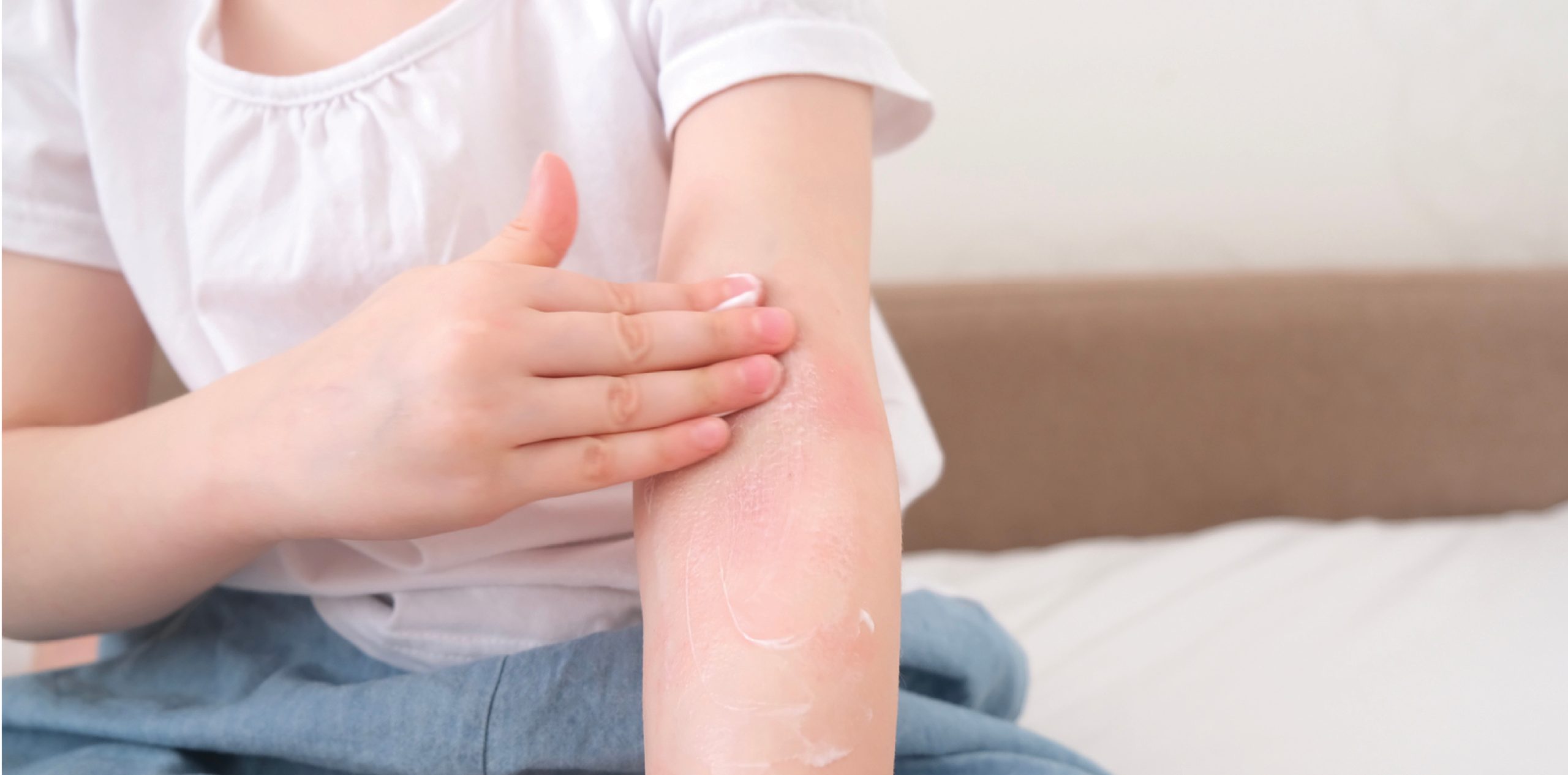
Children and carers can struggle to achieve long-term eczema control, highlighting the importance of education.
Eczema affects around one third of Australian children under 6 years.1,2 however, many children and their carers struggle to achieve long-term control of their symptoms,1 highlighting the importance of patient education about long-term eczema management that extends beyond flares.
Eczema is a chronic, relapsing condition that requires ongoing skin care rather than just reactive treatment. Guideline-recommended management involves the daily use of emollients to maintain the skin barrier, plus topical corticosteroids (TCS) to treat eczema flare-ups.3,4
However, many children and their carers struggle to achieve long-term control of eczema symptoms due to a number of factors which impact on treatment adherence (see Table 1).1,5 As such, education of children and their carers is critical to achieve long-term eczema control, with emphasis on ‘control’ rather than ‘cure’, and implementation of an eczema management plan that can be adapted to each patient’s needs.6
| Table 1. Key barriers to effective eczema management in children5 |
| * Limited understanding of eczema and proper use of treatments |
| * Exposure to negative or inconsistent advice about topical therapies, particularly TCS |
| * Practical issues such as treatment being time-consuming and burdensome, particularly applying creams and managing triggers or irritants |
| * Dislike of topical treatments by parents/carers and children due to texture, smell or stinging sensations |
| * Child resistance when parents attempt to apply topical treatments |
| * Concerns about the safety of TCS and ‘unnatural’ ingredients |
| * Uncertainty around how and when to use TCS appropriately |
| * Uncertainty about the effectiveness of topical treatments for eczema |
Adapted from Sivyer K et al. 2022.5
Case study: James
| Age: | 6 |
| Gender: | Male |
| History: | Mild eczema |
| Current Management Regime: | Moisturiser (intermittently) |
James is a 6-year-old boy who presents with his mother.
He has small patches of dry, mildly red skin on his face and groin. Itchiness comes and goes, and is worse after active play or warm days. His sleep is generally good, but he scratches when the skin is dry. After investigation, this was diagnosed by James’ GP as eczema. His mother has been using moisturiser when the skin looks red and dry, but is hesitant to use “steroid creams” on her child’s skin.
5 key counselling points to optimise eczema care for children like James:
- Remind parents that children with eczema require ongoing skin care, regardless of the appearance of their skin3
- Explain the importance of topical corticosteroids for the treatment of eczema flares3,4
- Reassure parents about the safety of topical corticosteroids when used as directed3,4
- Discuss the importance of maintaining and restoring the skin barrier and hydration to help minimise the risk of future flares4,7,8
- Counsel parents about common triggers and how to manage them3,4
The importance of skin maintenance
Regular maintenance of the skin is the foundation of eczema care, even when the skin looks mostly clear. Maintenance of the skin with a moisturiser helps support the skin’s barrier function by reducing transepidermal water loss, enabling skin hydration and reducing dryness and itch.3,9
In addition to supporting hydration, maintenance of the skin through moisturisation has also been shown to reduce the frequency and severity of eczema flares, making their continuous use pivotal to gaining long-term control of eczema symptoms.7,8
In James’ case above, his mother was only using moisturiser when the skin looked red or dry, highlighting suboptimal use of moisturisers and an opportunity to gain better long-term control of his eczema.
Choosing maintenance products
It is vital that any moisturiser used to manage the symptoms of eczema be formulated specifically for sensitive skin, and only contain appropriate ingredients to minimise the risk of sensitization or irritation. Ingredients such as fragrance, colour or lanolin should be avoided, as these are well known sources of irritation.6,10-12
In addition, a number of ingredients can be beneficial in the management of eczema, including:
- Humectants: to help draw and retain water in the cells of the outer layer of the skin (eg; glycerin)13
- Occlusives: oil-based ingredients to form a near waterproof coating on the skin, reducing trans-edpidermal water loss (eg; petroleum jelly)14
- Emollients: to lubricate and soften the skin (eg; dimethicone, liquid paraffin)7
- Ceramides: crucial for the proper functioning of the skin barrier, to help protect against water loss (eg; ceramides 1 and 3)15,16
QV DermCare Eczema Daily: Purple for eczema
| BLUE FOR DRY | PURPLE FOR ECZEMA |
| QV Body for dry, sensitive skin | QV Dermcare for mild to moderate eczema |
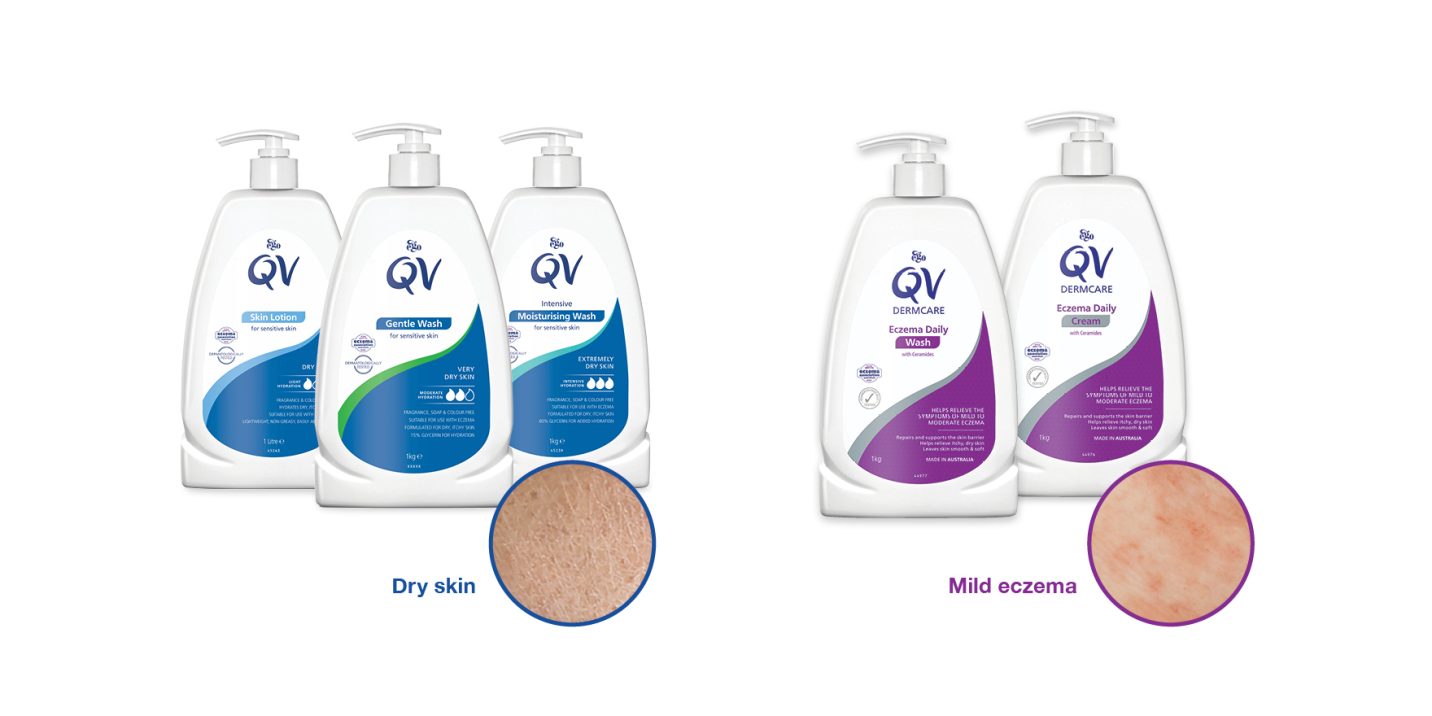
Standard moisturisers like the blue QV Body product range contain humectants, occlusives and emollients to hydrate and soften the skin through more superficial mechanisms, however they do not contain specialised ingredients that may benefit people with eczema by addressing functional deficits in the skin’s barrier.15
People with eczema suffer from a dysfunctional skin barrier, primarily due to a deficiency in the level of ceramides in the outermost layer of skin. A significant reduction in the level of ceramides in people with eczema is associated with increased trans-epidermal water loss, and may pre-dispose the skin to inflammation caused by allergens and irritants, ultimately resulting in flares. Addressing this functional deficiency could help correct skin barrier dysfunction in people with eczema.15
Purple QV Dermcare Eczema Daily has been clinically tested for symptomatic relief from mild to moderate eczema. In addition to humectants, occlusives and emollients, it contains specialised ingredients ceramides 1 and 3 to help repair the skin barrier, plus L-lactic acid and nicotinamide to help promote ceramide biosynthesis.15,17,18
Skin maintenance in practice
Guidelines recommend that optimal every day eczema management involves applying specialised moisturiser generously top-to-toe, twice per day. More frequent application may be appropriate when skin is particularly dry, or during flares.4,9 To help encourage adherence with daily moisturiser use and optimise condition outcomes, clinicians can:4
- Educate patients about the benefits of maintenace and adherence
- Encourage a simple routine that fits family life, such as applying after bathing
- Provide empowering quotes from other parents/carers about how easy it is do relevant activities or how they overcame barriers
Find out more about the specialised QV Dermcare Eczema Daily range here.
References:
1. Eczema Support Australia 2023. The burden of eczema – Evidence for a National Strategy. Available at: https://www.eczemasupport.org.au/wp-content/uploads/2023/08/The-Burden-of-Eczema-Evidence-for-a-National-Strategy.pdf Accessed April 2026.
2. Zeleke B, Lowe AJ, Dharmage SC et al. Epidemiology of eczema in South‐Eastern Australia. Australas J Dermatol 2023;64(1):41–50.
3. Therapeutic Guidelines. Dermatology; Summary of management in atopic dermatitis. Available at https://tg.org.au Accessed April 2026.
4. The Royal Children’s Hospital Melbourne. Clinical Practice Guidelines: Eczema. Available at: https://www.rch.org.au/clinicalguide/guideline_index/eczema/ Accessed January 2026.
5. Sivyer K, Teasdale E, Greenwell K et al.Supporting families managing childhood eczema developing and optimising eczema care online using qualitative research. Br J Gen Pract 2022;72(719):e378–389.
6. Ross T, Ross G, Varigos G. Eczema – Practical management issues. Aus Fam Phys2005;34(5):319–324.
7. van Zuuren EJ, Fedorowicz Z, Christensen R et al. Emollients and moisturisers for eczema. Cochrane Database of Systematic Reviews 2017, Issue 2. Art. No.: CD012119. DOI: 10.1002/14651858.CD012119.pub2.
8. Nicol NH, Rippke F, Weber TM, Hebert AA. Daily Moisturization for Atopic Dermatitis: Importance, Recommendations, and Moisturizer Choices. J Nurse Pract2021;17(8):920–925.
9. Ross G. Treatments for atopic dermatitis. Aust Prescr 2023;46:9–12.
10. Johansen JD. Fragrance Contact Allergy – A Clinical Review. Am J Clin Dermatol 2003;4(11):789–798.
11. Mayer RL. Aromatic Amines and Azo-Dyes in Allergy and Cancer. J Invest Dermatol 1948;10(5):389–96.
12. Sulzberger MB, Lazar MP. A study of the allergenic constituents of lanolin. J Invest Dermatol 1950;15:453–458.
13. Grieve K. Glycerine: the naturally effective humectant. Dermatol Nurs 2012;11(1):30–34.
14. Ghadially R, Halkier-Sorensen L, Elias PM. Effects of petrolatum on stratum corneum structure and function. J Am Acad Dermatol 1992;26(3):387–396.
15. Spada F, Harrison IP, Barnes TM et al. A daily regimen of a ceramides-dominant moisturizing cream and cleanser restores the skin permeability barrier in adults with moderate eczema: a randomized trial. Dermatol Ther 2021;34(4):e14970.
16. Di Nardo A, Wertz P, Giannetti A, Seidenari S. Ceramide and cholesterol composition of the skin of patients with atopic dermatitis. Acta Derm Venereol 1998;78:27–30.17. Rawlings AV, Davies A, Carlomusto M, et al. Effect of lactic acid isomers on keratinocyte ceramide synthesis, stratum corneum lipid levels and stratum corneum barrier function. Arch Dermatol Res 1996;288:383–39018. Soma Y, Kashima M, Imaizumi A, Takahama H, Kawakami T, Mizoguchi M. Moisturizing effects of topical nicotinamide on atopic dry skin. Int J Dermatol 2005;44:197–202.
Sponsored by EGO PHARMACEUTICALS PTY LTD 21–31 Malcolm Road, Braeside 3195 Australia
australia +61 3 9586 8800 toll free 1800 033 706
© 2026 Ego. ask@egopharm.com www.egopharm.com Prepared: May 2026