

That didn’t take long.
One of the world’s highest impact-factor and most-relied-upon medical journals can’t be relied upon when it comes to writing about AI vs doctors, apparently.
Last week JAMA did something unexpected when it comes to AI. It didn’t use AI and publish some sort of hallucination.
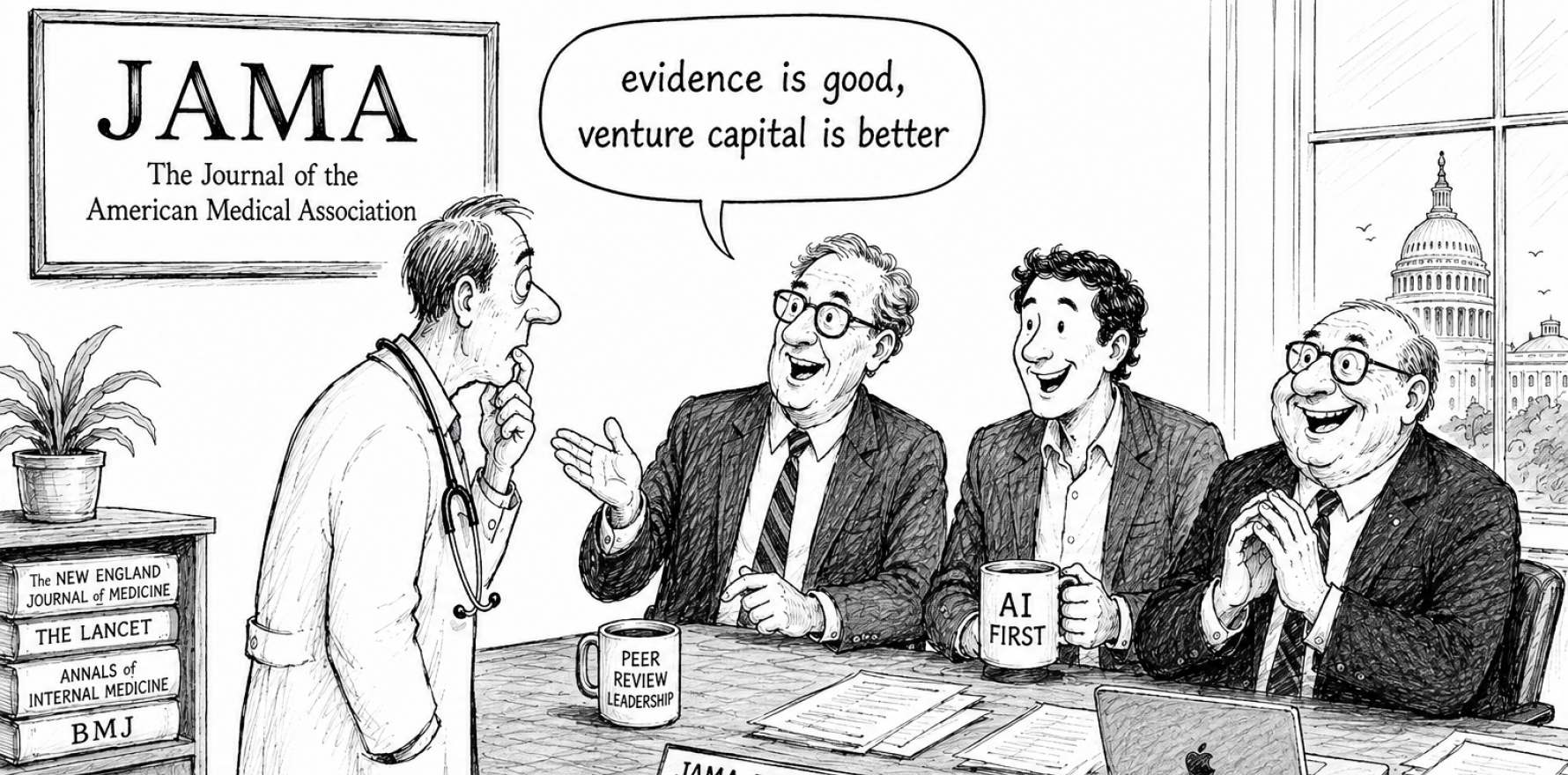
It instead published a Perspective arguing autonomous AI will soon outperform doctors, co-authored by a venture capitalist who was one of the earliest backers of OpenAI, his son who runs a rival AI health startup, and a research assistant with no medical or technical training.
In other words, the editors were hallucinating not the AI, and outed themselves as either stupid, conflicted or both.
Why did they allow this group of usual AI money men suspects to publish this on a topic so important in one of medicine’s most cited journals?
The piece – “Will Autonomous AI Exceed AI-Aided Physicians as the Best Medical Care?” – concludes yes, probably, by 2030, and that regulators should stop insisting on a human in the loop.
While lead author Ezekiel Emanuel is a health policy expert, he’s also a Venture Partner at Oak HC/FT, a growth equity firm with its own healthcare portfolio.
Co-author Neal Khosla is CEO of Curai Health, an AI primary-care company that stands to benefit directly from exactly the regulatory shift the piece argues for. His father and co-author Vinod Khosla is a venture capitalist worth an estimated $13.5 billion, one of the earliest investors in OpenAI, and an investor in Curai Health itself.
The fourth author, Abe Baker-Butler, is Emanuel’s research assistant – a Global Affairs graduate doing a Master of Public Administration, credited with “conducting and leading peer-reviewed scientific research on AI in healthcare.”
JAMA doesn’t hide the authors’ bios. But it does nothing to frame how the article could be entirely biased either.
Kent Anderson author of the book How the Internet Disrupted Science – about Silicon Valley’s business and cultural habits infecting the scientific claims space – called the piece in his blog The Geyser “basically an ad in editorial clothing,” and noted Vinod Khosla posted “Game mostly over for human doctors vs. AI?” on X the moment it published.
A physician writing on The Techy Surgeon Substack under heading “The Commoditization of Clinical Intelligence” called it “shots fired,” describing the “considerable consternation” it caused across the profession, and noted Khosla’s own framing “less delicate” than the paper itself.
The Decoder led its coverage by pointing out that “knowing who wrote the JAMA piece helps explain its angle,” and that “two of the authors stand to gain directly from the future the piece champions.”
American Medical Association CEO John Whyte said on LinkedIn: “Zeke may be right about the tasks. But medicine is not a collection of tasks.”
Compounding JAMA’s problem was its own press release on EurekAlert describing the piece as a “peer-reviewed study”.
Perspective is an opinion column, not new research.
Forbes ran with “new research” language regardless. And we wonder how misinformation starts.
Khosla Ventures then published its own promotional writeup of the coverage and unsurprisingly the piece became “research” suddenly.
The question of how it got published at all is where JAMA’s own marketing becomes awkward.
The journal states on its own “Why Publish in JAMA” page that it accepts just 12% of the more than 10,200 manuscripts it receives annually, and only 5% of research submissions.
It’s a member of the International Committee of Medical Journal Editors, and cosponsors the International Congress on Peer Review and Biomedical Publication – positioning itself as a co-steward of global peer review standards, not just a publisher of them.
For a journal that says it turns away 95% of research submissions on rigour grounds, letting two people who profit directly from the conclusion, a $13.5 billion-exposed investor, and an under-qualified ghostwriter through as authors of a significant opinion piece on AI in medicine makes you start wondering what you can actually trust.
A peer-reviewed audit of editorials in high-impact journals found that of JAMA’s 2016 drug/device editorials with a US-based physician author, nearly 22% involved an author with an undisclosed or disclosed financial conflict tied to the very drug or device under discussion.
Is that evidence of a measurable, recurring conflict problem at a journal that markets itself on rigour and peer-review leadership?
It makes this piece look less like an aberration than a pattern.
