


The latest data from the Kirby Institute shows sexually transmissible infections continue to be a significant public health issue in Australia.
Experts are concerned by the number of chlamydia diagnoses in young people, as well as rising syphilis cases in women.
New data from the Kirby Institute paints a mixed picture of the state of sexually transmissible infections in Australia over the past decade.
Chlamydia remains the most reported STI, accounting for nearly double the number of notifications of gonorrhoea and syphilis combined (94,184 compared to 42,393 and 5896 in 2025, respectively). The number of chlamydia notifications registered by the National Notifiable Disease Surveillance System fluctuated between 2016 and 2025, while notifications for both gonorrhoea and syphilis have increased.
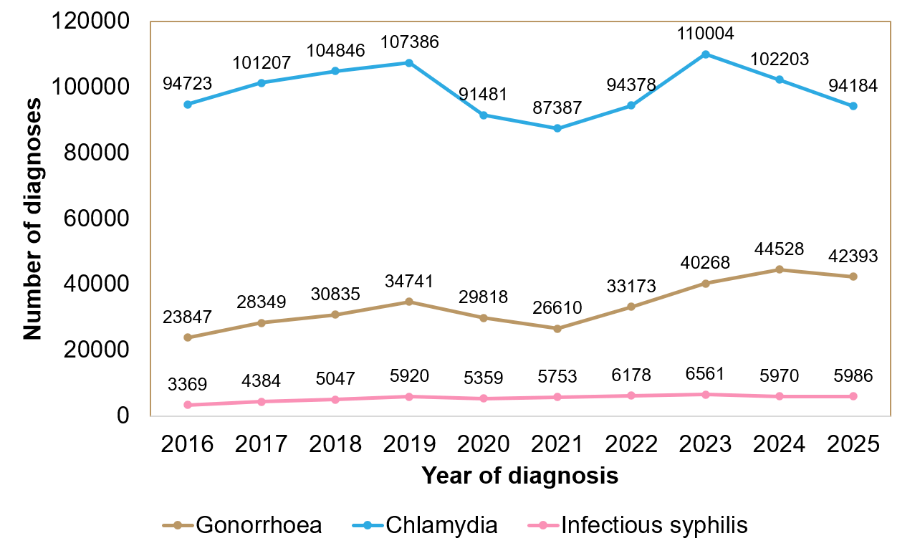
Since 2016, the age-standardised notification rate for chlamydia has decreased (399.6 per 100,000 to 353.4 per 100,000), but gonorrhoea and syphilis rates have increased by more than 50% during the same period (101.2 per 100,000 to 158.6 per 100,000 and 14.3 per 100,000 to 22.3 per 100,000, respectively).
Dr Skye McGregor, an epidemiologist at the Kirby Institute at UNSW Sydney and the report’s lead, said the data served as a vital reminder that STIs remain a public health issue in Australia.
“The rise in syphilis and gonorrhoea tells us we need to ensure testing and treatment are easy to access and prevention efforts reach the people and communities most affected,” she said.
“Sexual health is a normal and important part of overall health and wellbeing. Many STIs have no symptoms, but they can be detected and treated easily, which supports both individual and community health.
“People who are sexually active can prioritise their sexual health by getting tested regularly, seeking treatment early, and talking with their partners and health providers about prevention options.”
One concerning finding from the report was the increasing rate of syphilis notifications among women. Although the majority of syphilis notifications still occur in men (78% in 2025), the rate of notifications in women has increased by 167% over the past decade compared to just a 39% increase in men.
“The rise in infectious syphilis in women is an urgent priority. While syphilis is entirely curable, untreated syphilis during pregnancy can lead to miscarriage, stillbirth or infants being born with congenital syphilis, which is when the infection is transmitted to an unborn child. Congenital syphilis is an extremely serious condition for infants that can result in significant lifelong health impacts, and in the most severe cases can be fatal,” said Dr McGregor.
There were 14 notifications of congenital syphilis in 2025, adding to the 99 that occurred between 2016 and 2024. Forty of these 113 notifications have resulted in the death of an infant – meaning Australia still has work to do before it achieves its goal of registering zero congenital syphilis cases.
“With timely screening, syphilis can be cured and transmission prevented, so even one case of congenital syphilis is completely avoidable and unacceptable. National guidelines have recently been updated to recommend a minimum of three syphilis tests during pregnancy, and monitoring the impact of this change on congenital syphilis incidence will be critical,” Dr McGregor said.
Related


The disproportionate impact of STIs on First Nations Australians continues to be an issue, who were diagnosed with chlamydia at more than 2.5 times the rate of non-Indigenous Australians in 2025 (932.7 per 100,000 population versus 336.3 per 100,000). The comparisons for gonorrhoea (583.6 per 100,000 and 136.5 per 100,000, more than four times the rate) and syphilis (114.4 per 100,000 and 18.7 per 100,000, more than six times the rate) were similarly bleak.
Mr Robert Monaghan, Manager of the Yandamanjang First Nations health research program at the Kirby Institute, said the gap between First Nations and non-Indigenous Australians were “deeply concerning” and represented more than numbers on a page.
“They reflect ongoing inequities in access to culturally safe, trusted, and appropriate sexual health services,” he said. “We know what works. We need sustained investment in services that are accessible to First Nations communities and designed with communities, rather than for communities.”
A targeted point-of-care testing program is an example of something that works for First Nations communities, with modelling data suggesting this approach can more than double the proportion of people who are treated and cured of an STI within 48 hours. Point-of-care testing will reduce the prevalence of STIs in remote Australian communities, according to Mr Monaghan.
“The First Nations Molecular Point-of-Care Testing Program has demonstrated how effective these interventions can be when local health services and communities are leading the response,” he said.
Elsewhere, gay and bisexual men remain a priority population from a public health perspective. Men accounted for 78% of syphilis notifications and 73% of gonorrhoea notifications in 2025, leading the report to suggest that most transmissions occur between men, and that gay and bisexual men are disproportionately affected by STIs.
Data provided by a network of sexual health clinics show that there has been a 30% decrease in syphilis notifications in HIV-negative gay and bisexual men, as well as a 37% decrease in HIV-positive gay and bisexual men. Similar declines were observed for chlamydia notifications (31% and 26%, respectively) but gonorrhoea notifications remained relatively stable.
Professor Andrew Grulich, head of the HIV epidemiology and prevention program at the Kirby Institute, attributed the declining STI notifications to increasing use of doxycycline post-exposure prophylaxis.
“We know how effective health promotion can be among gay and bisexual men as we have seen with the enormous reductions in HIV. We need to encourage increased targeted uptake of doxy-PEP to further drive down syphilis and chlamydia. People should continue with trusted methods for preventing gonorrhoea infection, such as condoms and regular testing, which they can access via sexual health clinics and community-based testing services,” he said.
The data included in this story were presented at the 2026 Australasian HIV&AIDS and Sexual and Reproductive Health Conference, held in Melbourne from 14-17 of September. The complete report, containing more detailed data on this topic, will be released in November 2026.
