

Surprises from the latest CDC data ahead of the upcoming WHO consultation on the composition of vaccines for 2027, where the state of avian flu will also be discussed.
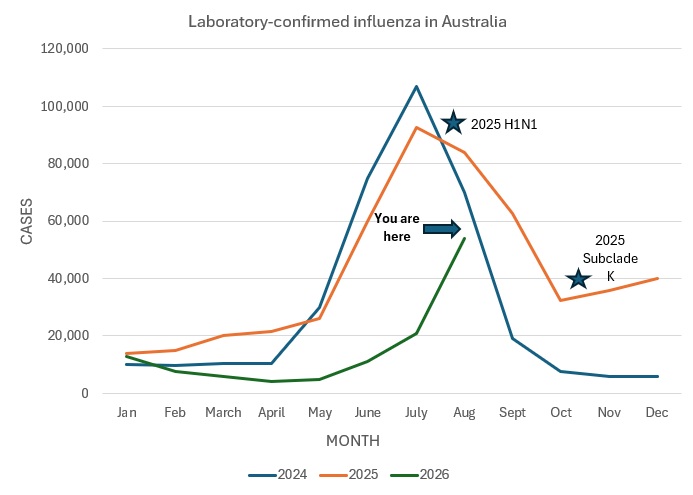
The latest Australian Centre for Disease Control respiratory surveillance report has been released, indicating that we may only now be heading into the peak of our flu season.
Professor Patrick Reading, director of the WHO Collaborating Centre for Reference and Research on Influenza at the Doherty Institute, told media that 2026 is turning out to be an interesting year for influenza.
“What you can see for influenza is that the number of positive tests is increasing, and it’s actually continuing to increase even as we’re starting to move into spring, which is a little bit unusual,” said Professor Reading, who is chair of the upcoming WHO consultation.
“There was a lot of news about last year’s season because it was really unusual; we had a peak in our winter in July, which was caused by our H1N1 virus. But then later in the year, we had a surge of H3N2 viruses of the subclade K, and this caused influenza activity right through until Christmas, which was very unusual.”
“What we’re seeing in 2026 so far… is we had quite low levels of activity through our typical seasons (May, June, July) but we’ve seen quite an uptick towards the end of August and into early September, so influenza activity is late and it’s increasing.”
He said the same late peak is being observed in New Zealand and Fiji but interestingly, other southern hemisphere states are not following the same trend.
“Countries in South Africa and South America had typical peaks in the June, July months of winter, with activity decreasing afterwards. So even [comparing to the rest of] the Southern Hemisphere, we’re seeing that Australia is really having a very late influenza season this year.”
He described the current surge of flu in NZ as one of their biggest seasons on record in terms of hospitalisations.
“Australia and New Zealand are certainly sharing this later circulation. It could relate to international travel; it could relate to climate features. I mean, influenza transmits better when people are indoors and when the air is dry. So cold weather promotes kind of transmission of the virus,” he said.
“As to specifically why the peak or the increase is happening now, and whether or not we’ve peaked, it’s a bit hard to tell. I think from some of the earlier seasons pre-covid we’ve seen September peaks, but at the moment it is a bit like crystal ball gazing, so not sure if we’ve reached the peak or if it’s still coming.”
He said immunity is likely quite variable across the Australian population, describing vaccination coverage as “fairly patchy” – current data indicates it’s at 30.2%, a very slight increase from last year’s 30%, but significantly lower than 2022, for example, where we saw overall coverage of 37-38% of the population.
“[There are] particular age groups have higher rates of vaccination, particularly the over 65s, which is about over 60% this year, and also the six months to five-year-olds – that sits at about 36% this year,” he said.
“I would say that the vaccine [this year] has been a good match in that most of these viruses are well recognised by immune responses to the current vaccine, so that’s encouraging. But what I would say is probably the vaccination rates being quite low means there’s quite a susceptible population out there, so that’s part of the reason why I guess we’re seeing a surge in cases at the moment.”
He recommended continuing to push vaccination despite being past the typical flu season.
“I would say there is definitely good opportunities to try and increase and enhance the immunity that we have throughout the community to try and limit the impacts of influenza. It’s still unpredictable what will happen this year, but I think it’s the best way that we have to keep people out of hospital and keep people from being really sick with influenza.”
As of 18 September, there have been 154,342 confirmed national influenza cases in 2026, compared to 393,941 up to the end of September last year (source: the National Notifiable Disease Surveillance System).
The latest CDC respiratory surveillance report (24 August to 6 September 2026) can be accessed here.
An update on avian flu
Professor Reading said a second important part of the WHO meeting was the assessment of zoonotic infections from the last six months.
Given that previous avian and swine viruses have led to “human spillover infections” and there’s been recent activity with avian H5N1 in the southern hemisphere, a key component of the upcoming consultation will be ensuring there are suitable vaccine candidates ready to provide protection against the latest zoonotic strains.
“Increased detections of bird flu H5 have been seen in Australia this year [but] it’s important to note that from the CDC, the risk to people in Australia remains low,” he said.
Dr Michella Wille, an ARC Future Fellow at the University of Melbourne and the Outreach Coordinator at the WHO Collaborating Centre for Reference and Research on Influenza, explained the current H5 situation in Australia.
“There have been 572 positive events. We’ve transitioned into a phase where we are seeing mass mortalities, and the jurisdictions are transitioning to using an epidemiological unit-based approach,” she said.
“Of these 572 events, the vast majority of them are in South Australia, which seems to be an important epicentre of activity, as well as Victoria. However, there have been small numbers of events and cases in some of the other jurisdictions, where the Northern Territory and ACT are the only jurisdictions which have not yet had any positive detections.
“There are [now] almost 200 full genome sequences which have been generated by… the CSIRO Australian Centre for Disease Preparedness. The same way that these genomes were really important in tracking the spread of covid globally, these genomes are really important for us to track the spread and contextualize the activity of H5N1 in Australia.”
She said that since the first transmission event into domestic birds in Australia, there has been sustained transmission and a lot of opportunity for surveillance. An area of focus is spillover into ducks.
“Thus far, we have not detected H5 in any ducks in Australia, but we know ducks are critical movers of the virus throughout the northern hemisphere, and the emergence of genotypes predominantly occurs in ducks,” she explained.
In collaboration with Deakin University since June, they have sampled more than 900 ducks for avian influenza.
“There have also been no cases in poultry to date, and there continues to be important biosecurity and vigilance in poultry producers to ensure that we can respond to this as quickly as possible if the event occurs.”
“From there, if we look at what’s happened overseas, there have, in some countries (particularly the US) been spillover into dairy cattle. Whether or not that happens in Australia is unknown, and of course, wherever there have been cases in animals, particularly domestic animals, there have been human cases.”
“The general public play a really crucial role in our ability to respond to the outbreak. When the public see sick or dead animals, they are encouraged to call the hotline, and then those calls are triaged, and the jurisdictions respond.”
She said that as of September 17, there had been more than 40,000 calls made to the Emergency Animal Disease (EAD) hotline.
