

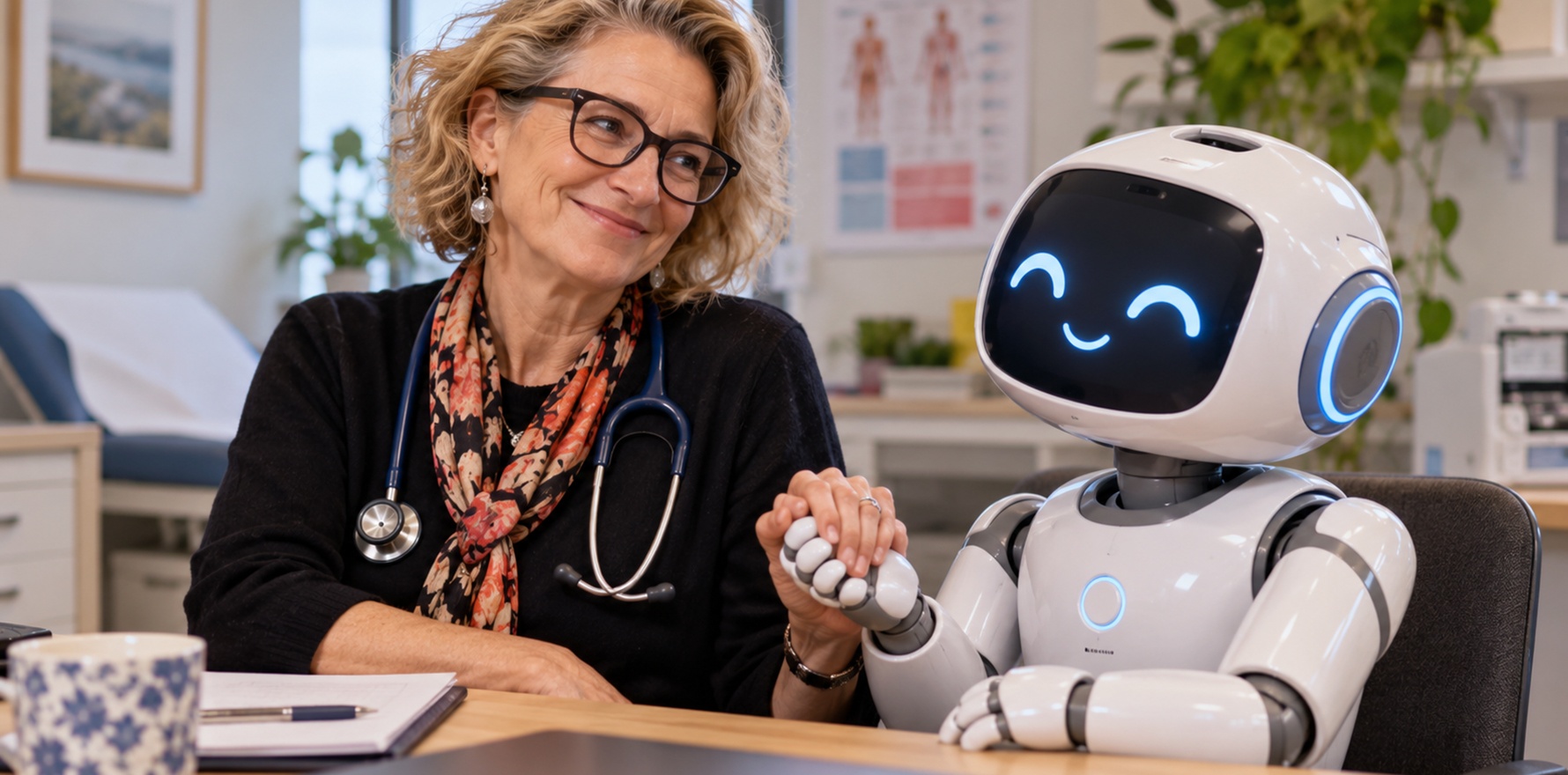
I remain appropriately critical, but I am also intrigued by our potential futures, and to me, that is where a GP thrives.
I’ve been reflecting on the use of AI in general practice, its benefits risks and limitations and having delivered a slightly unhinged argument in a dinner debate at Burning GP, I wanted to share my reflections.
Burning GP gave me a full day of interactions with intelligent, thoughtful and committed people utilising AI to improve the workflow for GPs, the knowledge available for diagnosis and the optimisation of business processes for practices.
There are serious attempts to utilise these new technologies to enable better, more efficient, more accountable care in a variety of settings.
I also saw appropriate concern.
For GPs, this is not the first time we have had to adapt to innovation. Every drug, process, intervention and innovation has benefits, risks, side effects and interactions, and we operate in a complex system that can be easily derailed in a variety of ways.
We have had many, many vendors of various products, including, of course, pharmaceuticals, who use marketing techniques and selective use of data to encourage the use of their particular product.
So yes, we are critical consumers.
We also serve more than one market. We serve those who are highly literate in English and are also health literate, digitally literate and financially secure. We serve those who are not.
There is a place for what Trish Greenhalgh calls being “strategically traditional”, which is where I sit.
Digital poverty is real. I am not a Luddite. I am happy for my business to have its backend processes optimised through a variety of technological solutions, but my vulnerable patients need me to the be their safe interface. The GP is the last human firewall between each patient and a system that doesn’t distinguish between them.
We are aware that changing one element in a complex system can have unintended consequences in another. It may be a good thing to implement a technological change for a particular part of the health system, but not if the cost means people seeking public psychiatry services continue to sleep in corridors in the local hospital.
These days, it is not enough to prove something is useful. We should be asking how each precious dollar is spent, and in my view, there have been some stark examples of overinvestment in potential technological solutions that never materialise.
We humans are dazzled by the glitter of certainty. There is a tendency for AI to suggest optimal solutions based on statistical norms from non-representative data.
Treating to the average creates a consistent healthcare system, but it selectively disadvantages outliers. These disadvantages are additive, as these patients are usually outliers in a variety of systems. Treating to the average is good economics, but terrible medicine.
Creating a portal does not ensure access. Patients include robodebt survivors, people who have had harms from government interventions, and those who have reason to be suspicious of anyone’s privacy and security systems.
Mark Butler may laugh at my ancient fax machine, but no one has extracted its private data. My tiny clinical database is of little interest to the hackers, keeping the precious privacy of my vulnerable patients protected.
GPs are frustrated by the weaponisation of “evidence”. We have had countless experiences of products, systems and processes developed in the rarefied high ground of tertiary hospitals, privileged urban communities and well-funded NGOs and then tossed into the swamp for our use.
We are SO tired of being told that the mismatch of our need and their solution is due to our ignorance, bias or sheer bloody-mindedness. By all means, develop your evidence-based, patient-centred, co-designed scooter, but don’t be surprised if I choose not to use it in my swamp.
All that being said, I think the one thing we didn’t manage to discuss in such a packed program was the role of AI in helping our patients cope with chronic, distressing and disabling illness. The dinner wasn’t the time to be this serious, so let me outline what that might look like.


Coping
Illness is lonely, isolating and profoundly disrupting to your sense of identity. For those living with chronic illness, human supports often fail.
There is a time when the initial concerns of friends and family peters out, and the ill person becomes unable to engage in a social world that is increasingly unfamiliar.
Coping theory suggests there are a series of strategies that can be utilised to survive, and all may be enriched using AI systems
Appraisal
In order to cope, it is important to understand the disease and its treatment, and your own capacities. People have already benefited from technology in this space, accessing lived experience narratives, patient education materials and social groups to help them understand their illness and its treatments. They are encouraged by others, and gain confidence.
However, I can see a time when information can be personalised to a far higher degree.
It is confusing to manage conflicting information, and it can easily lead to overwhelm early in illness. AI will be able to tailor relevant information to the person, their context and the specifics of their disease, to remove the informational “noise” and refine the message.
I expect AI will also be able to present information in a variety of formats: as animations, texts, or graphics, with an appropriate level of complexity for the individual.
This will not replace the need for clinician interventions, of course, but it will enable the person who is living with the illness to feel more of a sense of agency and security.
Problem-solving
Consumers already use AI to seek specific solutions to specific problems, many of which are outside the realm of health professionals.
This may include accessing financial support, understanding the role of various people in their care, using off-the-shelf products for distressing symptoms or finding local providers of services.
Emotion-focused coping
There has been a lot of concern about AI companions, and some is well founded.
Like humans, there are AI sociopaths, leading people into dangerous situations and encouraging behaviours that are harmful. An AI is not a therapist, and should not be treated as one.
However, there is a parallel argument that loneliness kills people. Yes, AI companions can endlessly validate a person, and that is unrealistic, but illness and disability can lead to constant invalidation, and that is equally harmful.
Is it really so bad to consider that a person in pain at 3am may be able to talk with an artificial construct and get a sense of peace from the interaction? Is it so different to a pen pal from the mid-20th century, or a reflective journal?
I think this space has promise, coupled with challenges in terms of privacy and safety.
I have often thought it might be interesting to consider, as digital natives age, what might happen in the management of dementia. Could an AI companion interact using the communication preferences of a person embedded in a particular time and place? Possibly.
Meaning-focused coping
Coping involves endurance, tolerating chronic symptoms that are distressing and often relentless. Coping theory suggests key strategies involve distraction, connection and a focus on activities that feel purposeful.
AI can help in all three.
There is an interesting AI option designed to fish out examples from philosophers, scientists, religious leaders and others when a person types in the things that trouble them. We may be in a modern age, but people still grapple with age-old questions around the purpose of suffering, and the meaning of life.
At the end of the day, I think there is a bright future ahead, even though my vision of a bright future is tempered with realistic concerns about what it all means for those who are marginalised, lonely and poor.
It is my role to help my patients access appropriate and affordable care, and so it will be my job to engage with AI innovation with them. In doing so, I remain appropriately critical, but I am also intrigued by our potential futures, and to me, that is where a GP thrives.
Professor Louise Stone is a GP in Canberra and an academic at Adelaide University. A collection of her research, policy and teaching materials can be found at drlouisestone.com.
