


Appetite suppression is common with stimulant treatment for ADHD, but it does not always translate into growth or nutritional problems.
Attention-deficit hyperactivity disorder (ADHD) is the most common mental health disorder among Australian children and adolescents, affecting an estimated 7.2%. Psychostimulants are the most widely prescribed medications for ADHD and are generally recommended as first-line pharmacological treatment.
While generally well tolerated, reduced appetite is one of the most commonly reported adverse effects of stimulant medication for ADHD and can be a significant source of concern for parents.
For families, appetite suppression can also be a particularly visible adverse effect. The benefits of treatment may be evident at school or through improved functioning across the day, while at home parents are confronted with an untouched lunchbox or a child who suddenly insists they are not hungry.
Research suggests that some families may be left wanting more practical support following an ADHD diagnosis. In a New Zealand survey of 288 parents of children with autism, ADHD or both, some parents described a “given meds and carry on” approach, highlighting a potential gap between prescribing treatment and helping families manage what comes next.
This may be particularly important when it comes to medication side effects. Appetite suppression can contribute to parents’ concerns about stimulant treatment and decisions about whether their child should continue taking medication.
Routine clinical reviews provide an opportunity not only to ask about appetite, but to help families understand when reduced eating is a cause for concern – and what they can do about it.
When does reduced appetite become a growth concern?
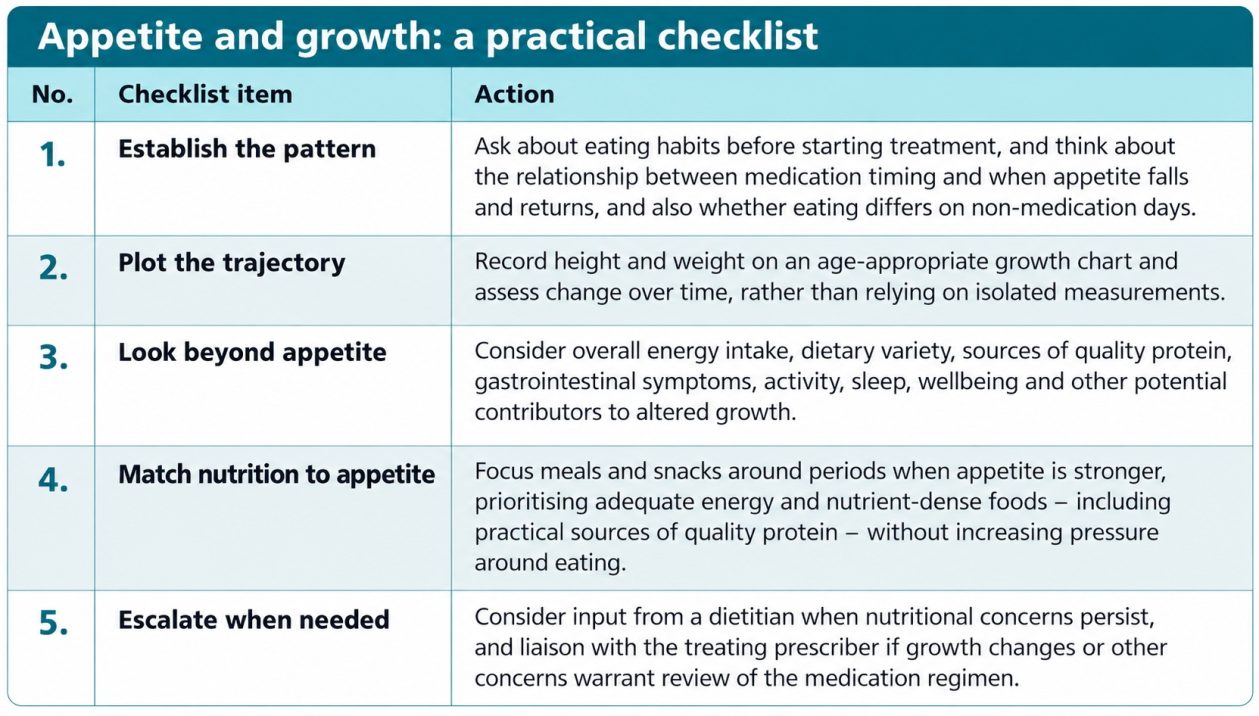
A child may eat considerably less while their medication is active but compensate at other times of the day and continue to grow normally. The key is therefore to look beyond how much is being eaten at individual meals and consider the child’s growth trajectory and overall wellbeing.
This distinction can help GPs determine when reassurance and monitoring are appropriate and when further action is needed.
The key is to look beyond appetite at the child’s growth trajectory and overall wellbeing. A child may eat considerably less during parts of the day but still compensate at breakfast, in the evening or at weekends and continue to grow normally.
What becomes more concerning is a sustained change in weight gain or height velocity, particularly if the child starts crossing down centile lines on their growth chart.
The relationship between ADHD medication, appetite, and growth has long been recognised. A review by the European ADHD Guidelines Group identified reduced caloric intake and suboptimal nutrition due to appetite suppression as likely contributors to growth suppression.
A 2021 systematic review and meta-analysis of 18 studies involving 4868 children and adolescents with ADHD found long-term methylphenidate treatment was associated with statistically significant reductions in height and weight z-scores.
The effect was most prominent for weight during the first 12 months of treatment and for height during the first 24-30 months. However, the overall effect sizes were small and the authors considered the clinical impact potentially minimal.
Earlier evidence reviewed by the European ADHD Guidelines Group also suggested that growth deficits may attenuate over time and that catch-up growth can occur after treatment is discontinued.
The practical implication is less about predicting an individual child’s eventual height and more about monitoring their growth trajectory over time.
Reduced appetite is something to monitor; altered growth is something to act on.
Put growth on the chart
The Australian Evidence-Based Clinical Practice Guideline for ADHD provides a framework for monitoring children and adolescents taking ADHD medication. Height should be measured at least every six months in children and adolescents, while weight should be measured three and six months after starting treatment and every six months thereafter, or more often if concerns arise.
Importantly, height and weight should be plotted on a growth chart rather than considered as isolated measurements. This longitudinal view can help put parental concerns about appetite into context.
A child’s lunchtime appetite can look dramatically different after stimulant treatment, and understandably that worries parents. But the more useful question is not, “How much did they eat today?” It is, “Are they continuing to gain weight, grow and develop as expected?”.
For a child whose appetite has changed but who remains on their expected growth trajectory, the growth chart can provide useful reassurance. Conversely, a sustained plateau or fall in weight, slowing height velocity or crossing down centile lines may signal a need for a more in-depth assessment or intervention.
Growth is not the only consideration. The overall quality and variety of the child’s diet, energy levels and general wellbeing, gastrointestinal symptoms and increasingly restrictive eating can provide additional context.
It is also important to establish whether eating difficulties were present before treatment commenced, rather than assuming that all changes in food intake are attributable to stimulant medication. The European ADHD Guidelines Group recommends distinguishing between pre-treatment eating problems and those that emerge following medication.
This is particularly relevant given the recognised association between ADHD and eating disorders. A review of studies in children and adolescents found that most reported an association between ADHD and eating disorders, including anorexia nervosa, bulimia nervosa and binge eating disorder, with some estimates suggesting that up to 20% of children with ADHD may develop an eating disorder.
When weight or growth begins to falter
A plateau or drop in weight does not automatically mean an otherwise effective ADHD medication needs to be stopped.
The Australian Evidence-Based Clinical Practice Guideline for ADHD outlines several strategies to consider when weight loss or insufficient weight gain becomes a clinical concern.
These include taking medication with or after food rather than before meals, adding meals or snacks early in the morning or late in the evening when stimulant effects have worn off, obtaining dietary advice and consuming higher-energy foods of good nutritional value.
When a child is eating less, the nutritional value of each eating opportunity becomes increasingly important. Adequate energy remains essential, while foods providing quality protein and a range of nutrients can help support normal growth and development within smaller, more manageable meals and snacks.
Depending on the severity and persistence of the problem, a planned break from treatment or changing or stopping medication may also be considered.
This provides a stepped approach to management, beginning with understanding what the child is eating and when, and identifying opportunities to improve energy and nutritional intake. Where these strategies are insufficient, dietary input may be helpful and the medication regimen may need to be reviewed with the prescriber.
Where growth has significantly decreased over time, Australian guidance recommends considering a planned treatment break during school holidays to allow catch-up growth or an alternative medication, while also considering non-medication causes.
Planned medication breaks are not, however, something families should institute independently and without the advice of their prescriber.
This becomes particularly important when parents are considering stopping treatment because of appetite concerns. The important message is not to make that decision based on appetite alone.
Medication may be providing substantial benefit in learning, behaviour, relationships and daily functioning. The appropriate response is to assess whether the appetite change is affecting weight or growth, then look at practical nutritional strategies and medication adjustments if necessary.
In many cases, appetite suppression can be approached as a management issue rather than automatically being considered a treatment-limiting problem.
This is consistent with the broader conclusion of the European ADHD Guidelines Group review: while adverse effects need to be recognised and managed, most do not require medication to be stopped.
Would changing medication help?
There is no universally “appetite-friendly” ADHD medication. Evidence comparing the effects of different medications and formulations on appetite is limited, and comparisons are complicated by differences in dose. Appetite suppression may itself be dose dependent, while different children do respond differently to the same medication.
The European ADHD Guidelines Group review concluded there was insufficient good-quality evidence to recommend switching to a different drug class or formulation specifically to reduce appetite loss or growth delay, although changing treatment may be helpful in individual cases.
Persistent appetite or growth concerns may therefore prompt a broader review of treatment rather than an assumption that switching to a particular medication will necessarily resolve the problem. Depending on the individual child, this may include consideration of dose, timing, formulation, duration of medication coverage or medication choice.
When additional support may be needed
For some children, additional dietary or specialist support may be appropriate.
Dietitian input may be useful where energy or nutrient intake appears inadequate, food choices are becoming increasingly restricted, families need more detailed practical dietary support, or weight gain remains problematic despite initial strategies.
Review by the treating ADHD specialist is usually warranted where the growth trajectory is clearly changing, medication adjustment is required, significant comorbidities are present or the issue appears to extend beyond dietary management.
Referral to an endocrinologist or growth specialist may be considered where there is significant or unexplained impairment of linear growth, particularly if growth remains abnormal despite adequate nutritional intake or the pattern raises concern for another cause.
The European ADHD Guidelines Group review similarly recommends referral to a paediatric endocrinologist or growth specialist where height or weight reaches concerning thresholds, while noting that available evidence does not identify a single degree of growth deceleration at which referral should occur.
Regular monitoring provides an opportunity for emerging growth concerns to be identified and addressed before a substantial deficit develops.
For children whose appetite has fallen but whose growth remains on track, the focus can usually remain on practical strategies to support nutritional intake – including working with the child’s appetite pattern rather than against it.
Finding the windows for eating
Stimulant-related appetite suppression is not necessarily uniform across the day.
For many children, appetite is relatively good in the morning before medication takes effect, decreases while the medication is active and returns later in the afternoon or evening as its effects wear off.
Understanding this pattern can help identify periods when eating is easier. This might mean making more of the morning meal before medication takes full effect, having food available when appetite returns after school, or allowing greater flexibility around the timing of the evening meal.
Breakfast can therefore become an important nutritional opportunity. Where appetite is stronger before medication takes effect, families may be able to combine energy and quality protein in a relatively small meal – for example, eggs on toast, yoghurt with fruit or nut butter on bread.
For some families, a later dinner, second evening meal or nighttime snack may be more successful than expecting a child to eat according to conventional mealtimes. Smaller meals and snacks may also be more manageable than three larger meals.
The aim is not necessarily to restore the child’s previous eating pattern, but to take advantage of periods when appetite is stronger.
This approach is consistent with established clinical guidance. The European ADHD Guidelines Group review recommends giving medication after rather than before meals and suggests higher-energy snacks and late evening meals as strategies to help manage appetite reduction.
The Australian Evidence-Based Clinical Practice Guideline For ADHD similarly recommends considering medication with or after food rather than before meals, as well as additional meals or snacks early in the morning or late in the evening when stimulant effects have worn off.
In practice, the principle is “common-sense strategies”. Trying to force a large lunch when appetite is at its lowest can turn food into a battleground. A more practical approach is to work with the child’s appetite.
Nutrition when appetite is limited
When appetite is limited, nutritional quality becomes particularly important.
This does not necessarily mean increasing portion sizes. A large plate of food may be difficult for a child with reduced appetite, while nutrient-dense foods can provide energy, protein and other nutrients in smaller serves.
Nutrient-dense options may include eggs, dairy foods, nuts or nut butters and dried fruit, depending on the child’s preferences, allergies and dietary requirements. Eggs can be particularly practical because they provide quality protein and a range of micronutrients in a relatively small serve, can be prepared in different textures and formats, and work across breakfast, snacks and evening meals. A standard serve of two eggs provides 12.7 g of protein.
Food preferences are another practical consideration. Involving the child in identifying nutritious foods they reliably enjoy can help ensure familiar, accepted options are available when appetite returns, without increasing pressure around eating.
Nutritional intake also needs to be viewed across the whole day rather than through the lens of an individual meal. A child who eats very little at lunchtime may compensate at breakfast, after school or in the evening as the effects of stimulant medication wear off.
Taken together, these strategies provide a more flexible approach to managing reduced appetite: identifying when a child is most able to eat, adapting meal timing where appropriate and prioritising nutritional quality when intake is limited.
For families concerned about an untouched lunchbox, the meaningful clinical picture is the child’s nutrition, growth and wellbeing over time. Working with the child’s appetite windows – and prioritising adequate energy, quality protein and nutrient-dense foods when they are ready to eat – can help make every eating opportunity count.
Professor David Coghill is Professor of Child and Adolescent Psychiatry at the Royal Children’s Hospital Melbourne and is also the president of the Australasian ADHD Professionals Association (AADPA).
References available on request
