

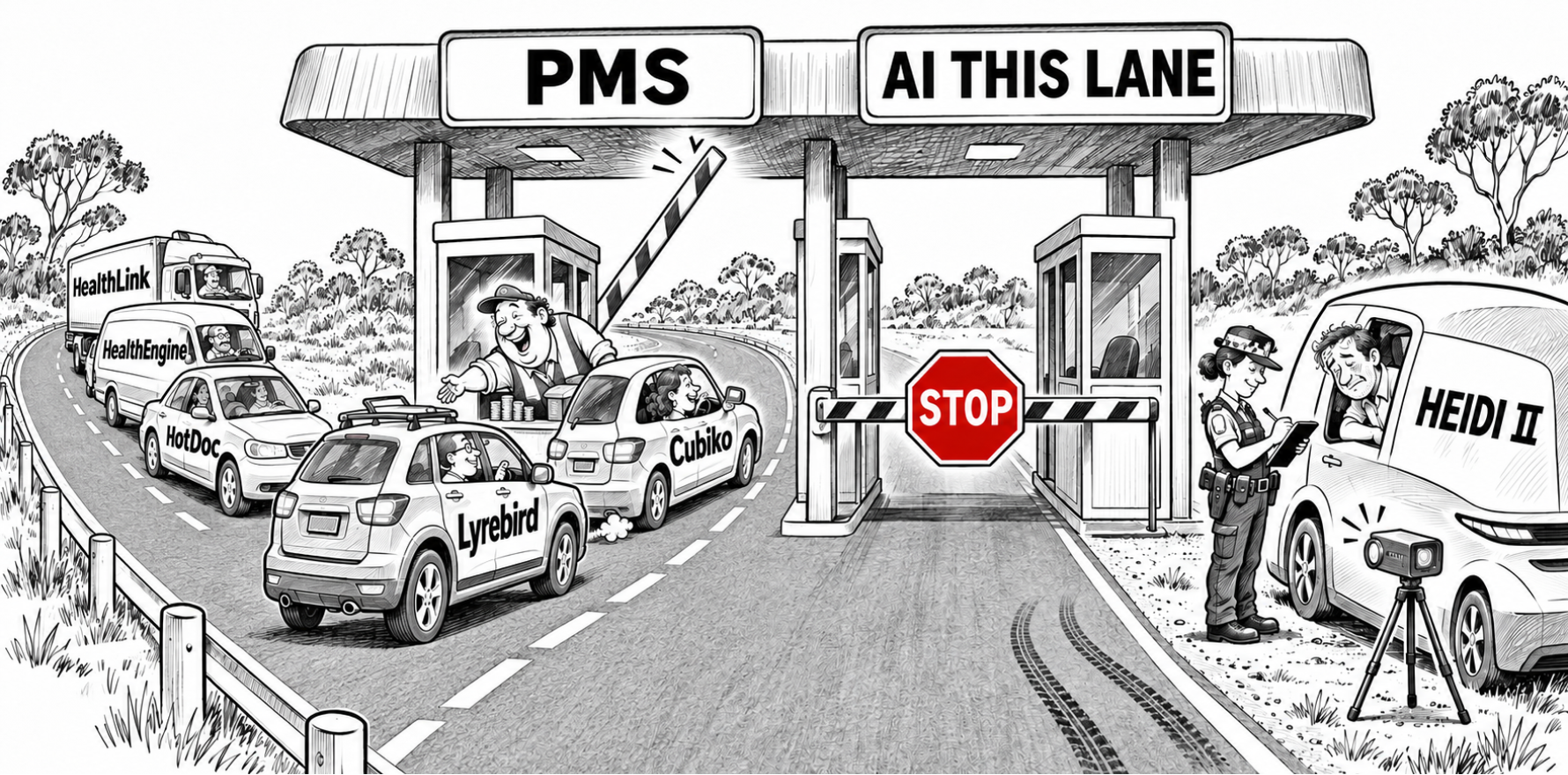
A licence dispute over AI agents has become a fight about who controls GP and specialist patient data, and who decides which tools they can use
The stoush between AI scribe company Heidi Health and Best Practice, the country’s most-used GP software, has turned into open conflict. How it ends will help decide which AI tools Australian GPs and specialists can use, and who gets to decide.
At the centre of it is Heidi II, launched in late September. Its AI agents can, in CEO Dr Tom Kelly’s words, “take the keyboard and the mouse”, navigating a practice management system under the doctor’s own login to pull a patient’s history before a consult, with no integration deal or vendor sign-off.
As TMR reported in early October, that almost certainly breaches the user agreements of most major PMS vendors, not just BP’s. MedicalDirector’s terms explicitly name bots, scraping tools, and robotic process automation; Magentus and MediRecords also restrict such access. And because those agreements sit between vendor and practice, the party in breach is the GP, not Heidi.
On 29 October, BP made it official.
CEO Craig Hodges wrote to users that using Heidi II with Bp Premier breaches its licence agreement, which the Oxford SP2 update will amend to explicitly ban bots, scraping and RPA.
Related



Hodges cited patient safety, privacy (using it without patient consent “seriously risks breaching the Privacy Act”) and the TGA’s finding that eight of 12 AI scribes reviewed likely meet the definition of a medical device.
Dr Kelly said it was within BP’s rights to pull the Ts and Cs card, but that Heidi had tried to integrate with BP for three years without reasonable access. “I don’t think they actually care about patient privacy, safety,” he said.
As we argued, BP’s difficulty is that if the risks were as serious as it says, it could fix them by giving Heidi a proper API, as it does for selected partners such as Lyrebird.
Heidi isn’t spotless either. Newcastle GP Dr Max Mollenkopf spotted that clause 7.2.9 of Heidi’s own master services agreement bans “any automated means (including bots, scrapers, or scripts)” from accessing its platform.
Heidi conceded the point and said it would change its Ts and Cs to reflect its stance, but it wasn’t a great look.
In his own column, Dr Mollenkopf concluded BP is probably protecting both its customers and its business model, and said the real question is who owns the data in a PMS.
What it means for doctors
For GPs on any major PMS, the message is to start paying a bit more attention to what is going on, just in case.
If you run Heidi II, or any agent that operates your software through your login, the contractual risk sits with your practice, along with the governance and privacy obligations attached to that login.
BP has drawn the line clearly, but other vendors’ terms point the same way, and the regulatory status of agentic tools is far from settled.
The bigger question is choice.
Heidi’s chief medical officer, Dr Simon Kos, argues on LinkedIn HERE that GPs, not software vendors, should decide which tools they use. Right now, in Australia, that decision is effectively written into vendors’ licence agreements.
“Sharing by default” is MIA
The US has tackled the problem head-on. Under the 21st Century Cures Act, health IT developers that block access to patient data face penalties of up to US$1 million per violation, and HHS announced an enforcement “crackdown” in September 2025.
Dr Kelly cited the Act at last week’s HSD summit: “In the US, we don’t have this problem.”
Even there, access fights end up in court. In September 2025, a New York judge allowed three antitrust claims by data start-up Particle Health against Epic to proceed.
Separately, CureIS Healthcare is suing Epic, alleging it blocked access to customer data. Epic denies wrongdoing in both cases.
Given the size of the US market and the success of the 21st Century Cures Act, it’s getting very hard to see the logic in how the Department of Health, Disability and Ageing is delivering its piecemeal “sharing by default” agenda.
So far only pathology and imaging companies have been directed by legislation to share their data, and even then, only really to My Health Record, which many would argue is not openly sharing at all.
Surely BP and the other PMS vendors must see the writing on the wall: eventually the government is going to do what it has been threatening to do and make them build standards-based FHIR and open API interfaces that allow data to flow to anyone, without the sort of gating BP is currently applying.
But the US also holds a lesson for us, even though the law there demands free sharing of meaningful data with patients and, through that edict, with other providers via their workflow software.
Even with a law requiring data to flow, incumbents will push back, and they can and will make things difficult, just as Epic and Oracle are doing in the US.
Without one, as the Heidi–BP fight shows, the contract decides, and it’s GPs who are left holding the risk.
