


The results of a new Australian study have experts pushing for improved access to dose-escalated therapy for people living with inflammatory bowel disease.
Although dose escalation of biologic therapies is a necessity for many people living with inflammatory bowel disease, there is little data on whether it improves long-term outcomes for patients.
“Current standard dosing based on registration studies (randomised clinical trials) is insufficient for optimal disease control in all affected people, with many requiring dose escalation (DE) in real-world practice,” Australian researchers wrote in a new study published in the Internal Medicine Journal.
“The most common reason for DE is loss or inadequate response. The long-term outcomes of DE are unknown due to the paucity and quality of data available. This retrospective analysis of prospectively collected data examines longer term outcomes of dose escalated biologic therapy in real world care.”
Using data from Crohn’s Colitis Care, a cloud-based electronic medical record specific to IBD, the researchers identified a cohort of patients with IBD who were treated with adalimumab, infliximab, ustekinumab, or vedolizumab.
Patients were deemed to have received DE therapy if they received more than 40mg of subcutaneous adalimumab each fortnight, more than 5mg/kg of intravenous infliximab every eight weeks, more than 120mg of subcutaneous infliximab every two weeks, more than 300mg of intravenous vedolizumab every eight weeks, more than 108mg of subcutaneous vedolizumab every two weeks, or more than 90mg of subcutaneous ustekinumab every eight weeks as part of their maintenance therapy.
A range of outcomes, including disease remission and healthcare utilisation, were compared in the 12 months before and after DE.
The researchers identified 6093 patients receiving biologic therapy within CCCare with a median age of 40 years and a median disease duration of 11.8 years. Compared to the standard dosing group, a greater proportion of patients in the DE group were diagnosed with Crohn’s disease (73.6% versus 66.4%), while a greater proportion of patients in the standard dosing group were diagnosed with ulcerative colitis (31.4% versus 25.0%).
Infliximab was the most commonly used biologic (36.1% of courses), ahead of adalimumab (27.5%), vedolizumab (19.2%), and ustekinumab (17.3%). A greater proportion of patients in each biologic therapy received standard dosing compared to DE: 65.9% for adalimumab, 57.7% for infliximab, 56.5% for ustekinumab, and 73.2% for vedolizumab.
Dose escalation increased the proportion of patients with a faecal calprotectin level less than 250µg/g across all patients and when individual biologics were considered.
Increases in the proportion of patients experiencing patient-reported remission (defined as an abdominal pain score ≤1 and a stool frequency score ≤3 for Crohn’s disease, or a rectal bleeding score of 0 and a stool frequence score of 0 for ulcerative colitis) and endoscopic remission (Simplified Endoscopic Activity Score for Crohn Disease less than 3 or no evidence of inflammation in all of the examined bowel segments for Crohn’s disease, and a Mayo score of 0 or Ulcerative Colitis Endoscopic Index of Severity score ≤1 or no evidence of inflammation in the examined bowel segments for ulcerative colitis) were observed following dose escalation at in all groups.
There was also a reduction in the proportion of patients receiving systemic steroids after DE both overall and across each of the four biologics. However, there was no significant change in the proportion of patients who experienced radiological remission (defined as no IBD-related abnormalities on the most recent magnetic resonance or computed tomography enterography, intestinal ultrasound, or pelvic magnetic resonance imaging) before and after DE, regardless of whether the biologics were considered individually or as a group.
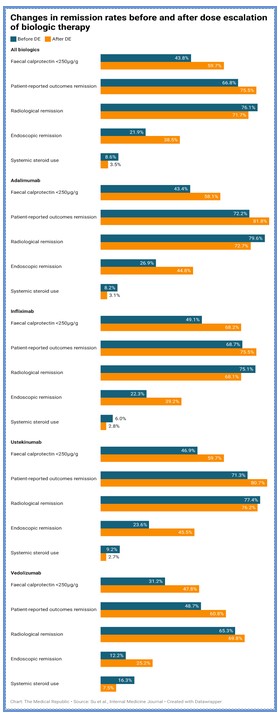
DE was also associated with a reduction in the number of endoscopies, radiology investigations, and helpline calls when the whole cohort was considered, but there was no change in the number of hospital admissions nor the number of clinical assessments. The effect of DE on healthcare utilisation varied between biologic therapies, with ustekinumab leading to reductions in endoscopies, radiology investigations, and clinical assessments.
The researchers felt that the improved readmission rates and HCU proved the clinical value of DE therapy while also showing the problems with current health economic assessments and funding frameworks.
“In Australia, the Pharmaceutical Benefits Scheme (PBS) currently subsidises standard dosing regimens, established using registration trial protocols rather than contemporary real-world practice and objective patient outcomes,” they wrote.
“Access to therapies has been identified as a major barrier to improving outcomes for people with IBD in the 2025 State of the Nation in IBD report. The disconnect between funding structures and clinical need has significant consequences as initial studies did not anticipate the frequent need for DE to achieve and sustain remission in routine care.”
Although DE therapy is costly, it is not without benefit.
“The estimated total cost savings using these HCU measures alone is A$1,759,962.71 or A$774.63 per course of DE therapy over a 12-month period,” wrote the researchers.
“However, this figure is likely a gross underestimate of the actual cost benefits because it does not include all direct and indirect costs. Indirect costs, primarily attributed to costs associated with work absences, are estimated to account for 30%–50% of all healthcare expenditure.
“DE therapy in this large real-world cohort of people with IBD is highly prevalent, improves clinical outcomes and reduces HCU. It is therefore an aspect of IBD care which requires a durable and secure solution, rather than the current ad hoc approach whereby access is precarious and additional staff time is spent on duplicating requirements to access supply.”
