

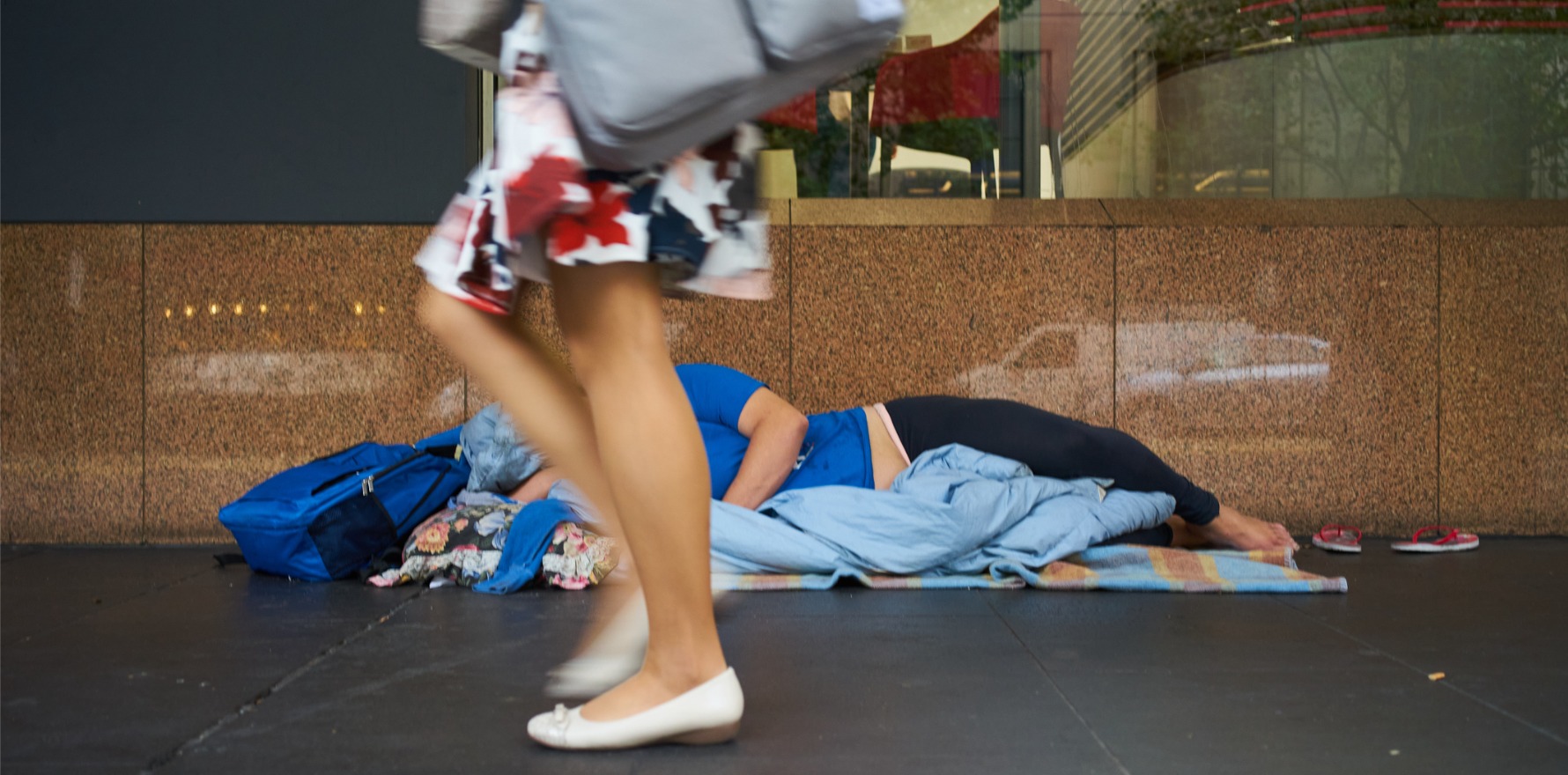
With discussion over bulk-billing heating up, many homelessness advocates have pointed out where marginalised communities are being left out of the conversation.
The cost-of-living crisis has evidently caused widespread collateral effect on many essential services.
General practice is no stranger to this, with discourse over bulk-billing sustainability consistently marred with anecdotes of struggles with clinic affordability.
What has emerged from this crisis is the question of how general practice should act to assist with the homelessness crisis in Australia.
Homelessness Australia made a call earlier this year urging state and federal governments to enact change in accordance with the findings from the National Housing Supply and Affordability State of the Housing System 2025 report.
Findings from the report showed that rental stress has seen an increase in Australian households with a rise in reported numbers of those stuck in rental stress for over two years in addition to a decrease of those in social housing.
This data has shown links between rental stress and risk factors for homelessness, with one in four stressed renters not having the financial backing to support themselves in an emergency.
“What’s scary about this housing crisis is there is no end in sight,” Homelessness Australia CEO Kate Colvin said.
“This report is the latest indicator telling us how bad things are. It’s affecting people’s mental and physical health and it has to end.”
A strong connection between rental stress, and a decrease in social housing was noted in the report, citing data that showed 280,000 people accessed homelessness services between 2023-24 and is expected to grow.
“Homelessness Australia supports the report’s recommendations to boost social housing to 6%, with a long-term target of 10% of all homes,” Ms Colvin said.
“This report calls for bold action to address the housing crisis and provide all Australians with the stability and security of a safe, affordable home.
“We urge the federal government to act swiftly on this report, and to work with us to turn this crisis around.
“Alongside growth in social housing we urgently need increased government investment in homelessness services to meet the growing need for support and ensure no one is turned away.”
Given that homelessness is an issue that receives support also from groups outside the health sector, the intersect between these groups is especially significant to reform.
Advocacy for effective infrastructure and affordable housing is a major point of intersection, especially with direct patient care.
This occurs as a result of how the numerous tiers of homelessness can be addressed inside general practice.
The common perception of what constitutes “homelessness” is primarily what is known as “rough sleepers”.
However, this is only representative of one tier of homelessness and thus doesn’t truly describe the scale of the homelessness epidemic in Australia.
Homelessness is divisible into three larger tiers:
- Primary homelessness: people without conventional accommodation, or “rough sleepers”.
- Secondary homelessness: people who frequently move from one temporary shelter to another. For example: emergency accommodation, youth refuges, and “couch surfing.”
- Tertiary homelessness: people staying in accommodation that falls below minimum community standards. Many cases of overcrowded rental properties are examples of this.
Given the current state of the rental crisis in Australia, there has been a large increase in tertiary homelessness, especially in more urban areas.
“According to the 2021 census, there’s 122,000 nearly 123,000 people on any night in Australia that we identify as homeless at the most macro level,” Shelter NSW CEO John Engeler told The Medical Republic.
Mr Engeler also described how the category of ‘rough sleepers’ is proportionately the smallest group of homelessness.
“That’s about 7000 people nationally,” Mr Engeler told TMR.
“Most of those people would be in capital cities, most of them in Sydney, Melbourne, Brisbane and the Gold Coast, mostly bright in the city centre, and most of them are pretty much well known already to the health services that that exist in the area.
“So we’ve got pretty good, a pretty good understanding of the most divert formlessness, which is rough sleeping.”
Related


Beyond the most extreme form of homelessness, the upper tiers have become increasingly normalised due to cost of living pressures.
Overcrowding in housing was a primary example of this which describes living conditions such as share-houses that accommodate a disproportionate amount of people in comparison to the property size and number of amenities.
“That’s the sort of metric where you’d need four bedrooms to otherwise capture how overcrowded this particular dwelling is, and of those, nearly 39% of all of that 122,000 odd figure is taken up by that category,” Mr Engeler told TMR.
“The reason why it’s particularly important, is because we learned a lot about it during covid. And to be honest, it’s more the important, but not the urgent, end of homelessness.
“So even though homelessness is a big figure in a big category, you might often see ads talking about 122,947 people will be homeless tonight.
“That figure, and it’s often portrayed as being rough sleeping that that’s not true.
“The reason why that’s important is because we know what we need to do, what questions need to be asked, and what the answers are for the overt, rough sleeping population.”
Severe overcrowding was measured extensively during covid, with social distancing and lockdowns exposing the health dangers of too many people living in crowded spaces.
Mr Engeler highlighted where general practice can assist with the issue of overcrowding as part of routine care.
Especially in the metropolitan areas with higher rates of overcrowding, Shelter NSW has suggested general practice implement non-invasive questioning regarding living conditions to not only better understand the scope of overcrowding but also adjust treatment accordingly.
The increase of homelessness has also been felt profoundly by GPs.
Sydney-based GP Dr Brad McKay noted that “more and more people are coming through the doors and asking for their GP to fill out their housing forms”.
This aligns with the aforementioned report’s findings of a decrease in social housing with the application process being disproportionately tenuous given that the housing is intended for already marginalised social groups.
“A lot of the people who are trying to find affordable housing know that if they’re filling out a form that it could be even 10 years until they have a place allocated to them by the government,” Dr McKay told TMR.
“There’s this sort of acceptance in the community that there’s just nothing available at the moment, and a lot of people are really struggling to make ends meet.”
Bulk billing has also been a barrier for many of those experiencing housing stress in being able to access healthcare.
“A lot of the GP clinics have changed from being bulk billing clinics to being privately private fees and it’s harder and harder to find a GP who’s able to bulk bill for services,” Dr McKay told TMR.
“We’ll often have to limit the number of patients that we bulk bill, and so that’s sort of getting worse and worse over time.
“The government has talked about giving additional funding and trying to encourage general practitioners to bulk bill for our patients but we’re still waiting for a lot of those changes to come into place.”
Homelessness is further reiterated as a major point for public health when in consideration of how many people who are homeless have a dramatically lower average lifespan, living 22-33 years less than those who are housed.
The capacity of general practice to collaborate with homelessness services is best shown via groups such as Streetside Medics in Sydney that act as free GPs for the severely disadvantaged.
A major element of their practice is exploring how people who have not been able to comfortably access medical services can be reintegrated into systems in a sustainable way.
“The difference is we’re doing it on the street, and kind of going to where some of these people that often are pretty disconnected from the broader health system,” Streetside Medics CEO Nic Brown told TMR.
“So going to them kind of removes a number of the barriers for them to access a GP.
“We kind of see it more about bridging the gap between people and connecting with the health system and often what we’ll want to do is refer patients back into a regular GP.
“The whole system of trying to access a GP can become quite complicated for someone that already has a whole lot of other needs.”
Especially with the recent focus of investing more into preventive and chronic care management, Streetside Medics has expressed how these marginalised communities are often left out of the conversation despite a consistent lack of accessibility.
“I mean, generally speaking, it’s very low to non existent, until there’s a real kind of crisis or, you know, they’re picked up in an ambulance,” Mr Brown said to TMR on accessibility to mainstream healthcare for homeless people.
“A lot of this group don’t access health services in the way that, we would like to see.
“It means that obviously smaller issues become more chronic issues and go unmanaged, and get to a crisis point where they’ll end up in emergency departments where there isn’t that same ability to provide that continuity of care.
“I think that trying to get an increase in bulk billing will be a massive move forward.”
