

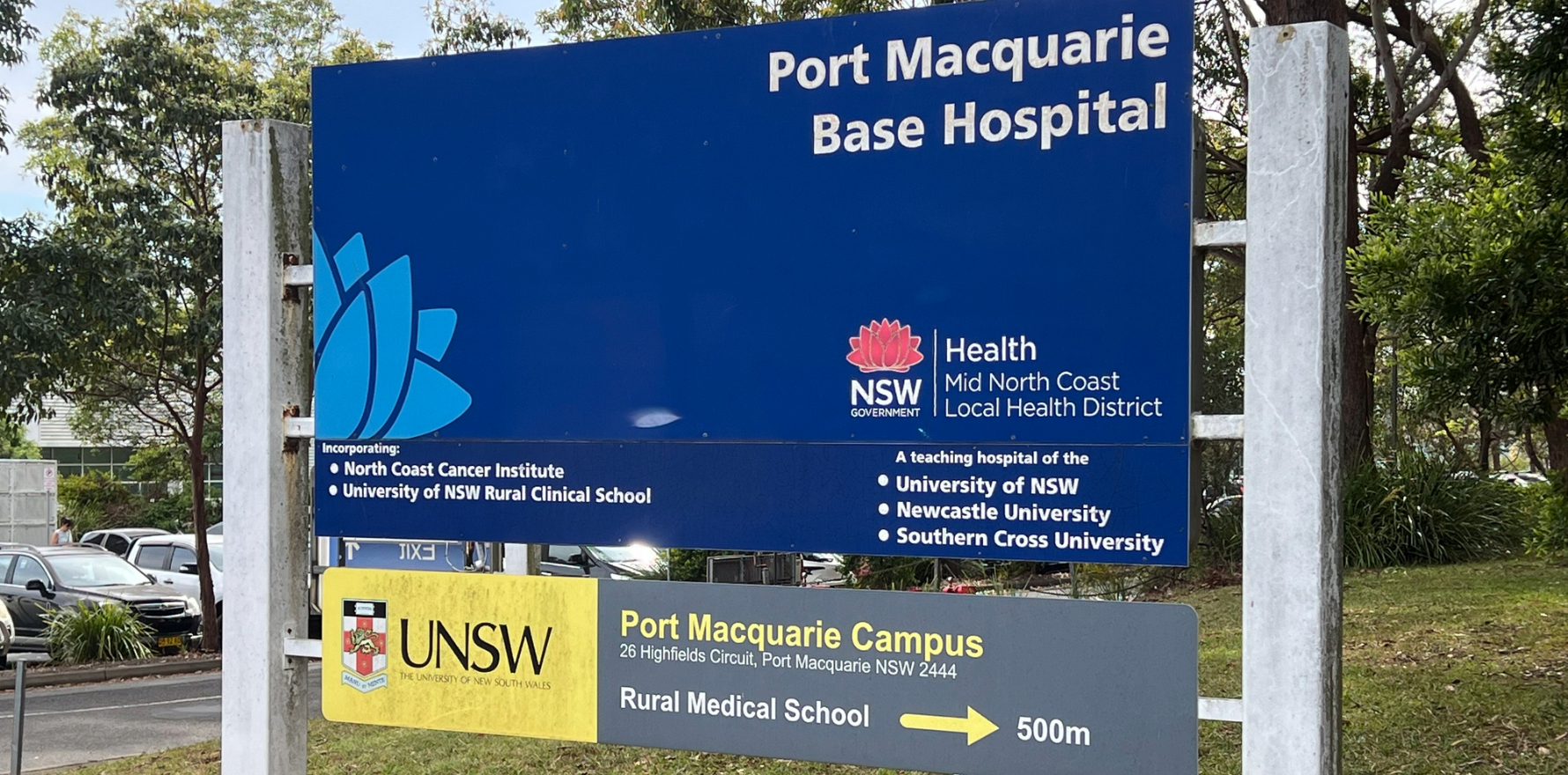
A regional specialist flagged unsafe on-call rosters for years. Then his contract was terminated.
When gastroenterologist Professor Stuart Kostalas moved to Port Macquarie with his GP wife Dr Kristy Kostalas, part of the motivation was to provide his specialist skills to their community.
“You don’t move to a regional town not to participate in giving back to the community, right? My wife and I are deeply entrenched in that,” he said.
As one of the leading experts in endoscopic cancer removal, he offered this and other gastroenterology services to both public and private patients in this growing regional centre.
That was until earlier this year.
As he and his wife have shared in Fairfax newspapers and through social media, despite repeated calls to the Mid North Coast Local Health District about unsafe on-call practices, instead of working with him to solve the problem, they terminated his contract.
A growing population and ‘no workforce plan’
When Professor Kostalas moved to the area in 2013, he said there were three public gastroenterologists in the region.
“We created an endoscopy roster to make sure that the community was serviced by one of the three of us, 24 hours a day, seven days a week. It wasn’t too bad, but you can imagine, 13 years later it’s become a lot busier,” he told The Medical Republic.
After about 10 years, they flagged with the LHD that it might be worth recruiting an additional gastroenterologist, particularly as it could be difficult to recruit specialists into the area.
“I managed to find a guy who was recommended to me, and he relocated after he’d returned from an overseas fellowship. That enabled us to offer him a job in the private hospital, and we asked the public for a job,” Professor Kostalas said.
While he didn’t expect the LHD to offer him a job straight away, after a few years the LHD continued to resist providing a contract.
“They wouldn’t put him on an ERCP roster at the base hospital in the public system, and it just became a very difficult negotiation with the public hospital, who basically kept saying no,” he said.
Eventually after eight years, the doctor left town.
The breaking point
As Dr Kostalas wrote in her Facebook post, Professor Kostalas has been working a one in two on-call offering ERCP and a 1 in 3 on call for general medicine/gastro.
“I want you to do the math on having someone work a simultaneous one in two AND one in three on call,” she wrote.
“And then I want you to run it over YEARS. And during that time I want you to raise three young children with a working GP wife.
“The level of relentless dedication to serving the public system saved hundreds, if not thousands, of lives.”
So in December, when LHD asked what Professor Kostalas’ commitment was for the on-call roster, he said he needed to scale back to one week in four.
“I said to them… ‘I cannot commit to doing one week in three anymore. That’s too onerous’,” he admitted.
“Then they sent me a letter that said, ‘under the terms of your contract, we’re moving in a different direction, and we no longer require your services as of April. The LHD has decided on a different service provision plan’,” he said.
Ending the accreditation pathway
Not only has the termination of Professor Kostalas reduced the number of specialists providing public services, but it has also meant Port Macquarie Base Hospital has lost its accreditation status as a training provider of gastroenterology.
He said that in 2025, the Royal Australasian College of Physicians surveyed the department and told them the number of gastroenterologists was borderline. They had 0.6 FTE, but it would be preferred if they had at least one full-time equivalent working from the public hospital to provide adequate training.
“But they said, ‘your trainees give you great feedback. You’re very engaged. You’re looking out for them. They appreciate their time with you, they learn a lot’,” Professor Kostalas said.
They said in their report to the LHD that they’d encourage more FTE to keep the training program.
“But if you lose any full-time equivalents, then the position is just not a sustainable training site,” he said they warned, which is exactly what happened.
“It means everyone misses out. The community misses out in a regional area because specialist trainees who trained here come back here (hopefully) if they get a job.
“And also, the community misses out because you don’t have accredited trainees. That means that they’re not on the pathway, they’re not vested in gastroenterology, they’re not vetted to the same standard. That creates a dearth and a decrease in the quality-of-service delivery in a regional area, so every everyone loses.”
Community outrage
Professor and Dr Kostalas’ story has caused a stir. Dr Kostalas received hundreds of comments from regional community members and fellow clinicians on her, horrified by what they’ve read.
“It frames public system doctors, as the ones to blame: The ones failing to carry out their responsibilities effectively. The ones seen as ‘quitters’ for giving up on a deeply broken system.
“The aftermath? The government; letting the public system crumble,” one person wrote.
“When we took our Hippocratic oath, it wasn’t an oath to the establishment. It was to the patients under our care. Time and time again we see colleagues fall under the sword of the establishment when they advocate for better outcomes. It is time. Time for doctors to speak out,” one doctor wrote.
Dr Kostalas called for local residents to contact their state MP Rob Dwyer, who also commented on the post saying he would reach out to MSW health minister Ryan Park.
“Our residents deserve access to quality healthcare, and I’m absolutely going to advocate as hard as I can for more local specialists in this field,” Mr Dwyer told TMR.
He said they were fortunate that there were some fantastic specialists in the Port Macquarie area.
“The local health district does its best with the budget that it has, but that budget needs to be stretched to make sure we keep the healthcare up for regional people.
“The concern that I have is that you know we hold 25% of the population in regions, and less than 9% of specialists are in regional areas in New South Wales,” he said.
Related


The Gastroenterological Society of Australia (GESA) agreed. The peak body highlighted that federal workforce data showed that more than 91% of Australia’s gastroenterology workforce was located in major cities, while just 0.7 per cent worked across rural and remote Australia.
GESA chief executive officer Claire Sime said equitable access to specialist care should be a fundamental principle of Australia’s health system.
“Where you live should not determine the healthcare you can access. Australians in regional and remote communities should have timely access to high-quality digestive and liver care without routinely travelling hundreds of kilometres away from their families and communities,” she said.
“That means we must not only attract specialists to regional Australia; we must support and retain the experienced clinicians who have committed their careers to these communities and built the services patients rely on.”
Not an isolated case
Specialist board member of the New South Wales Rural Doctors Association, Dr Sue Velovski, said it was just another blow for rural and regional specialists.
“There’s always two sides to the story, and but part of what we see a lot as a board member of New South Wales Rural Doctors is administrators attempting to meet metro-centric KPIs that cannot ever be achieved in rural and regional centres,” she said.
“If you have one major rural hospital and one maybe public private hospital, and the public hospital is trying to meet category one patients, which is to be done within 30 days, but you have no other hospitals to send extra patients to.”
Furthermore, she said reducing the number of doctors went against the NSW Regional Health Strategy Plan 2022 – 2032.
“There was an inquiry into rural and regional health outcomes, and one of the main things that came out of that is patients to be treated closer to home for the right reason, in the right hospitals,” Dr Velovski said.
“We have the capacity, but it’s been done really much on passion and goodwill of more senior colleagues, some of whom don’t get paid to do this work, but they do it because it’s the neighbour next door who will end up with the infection, or mortality or death.”
Unfortunately, Professor Kostalas and Dr Velovski said this isn’t an isolated case.
“I’ve been contacted by a lot of people after my op-ed, and it seems to be across the board,” Professor Kostalas said.
“Not only that, but I sit on an endoscopy Australian leaders forum. It’s happening not just in our state, but in other states as well. We know health budgets are stretched, we appreciate that. But that means that the services that are getting provided to the community are being restricted.”
“We’ve seen the same for rural maternity services being shut down, where either GP obstetricians or obstetricians wanted to work, but for various reasons they have been shut down by local health districts,” Dr Velovski said.
“Unfortunately it’s sending a negative message to those that are interested in rural and regional health.”
MNCLHD responds
In a statement, a Mid North Coast Local Health District spokesperson said gastroenterology services are delivered by qualified medical specialists supported by a multidisciplinary team of healthcare professionals.
“MNCLHD engages Visiting Medical Officers (VMOs) gastroenterologists to provide inpatient consultations,” they said.
“An emergency endoscopy service for patients requiring urgent intervention operates 24 hours a day, seven days a week. It is serviced by VMOs and credentialled general surgeons to ensure specialist care is available when required.
“Patients requiring admission during business hours may be admitted under the care of a Gastroenterology VMO, where appropriate. Outside business hours, patients requiring admission are admitted under the care of the on-call General Physician. Where specialist gastroenterology input is required, the treating team will refer the patient to the Gastroenterology service for review and, where appropriate, transfer of care to a Gastroenterology VMO.”
They said the district’s accreditation status did not impact the delivery of our gastroenterology service or the workforce.
“The District continues to support advanced medical training opportunities to strengthen specialist clinicians, particularly in regional and rural settings where workforce sustainability remains a priority and will work with the Royal Australasian College of Physicians on accreditation matters,” they said.
The Royal Australasian College of Physicians said that due to it being a matter of accreditation, the college wouldn’t provide any comment.
The sector’s ask
GESA is calling on governments, health services and specialist training bodies to:
- Protect and expand regional gastroenterology and hepatology training positions
- Support and retain experienced specialists who have established services in regional communities
- Create regional training and career pathways that enable specialists to build long-term careers outside capital cities
- Strengthen hub-and-spoke, outreach and telehealth models that support, rather than replace, local specialist expertise
- Invest in long-term workforce planning that recognises the time and expertise required to build sustainable regional services.
Ms Sime said Australia needed to treat specialist retention as a core part of regional workforce policy.
“Building regional specialist services takes years. Our priority must be to strengthen those services and ensure patients can continue to rely on them,” she said.
