

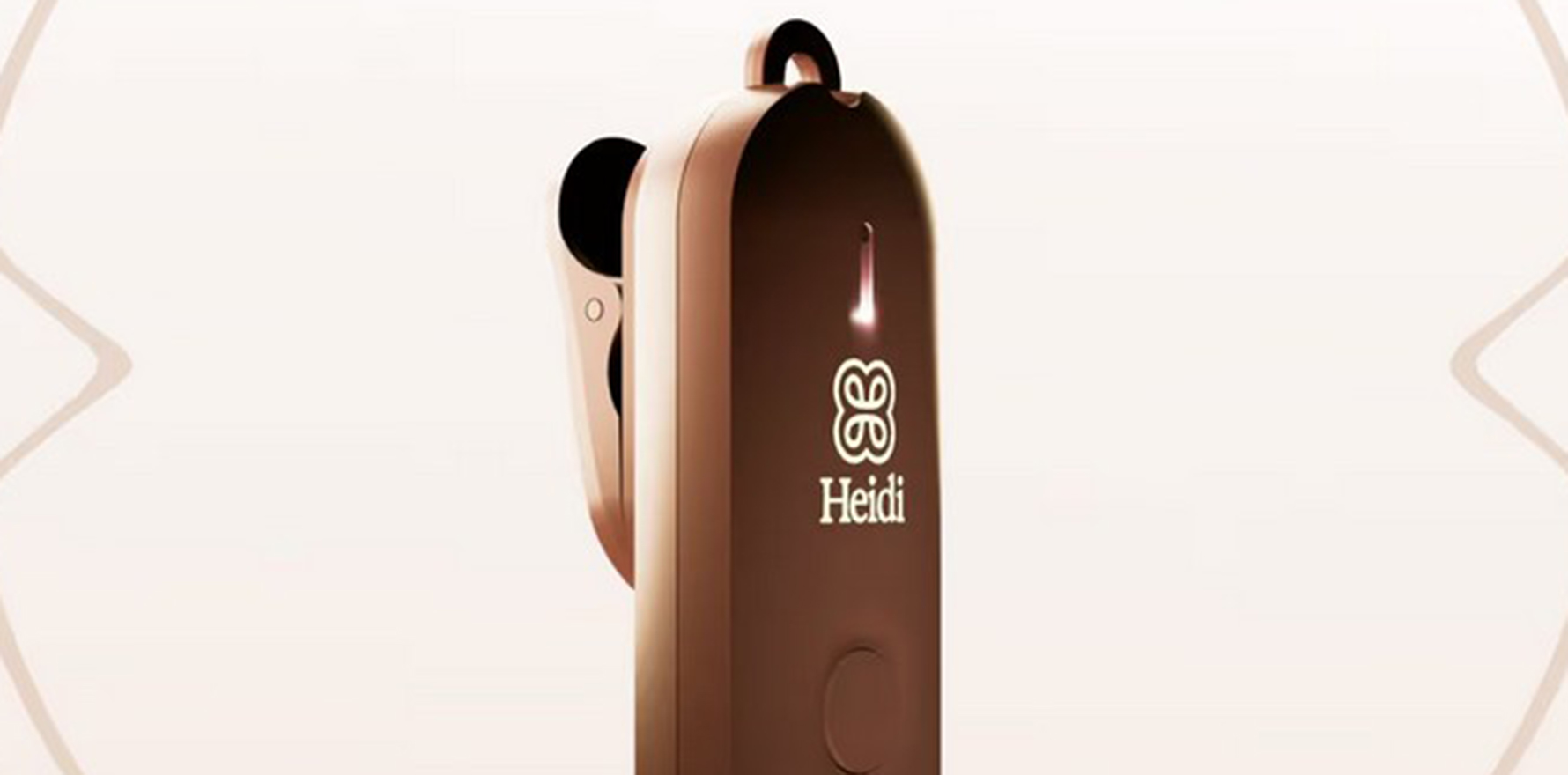
Heidi is going left field again, this time into a dedicated standalone lapel mic transcription device.
The device is tiny, but the ambition isn’t.
In a left-field major strategic play, Australian health AI company Heidi has launched its first piece of dedicated clinical hardware – stepping beyond software and, in doing so, into territory dominated by some of the world’s biggest technology companies.
At face value, the device – called Heidi Remote – is simple: a lightweight, clip-on recorder designed to capture clinical conversations. No screen. One button. Minimal setup.
But beneath that simplicity sits a direct challenge to an assumption that has quietly shaped digital health for over a decade: that consumer devices – phones, laptops, tablets – are “good enough” for clinical work.
Heidi founder Dr Thomas Kelly says they’re not.
This article originally ran on TMR’s sister site, Health Services Daily. TMR readers can sign up for a discounted subscription.
For years, clinicians using AI scribes have relied on whatever hardware they had on hand. A phone perched on a desk. A laptop microphone picking up both voices and keyboard noise. A device that locks mid-consult or drops out when a call comes through.
“The devices are just unreliable,” Dr Kelly said during last week’s product announcement. “They blame us – but it’s the device.”
It’s a blunt assessment, and one that cuts directly into the domain of Apple, Samsung and other consumer tech giants whose products underpin much of modern clinical workflow.
Because if Heidi is right, the problem with AI documentation hasn’t just been software performance. It’s been the hardware layer those tools are forced to sit on.
And that’s not something a software company can fix unless it builds its own device.
This one has a 360-degree microphone, on-device audio processing and encryption, and – critically – the ability to function entirely offline.
That last feature may be the most consequential according to Dr Kelly.
“This is a bigger deal than it seems,” he said.
In practice, it means clinicians can record consultations without relying on wifi, mobile reception or even a paired phone. Audio is stored securely on the device and synced later, when connectivity returns.
For healthcare settings – where network dropouts, patchy reception and constant movement are routine – that removes a persistent point of failure.
“No network dropouts, dead zones – it doesn’t really matter. Nothing’s going to interrupt your session.”
At 22 grams, it clips on to clothing and is designed to be worn all day. Battery life stretches to 14 hours or four clinical work days, according to Dr Kelly.
It can handle back-to-back consultations without needing to sync or reset. Clinicians can move from room to room without reconfiguring anything.
Press a button to start. Press again to stop. No login screens. No app dependency. No juggling devices mid-consult. But plenty of personalised security. If you lose it, it is encrypted to your Heidi app.
Dr Kelly’s ambition here is to “remove the need to think about the technology at all”.
Heidi has spent the past several years building AI that can transcribe, structure and summarise clinical conversations.
But the company’s broader ambition is much larger according to founder Dr Kelly who keynoted the launch at a Heidi medicine party in Melbourne.
It’s to create what he is calling an “AI care partner”, a system that handles not just documentation, but follow-ups, coordination, research and administrative tasks.
“Every clinician will have an AI care partner that handles all the work around the work,” the founder said.
The promise is to increase healthcare capacity without increasing workload says Dr Kelly: to allow clinicians to see more patients without working longer hours or cutting corners.
“We actually change the maths,” he said.
But by building its own hardware, Heidi is effectively stepping into a layer of the stack long controlled by Big Tech.
Apple, in particular, has spent years positioning the iPhone as a central tool in healthcare workflows – supporting apps, peripherals and integrations that extend its functionality. Samsung and others have followed similar paths.
But those devices are generalists.
They are designed for communication, entertainment, productivity and only secondarily for clinical use.
They receive calls mid-consult. They run out of battery. They prioritise notifications over uninterrupted recording. And crucially, they limit how much control third-party developers have over core hardware functions.
“All the hardware makers… don’t give us enough control,” Dr Kelly said. That has consequences for our customers.
A single interruption can kill an hour-long recording session. A locked phone can silently stop capturing audio. A poor microphone can degrade transcription quality at critical moments.
From Heidi’s perspective, these are systemic constraints.
Related



Constraints imposed by platforms it doesn’t control
So is the hardware move actually a massive strategic shift or diversion?
Not really. It’s all about utility and “delight”. If Apple can’t do it, Dr Kelly is saying Heidi will.
He can optimise for clinical environments rather than consumer ones. He can prioritise continuity over notifications, battery over background apps, and privacy over platform defaults.
Dr Kelly is ambitious and energetic. He’s buzzing with where to next.
The company is exploring whether transcription, note generation and even clinical evidence could eventually be processed entirely on-device—without relying on cloud infrastructure in any way.
“Packing the world’s medical knowledge into a single device that only needs power,” Dr Kelly says.
If he gets there it will mean the device is usable in low-connectivity environments such as rural and remote regions, and he will go some way to addressing growing concerns around data sovereignty and privacy.
Heidi Remote is priced at $290. It is designed to work alongside the company’s existing software subscriptions.
But its significance lies less in what it does today than in what it represents in terms of Heidi’s ambitions – a software company deciding that software alone isn’t enough despite the enormous challenge that may end up representing to the rapidly growing group.
It says Heidi isn’t a software company. It’s an idea. It’s an idea to solve interoperability and workforce capacity issues in healthcare.
I’m all in, notwithstanding the group needs to seriously fix how it does PR.
