

MedLuma is an Australian-centric clinical AI decision support and education platform that signals a significant shift in how doctors learn, document and prove competence.
At first glance, MedLuma sits in a fast-emerging category: AI-powered clinical evidence tools, alongside international players like OpenEvidence and Australia’s Heidi Evidence.
But MedLuma is positioned in a subtle but very different way to these global plays:
- It sits on Australian evidence, and lots of it: longitudinal Australian-designed clinical content and local clinical governance and guidelines designed specifically for Australian doctors.
- It doesn’t just provide a knowledge layer for doctors using it. It provides CPD directly embedded into the day-to-day workflow of a doctor and will be accessible via the country’s dominant practice management software, Best Practice.
The combination – focused and localised evidence, content and governance, automated CPD and PMS integration — should have far-reaching implications.
Australian answer to OpenEvidence, direct challenge to Heidi Evidence
One way to think of MedLuma is as an Australian “medical-grade clinical knowledge counterpart to OpenEvidence or Heidi Evidence” – which can do a good chunk of a clinician’s 50 hours of CPD each year on the fly as they work.
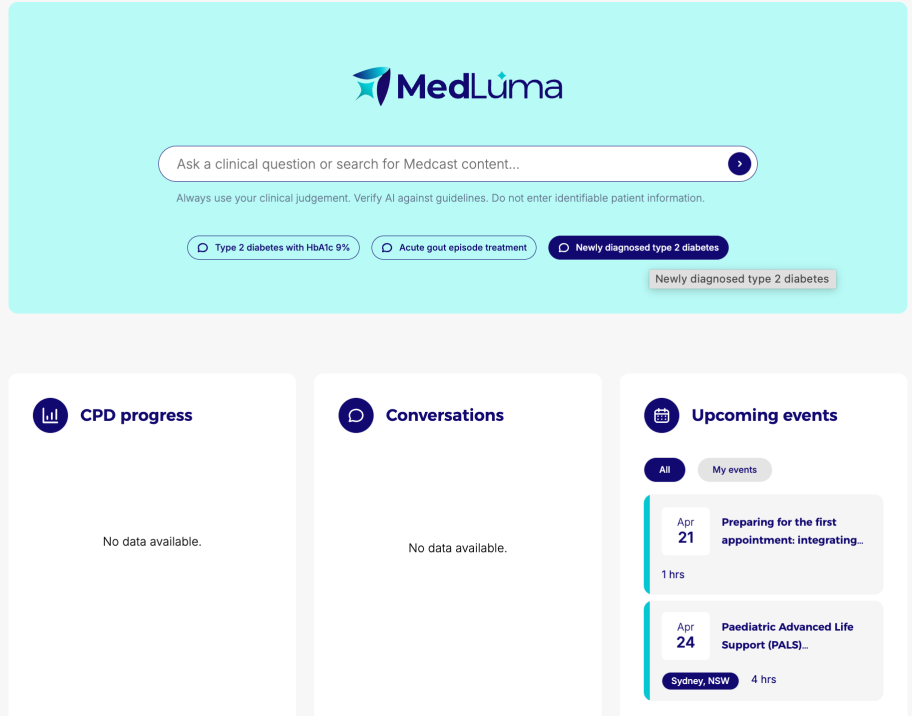
It is a tool that will be integrated to the PMS – that allows clinicians to ask questions in natural language and receive synthesised, referenced clinical guidance. And as doctors do all this it can align their real-life workflow to the three categories of Australian CPD, and prove to the CPD masters that doctors are learning from real-life work.
OpenEvidence is an Open AI-powered, US-centric, evidence-based medical search engine and decision-support tool designed for doctors, that analyses peer-reviewed literature, clinical guidelines, and databases to provide rapid and practical “doctor-grade” decision support in real time.
Heidi Evidence is a similar product, launched just over one month ago to extend the AI utility of its highly successful scribe, which tries to do the same thing as OpenEvidence via some partnerships and collaborations with high-value clinical evidence and guideline providers, such as the British Medical Journal.
Heidi’s acquisition of Automedica in the UK directly fuels its decision support layer because it came with existing relationships to UK regulators and medical datasets such as NICE guidelines and MIMS. It also can do CPD on the fly for doctors who are working with the Heidi Evidence layer, but so far only in the UK.
While the Automedica aspect of Heidi and Heidi Evidence give it a decision-support layer and an ability to build out CPD in Australia, MedLuma is purpose-built by a longstanding and respected Australian CPD provider – Medcast – with Australian evidence, content and guidelines and incorporating Australian CPD protocols and rules.
Heidi has spread far and wide. The NHS is a much more important market to them, as will be the US. It’s uncertain how much time Heidi will be able to give to customising its decision-support product enough to Australia to compete.
Which means a big question for doctors deciding on what to use now in Australia will be: can Heidi spare the time and focus to compete with the purpose-built Australian knowledge engine and automated CPD layer that Medcast is launching in MedLuma?
MedLuma has a deliberately narrower and potentially more powerful focus as far as Australian doctors are concerned.
“We’re not trying to solve a knowledge problem,” says Medcast founder Dr Stephen Barnett.
“Healthcare already has enormous amounts of knowledge. The problem is knowledge friction — getting the right knowledge to the right person at the right time.”
That framing underpins the product as far as Dr Barnett is concerned.
It’s not just search, or summarisation. It’s contextual, governed decision support inside (or outside) the consult, that captures and classifies CPD while a doctor works.
A key strategic move: integration with Best Practice
That MedLuma is being integrated into Best Practice, the patient management system used by an estimated 80% of Australian GPs, matters a lot.
It means that, for tens of thousands of doctors, AI-driven evidence support will not be a completely separate application — it can be accessed from the clinical workflow, alongside the patient record.
Barnett says this will be critical to broad adoption:
“If you want to change behaviour, you have to be at the point of care. You can’t expect clinicians to leave the workflow, search independently across multiple sites, and then come back.”
This is where the competitive dynamic is getting tricky for doctors.
So far Heidi has a strong front end (scribe, summaries), a growing international evidence and decision support layer and the ability to automate that at some point for Australian CPD.
MedLuma is so far a strong evidence tool, with its unique advantage being its deliberate build around Australian data, evidence and guidelines, and around the Australian CPD delivery structure.
Heidi has one big advantage still – its process is continuous from the scribing to the patient summary to decision support (and perhaps CPD, but not yet) and soon some other downstream stuff like referrals and CDMs.
Heidi also has an integration to Best Practice, albeit it’s supposed to be more clunky than its integration with Lyrebird, which Best Practice has an interest in and develops product with.
MedLuma is not a scribe, so at this point of time it doesn’t have the continuity in a consult that Heidi does from scribe to summary to decision support.
Related



But it seems almost inevitable, based on its partnership with Best Practice, that MedLuma will be joined to the preferred Best Practice scribe Lyrebird.
It’s a pretty obvious way to go for Best Practice, Lyrebird and Medcast – integrated in one flow.
Dr Barnett says that the sequence and combination is interesting, however one important aspect is understanding how the TGA views these integrations. Specifically, are they seen as a “medical device” because, at least in the case of Heidi, its decision support can act autonomously if a clinician is lazy.
(Heidi says it can’t and it won’t because it always needs clinician oversight.)
Regulatory frameworks globally are evolving alongside these tools, however it does not feel like the TGA will be able to stop the momentum here of Heidi and its evidence layer: too many doctors love it. And there is way too much productivity at stake to bog down what is going on in technicalities.
Doctors must always be in the loop but they are going to use these new knowledge tools the same way that patients are going to use them through ChatGPT and Claude.
Which should mean that MedLuma could soon be a part of a Best Practice-Lyrebird-Medcast specialised Australian triumvirate – a fully integrated Australianised AI stack for GPs – possibly one of the first early challenges for the Heidi freight train, at least in Australia.
The ‘knowledge layer’ strategy
Dr Barnett is already planning for MedLuma to spread its wings beyond just decision support and automated workflow CPD.
“What we’re really building is a shared knowledge layer — where information is curated, composed and governed properly — and then that can power different applications, enabling consistent knowledge across multiple tools.”
It currently includes clinical guidelines, organisational protocol, education content and automation, referral pathways and policy frameworks, but the longer-term ambition is clear to Dr Barnett: MedLuma could sit underneath multiple platforms, not just Medcast’s own interface.
MedLuma’s Australian edge is not data but ‘trust’
The most important differentiator MedLuma is claiming is not so much data but trust via partnering with trusted local content and data providers and regulators.
Unlike global tools that scrape broad datasets, MedLuma is built on explicitly sourced, permissioned Australian content, including:
- RACGP guidelines;
- the Red Book;
- the Australian Immunisation Handbook;
- Medcast’s 10+ years of CPD content;
- NGO and government programs;
- disease foundation materials;
- clinical pathways and protocols.
Dr Barnett says that provenance and permission is central to MedLuma.
“MedLuma is built on more than a decade of clinician education and national programs. That experience has informed our approach and we have deliberately engaged with publishers. We’ve done the work to curate and compose that information. That’s very different to just scraping the internet and worrying about it later.”
Dr Barnett says trust is also going to play out in the concept of data sovereignty.
“Where do the usage data and signals go?” he says.
“If everything is heading offshore, that’s a real issue. Over time, our view is that you’re going to see more localisation of AI.”
It’s a bit back to the future: “content (data) is king”.
A big disruption: CPD in the workflow
If you step back, the most novel feature of MedLuma at launch is not access to clinical knowledge and decision support – others already have that.
It’s CPD.
For Australian doctors, the Medical Board requires 50 hours of CPD annually, typically delivered through structured, external activities.
MedLuma is attempting to flip that model.
The system:
- uses clinician-initiated queries;
- identifies learning moments;
- classifies them into CPD categories which a GP can choose on the fly;
- generates documentation;
- and can upload directly to participating accrediting bodies.
Barnett says this is a potentially seismic productivity shift for doctors.
“This approach aligns with how clinicians already learn in practice – through real patient interactions, reflection, and application – rather than separate, classroom-style activities.
“Why would you step out of your day to do CPD, when you can learn while working, apply that learning immediately, and have it captured automatically?”
Instead of episodic learning, CPD becomes continuous, embedded and practice-based on what a doctor really is doing.
Depending on a doctors’ practice type and demographic, such a mechanism for CPD won’t capture everything a doctor needs to catch up on each year so their traditional CPD learning likely won’t disappear overnight.
But it might capture a meaningful amount of those 50 hours. Or, even better, reflect the total amount of all learning that a doctor does during a year.
It can do that because the knowledge is available for a doctor to learn while they are doing the actual work, not on an after-hours webinar, dinner meeting or live lecture.
If this pattern takes, CPD will start to change radically.
And those overseeing how CPD is done – the Medical Board of Australia, the various colleges – will have to rapidly and seriously rethink how they transition the current model, which was only introduced a few years ago.
What happens to the current 50-hour model?
MedLuma, and potentially Automedica inside Heidi raises a critical question: how much of a doctor’s CPD could now be completed during normal clinical work?
If a significant proportion of CPD can be generated automatically, tied to real patient encounters and documented in real time then the traditional model begins to look outdated.
Dr Barnett is blunt about the direction of travel:
“The old model of CPD — courses, modules, separate time — with the disruption in knowledge delivery, that’s not the only way people are going to learn anymore. The learning is going to start to happen in the workflow, with appropriate reinforcement outside the workflow.
In reality, that’s already how most clinical capability is developed – through day-to-day patient care, supervision, and reflection – rather than through isolated, classroom-style activities.
Will this disrupt incumbent CPD providers?
Potentially — yes. Traditional CPD providers, of which Medcast is still one, rely on structured programs and events.
But if platforms like MedLuma can:
- facilitate learning at the point of care;
- demonstrate behavioural change;
- and automate compliance.
Then the model will shift from “attend, learn and submit” to “learn while doing and submission is largely automatic in the background”.
Dr Barnett adds that there will always be a role for deeper learning and the the old and the new model should reinforce each other.
In this manner Medcast itself is already evolving rapidly according to Dr Barnett — from a CPD provider to a “knowledge infrastructure platform”.
From knowledge delivery to knowledge execution
MedLuma reflects a deeper change in healthcare AI. The focus is no longer just generating answers but embedding knowledge into action.
Dr Barnett frames it as reducing system-wide inefficiency:
“Every time there’s uncertainty, there’s cost, risk or delay. If you can reduce that uncertainty with the right knowledge at the right time, the upside is enormous.”
Applications already being explored by Dr Barnett for MedLuma include genomics support in primary care (where knowledge and workforce are sparce so far in Australia), reducing unnecessary referrals (possibly soon in combination with web based “advice and guidance” links to specialists), improving workforce efficiency and supporting non-clinical staff decision-making.
In respect of the latter point, all of this is likely making a lot of recent thinking around “scope of practice” in need of an urgent review as well.
The competitive endgame
The next phase of this market will likely be shaped by how four layers combine:
- Front-end AI (scribe/workflow/admin);
- Evidence/knowledge layer (guidance and ultimately, decision support);
- CPD, training and learning; and
- Core clinical systems (PMS/EMR).
The winners probably won’t be the best individual tools but who form the best partnerships and manage the smoothest deepest integrations.
If Best Practice, Lyrebird and MedLuma align effectively, they could create a tightly integrated, locally optimised ecosystem.
If not, fast-moving players like Heidi could still dominate through distribution and speed.
The competitive delineator
Underpinning all of this seismic change is: who will Australian doctors “trust”? What does “trust” look like in clinical AI for an Australian doctor?
MedLuma is betting on localisation of data and governance and, transparency.
Others, including Heidi, are so far betting more on scale and utility – Heidi just launched a really neat hardware scribe lapel that works offline and syncs to its software.
Dr Barnett is betting trust will ultimately decide the market:
“You need the power of AI — but you also need a version that’s governed and trusted. Otherwise clinicians won’t rely on it.”
