


Any issues are described as ‘standard’ for a go-live, but LHD frontline staff report long, stressful hours in the lead-up to the launch.
Workers inside the Single Digital Patient Record Implementation Authority reported that this morning’s go-live of the Epic EMR at the Hunter New England LHD went as well as could be expected, with any issues not impacting patients so far.
After being delayed twice and plagued by reports of overwork, burnout, poor planning and pressure from senior management, the SDPR go-live went ahead at 6am, the biggest implementation of the Epic software so far.
Justice Health NSW and the John Hunter Hospital Lab went live at the end of March, with the rest of the NSW Health Pathology Network joining HNELHD – which operates the region’s 24 hospitals, including John Hunter and Tamworth – this morning.
An anonymous source within the SDPRIA told The Medical Republic today that the main issues so far were around HNELHD staff not yet being trained and therefore not having access to the system, as well as administrative issues that were easily resolved by mitigation plans in place.
A frontline worker at HNELHD told TMR overnight that they had been working until 1.15am in preparation for the go-live and were back on deck at 7am.
“In short, the system hasn’t even come online yet and tonight was hell,” they said.
Related



Late yesterday, the CEO of Hunter New England LHD, Tracey McCosker, sent the following statement to TMR:
“This is a significant and complex transformation that will introduce a single integrated patient record across our District,” she said.
“Extensive readiness activities have been undertaken in partnership with the SDPRIA, including digital infrastructure upgrades, large-scale testing, and the migration of more than one million patient records.
“We acknowledge there will be challenges as our staff adapt to new systems and workflows, particularly in the early stages of go-live. Patient safety and continuity of care remain our priority.
“To support the transition, a 24/7 command centre will operate during go-live, bringing together clinical, operational, technical, and patient flow oversight, alongside close coordination with NSW Ambulance, SDPRIA and EPIC.
“Additional support staff and specialist teams will also be deployed across most facilities to support frontline staff during the transition.
“This is a District-wide go-live, not a staged rollout across selected sites.
“I want to recognise the enormous effort from staff across our District to prepare for this transition, along with the support provided by our partners across NSW Health, SDPRIA and EPIC.
“While we expect some challenges during implementation, we’re confident in the preparation undertaken and the support structures in place to respond quickly to issues as they arise.”
Attention now turns to Tranche B of the SDPR rollout, which is currently scheduled for November 2026 at Northern NSW LHD, Mid North Coast LHD, Northern Sydney LHD, Central Coast LHD and LIMS North.
TMR’s source within the SDPRIA told us the current November go-live was “highly unlikely” because preparations in those LHDs were “extremely behind”.
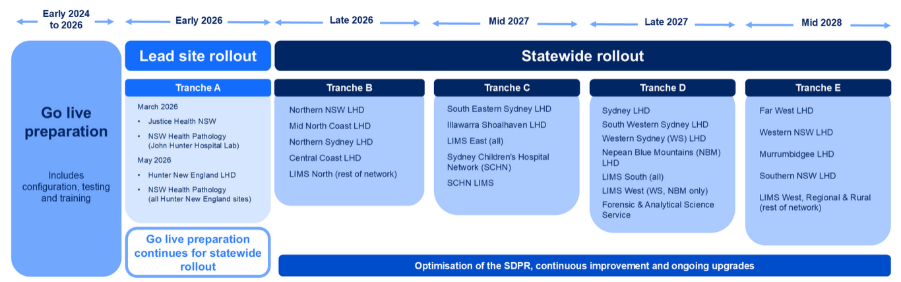
Source: SDPRIA website
A spokesperson for NSW Health told TMR that the delivery of the SDPR was a priority for the department, and its successful implementation relied on the support and collaboration of staff throughout the public health system.
“A staged rollout is being carefully managed by the SDPRIA, supported by rigorous testing and readiness assessments prioritising patient safety, staff wellbeing, and system reliability,” they said.
“Providing safe, high-quality care to the community remains our priority.
“While it is anticipated there will be some challenges, particularly in the early stages of implementation, due to the scale and complexity of the program, there are comprehensive plans in place to ensure patient care is not compromised.
“The SDPR will improve healthcare in NSW by bringing patient information together in one secure system, transforming how people experience and provide care.”
