


A Gold Coast GP with deep pockets, some interesting new ideas and a Cirque du Soleil gala dinner has entered Australia’s lucrative but crowded Australian independent CPD market.
Imagine you’re a GP and you’re running behind on your CPD.
Not catastrophically — you’ve been to a HealthEd day, caught a few Tuesday night webinars, maybe sat through a GPCE session — but you’re still a fair way short of your 50 hours and the triennium doesn’t wait.
You’ve got options, none of them quite right.
You could do the steady-state grind: HealthEd and GPCE can together get you close to 24 hours in a single live event, and if you stack in HealthEd’s free fortnightly webinars — 18 Tuesday nights, 18 more hours — you’re done.
Inexpensive, good quality, Tuesday-night-friendly.
Or — new option this year — you could pay $1,399 plus GST, commit to two full days at a landmark venue, add a gala dinner ticket for $169, and walk out the other side with 53 hours in your pocket – including pre- and post-event work.
One event, done, dusted, and the conference dinner has apparently been one of the more memorable nights in recent GP social history.
That’s the pitch for GP Refresh, a new kid on the independent GP medical education block.
The Market
To understand what GP Refresh is doing you need to understand the market it’s walking into — because from the outside it looks a tad impregnable.
Australia’s independent GP medical education space is effectively a triopoly that’s been running for decades.
HealthEd is probably the leader by numbers and revenue: built over roughly 26 years by Dr Ramesh Manocha, a GP with an almost obsessive feel for what practising doctors actually want to learn about, it mixes top industry-led in-depth sessions with a paid delegate and pharma sponsorship model – it runs a big exhibition hall.
It has had the odd detractor over the years trying to rock its boat based on it taking pharma money, but if you go to a HealthEd event or webinar, the sessions are usually a great selection of key opinion leaders talking about what’s relevant and hot.
At $120-$180 for a full live day— and free for the fortnightly two-hour webinars — it’s value, and it shows in the numbers.
Dr Manocha used to pull 1,200 to 1,400 GPs for a Sydney day; this year he got 2,500 at the ICCC.
The growth in large part is because the Medical Board of Australia decided to introduce a new 50 hour per year CPD model a few years back, which suits HealthEd formats to the ground.
But the base community who see the HealthEd value have always been there.
GPCE is slightly older, established again by a GP – Dr Lindsay Gazelle – and runs a similar live conference and exhibition model in Sydney, Melbourne, Brisbane, and Perth, but in 2004 it was acquired by global event behemoth Reed Exhibitions.
Reed has run it competently since, but some would say without the founder’s fire. Sensing this in a loss of content rigour, in 2015 they bought another GP-founded education group, ThinkGP.
The founder of ThinkGP, Dr John Crimmins, was the definition of a fiery and passionate character.
He had built a great online education business, and it certainly added to the quality of GPCE and upped the ante in the one-to-one competition GPCE had developed with HealthEd.
But like all founders eventually do, Dr Crimmins left the acquired entity and with it some passion left the building.
MedCast is the third independent, an online-only player that takes virtually no pharma sponsorship, runs on subscriptions, government contracts and not-for-profit partnerships and is now pushing into AI.
While Medcast takes a good slice of the CPD money on offer, it’s a different model entirely to HealthEd and GPCE.
Its recently launched MedLuma product looks like it could be the go-to decision support layer for all the AI scribes and GP patient management systems in the country. And if that happens, then the market might swing just a little out of the face-to-face and live online events to integrated CPD while you work.
Medcast was founded and is run by a GP as well, and it shows.
Dr Stephen Barnett (he has a finance whiz cofounder in Justin Lewis) has slowly but surely built online expertise and now diversified into a professional doctor-grade knowledge layer, which is going to be vital for GPs when their patients start walking in with ChatGPT and Claude questions.
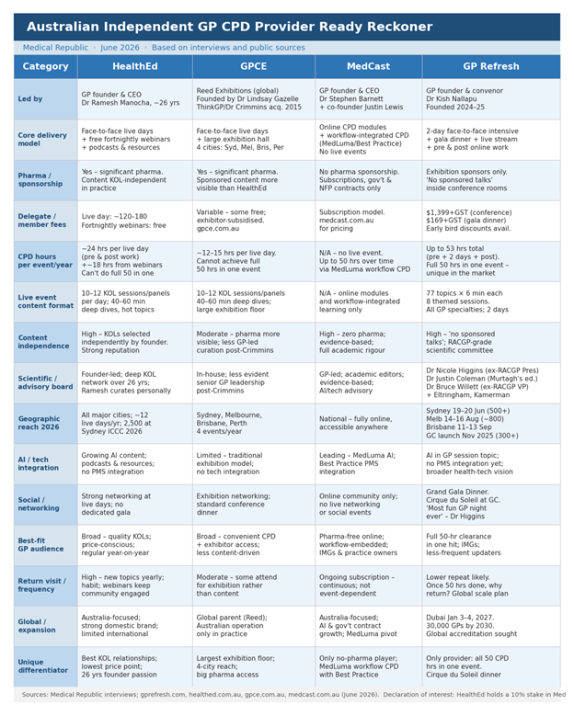
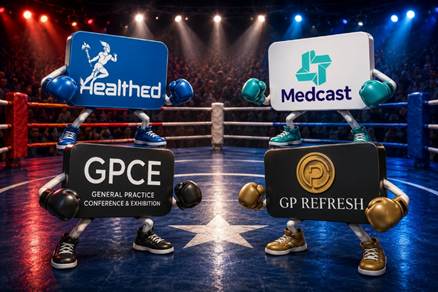
Together, these three incumbents aren’t easy to compete with.
They have community, habit, name recognition and long-standing GP loyalty. They cover off face-to-face, live online and in-practice live CPD.
And they have all been floated up on the boom that followed the Medical Board’s 2023 reconfiguration of CPD requirements — 50 hours per year, across a triennium, split across three activity types.
The market does not feel like it is wanting for options.
So you would not necessarily expect someone to walk into it with a completely different format, significant upfront investment commitment, and premium delegate pricing that makes HealthEd’s $120 day ticket look like rounding error.
Enter Dr Kish Nallapu.
The new kid on the CPD block
Dr Nallapu is not a typical Australian medical educator GP founder.
He grew up in Hyderabad, was running a family pharmacy at 12, moved to the UK, and for a decade was embedded in the NHS at a time when — as he puts it — for every £1 spent on patients, £1.88 was spent on administration.
He led a pilot commissioning project that he says brought that ratio down to 80 pence, saving the NHS roughly £980 million over five years.
Then he moved to India and spent five years building hospitals — four of them, from scratch, 600 beds across the network, tertiary cardiac centres, tertiary cancer centres — before deciding the work-life balance wasn’t what he wanted and relocating to Australia in 2016.
Since arriving on the Gold Coast he’s built two health precincts, which have cosmetic and aesthetic centres, cardiology centres, and surgical and specialist suites.
All up his group of companies runs approximately 29 entities. But he still sees patients.
GP Refresh is, by his own description, less than 1% of his business portfolio. He’s doing it, he says simply, for the love of the profession.
There’s more to it than that though. His bigger vision involves a concept he calls Medisquare: a network of 36,000-square-metre integrated health precincts, one for every half million Australians, combining bulk billed and private services in something that sounds like a Westfield crossed with a day hospital.
DA approvals are in place for the first one.
GP Refresh might be where you can see what Dr Nallapu does when he decides he wants to make a mark somewhere.
He says he is investing up to $24 million into GP Refresh.
He has to be making a sizeable loss – and likely will be for a while – but he seems entirely prepared to run with that in order to achieve a bigger vision.
The unique selling propositions
The format of GP Refresh is a classic differentiation play.
HealthEd and GPCE both run their live days on a model that GPs know well: deep-dive sessions from key opinion leaders, typically 40 to 60 minutes, on the hottest topics of the year.
You can get about 24 CPD points in just one day with pre- and post- work at HealthEd, and over two days at GPCE.
GP Refresh does something structurally different. Borrowed from a UK conference model, its two-day programme covers 77 distinct clinical topics — each allocated six minutes, or in some cases 12.
Eight themed sessions run across the weekend: respiratory and cardiovascular, endocrine/geriatric/GI, bones joints and pain, psychiatry/oncology/neurology, paediatrics and women’s health, men’s health and AI in general practice, emergencies and ENT, and dermatology and GP inbox.
The formula is one minute on basics, four minutes on the latest evidence and guidelines delivered as bullet points, one minute on what’s coming. Then move on.
It’s quite a different learning outcome which will suit certain GPs at particular points of time.
But the biggest attraction might end being that in the two days of GP Refresh, with pre- and post-work you can get every one of your 50 hours done. You can get up to 53 in fact.
The hard and fast 77 topics in two days concept apparently doesn’t induce the brain burnout you might expect.
Dr Nicole Higgins, a past RACGP president and a member of the scientific advisory committee, is careful and considered about it — wary in the way an experienced medical educator is wary of any new entrant — but she’s clear: the sessions are high quality.
And she danced at the gala dinner.
“It was the most fun GP night I’ve ever been to,” she said.
The scientific committee itself could be the other thing that makes people take GP Refresh seriously.
Dr Justin Coleman co-edits Murtagh’s General Practice — the bible — and has published around 1,500 medical articles.
Dr Bruce Willett is the former RACGP Vice-President and Queensland Faculty Chair who won the college’s Rose-Hunt Award. And there’s Dr Higgins.
These are not names you get to put on your conference advisory board by accident.
The market question
The Gold Coast launch event for GP Refresh in November 2025 at the Langham drew over 300 delegates. That’s impressive for a previously unknown newcomer charging that much per delegate.
Sounds like a reasonably solid proof of concept. Tick.
Sydney is running on 19–20 June at the ICC Sydney. Numbers there are expected to be over 500, which is pretty good if you consider the crowded Sydney calendar, where both HealthEd and GPCE have already been through earlier in the year.
Melbourne on 14–16 August is apparently going like hot cakes and selling out – it is heading to the 800 mark according to Dr Nallupu – and Brisbane on 11–13 September is tracking strongly, notwithstanding the inconvenience that GPCE Brisbane is somehow scheduled on the same weekend (oops).
The market question here is fascinating.
Does GP Refresh take a share, or does it grow the market?
There’s a genuine argument for both.
The 50-hour requirement has created a cohort of GPs — particularly those who are less engaged in ongoing education, or recently returned from extended leave, or simply overwhelmed by the breadth of what they need to update — for whom “get it all done in one go” is the most appealing option available.
There’s also a clear appeal to international medical graduates, for whom the breadth of the program — every specialty, in digestible bites, in two days — provides a kind of comprehensive orientation that topic-specific deep dives don’t offer.
But the 50-hour hook also creates a frequency problem too.
You can do all your CPD in one GP Refresh event. Will you do it again next year? Probably not.
Dr Nallapu says this is fine — his vision is global, not a repeat annual-event model for 42,000 Australian GPs.
“There is no way you can get that back through the Aussie market,” he says, with the pragmatism of someone who has already done the maths.
He’s registered a company in Dubai. He has a date — January 3–4, 2027 — already on the website.
He wants 30,000 GPs in Dubai by 2030.
Fun vs money
The inaugural Gold Coast event included a private Cirque du Soleil performance. A night of that calibre, privately booked, costs somewhere north of $150,000.
We can’t see what’s in store for the upcoming event Gala dinners but if Dr Nallapu goes big again, expect maybe Kylie Minogue to pop in.
Dr Higgins described the vibe at the Gold Coast as celebratory, warm, almost like a wedding.
“I hadn’t expected to enjoy a conference dinner quite that much,” she said (I think she also said Burning GP was a hoot too, but we didn’t get that on tape).
Whatever happens with GP Refresh in the Australian market, it is not doing what the incumbents do, which is a pretty good position to start from.
But whether it is the competitive differentiation or expensive indulgence that gets it over the line as a future calendar item for GPs might depend on whether you ask a delegate or an accountant.
Upcoming GP Refresh events
Sydney 19–20 June 2026 · ICC Sydney
Melbourne 14–16 August 2026
Brisbane 11–13 September 2026
Registration and programme: www.gprefresh.com
Declaration of interest: HealthEd holds a 10% stake in Medical Republic and the author once worked for Reed Elsevier which owns and runs Reed Exhibitions.
