


We must define our own healthcare AI future before global technology companies do, with a new national roadmap warning that overseas-controlled systems could become embedded in the foundations of care.
Australia risks becoming a “hostage to geopolitics” if it allows artificial intelligence systems that are controlled overseas to become embedded in the foundations of our healthcare system, according to the nation’s peak healthcare AI alliance.
The Australian Alliance for Artificial Intelligence in Healthcare has called for an ambitious, well-funded national healthcare AI strategy and sovereign capability that would give Australia control over the technology underpinning critical health services.
Launching the Alliance’s third National Policy Roadmap for AI in Healthcare, Professor Enrico Coiera warned that global technology companies were moving rapidly to position themselves between consumers and traditional health services.
If Australia failed to establish control over the AI models on which future services depended, decisions made overseas could disrupt access to those services, he said.
“If we do, as I expect and many expect, embed generative AI in the foundations of healthcare, then we become hostage to geopolitics if we don’t have control of those foundations,” Professor Coiera said.
He compared the risk with Australia’s lack of sovereign vaccine manufacturing capability at the beginning of the covid pandemic, which constrained the country’s ability to secure and deliver vaccines during the first year.
The roadmap said a handful of international “hyperscaling” companies dominated the AI market and had turned their attention to healthcare, seeking to become the “de-facto front door” through which consumers managed their health.
“For Australia’s healthcare system to remain sustainable and resilient, it will need to shift gears, and quickly, from catching up with overseas industry, to moving ahead and defining our own pathway,” it said.
“If there is to be wholesale change to healthcare, then it must be on our terms.”
Professor Coiera told The Medical Republic that sovereignty meant Australia retaining “control of our own technical destiny”.
“It spans having domestic capability to implement and localise AI – necessary to make AI work in the Australian health context and with the diverse population we represent,” he said.
“It also means having some capacity to manage our own health-specific large language models (LLMs).
“Whether we do this in partnership with large international companies, or develop our own, for example based on powerful emerging open-source models, remains to be explored.
“What we do not want is to find our health system’s foundations built on LLMs that are not in our control, because that leaves the system and its services hostage to geopolitical decisions beyond our shores.”
The Alliance is not necessarily proposing that Australia spend tens of billions of dollars developing a frontier large language model from scratch.
Professor Coiera said Australia could adapt emerging open-source models relatively quickly or enter agreements with international companies that ensured leading technology was available locally and remained under sovereign control.
The strategic imperative was to ensure Australia could continue operating health services if access to an overseas model was withdrawn.
He asked what would happen if large language models were built into My Aged Care, My Health Record, and other digital health entry points, only to be switched off because of an international dispute.
“Do we not provide the services, or do we have a backup? And how good is that backup?” he said.
Related


The roadmap argued that Australia could not assume products developed overseas would be suitable for its healthcare system, population or models of care.
“It is easy to assume that the AI healthcare products built overseas are fit for Australian healthcare. Nothing is further from the truth,” it said.
“We do not want to just export our clinical datasets and import back the models built with them. Australia needs to strategically build capability and expertise in AI that can be applied across sectors, including healthcare.”
Professor Coiera said the scale of the consumer healthcare market meant large technology businesses had powerful incentives to disrupt existing systems and establish direct relationships with patients.
ChatGPT alone estimated it answered 230 million health and wellness questions each week, he said, while companies including OpenAI, Anthropic, and Google were pursuing health-specific products.
These products could offer to connect with medical records and health applications, provide personalised information and steer consumers towards services.
Professor Coiera questioned attempts to draw a distinction between diagnosis or treatment and products that claimed merely to help consumers understand health information or provide advice.
“If it walks like a duck, it probably is a duck,” he said.
He said Silicon Valley’s mantra was to “move fast and break things”, but that was not an appropriate strategy for healthcare “because the things you break tend to be people”.
“Our first and most important recommendation is the need for a national AI in healthcare strategy,” Professor Coiera told TMR.
“The strategy development should be led by government but deeply engage with all the key agencies and stakeholder groups – healthcare is complex and government alone cannot address all of the issues relating to making AI safe and effective.”
He said ownership should ideally sit with the Department of Health, Disability and Ageing, working with the new Office of AI announced by the Prime Minister last week.
Healthcare faced issues that could not be adequately managed through a generic, whole-of-government AI framework, he said.
“Healthcare is complex with many moving parts, and has many sector-specific issues requiring attention,” Professor Coiera said.
“The development of whole-of-government regulations for safety and quality of AI is unlikely to address the many sector-specific issues healthcare faces.”
Digital Health Cooperative Research Centre CEO Annette Schmiede also backed the DoHDA taking the lead, closely coordinated with the Office of AI.
However, she said the success of the strategy would depend as much on genuine engagement with industry, researchers and small and medium-sized businesses as on which agency formally owned it.
“At DHCRC we work with over 60 participant organisations across government, academia, and industry precisely because healthcare innovation only works when those groups are pulling in the same direction from the start – that’s the model national ownership needs to replicate at scale,” she said.
Professor Schmiede said Australia’s central barriers were not the technology itself but data infrastructure, standards, the evidence base and community trust.
The country was moving from fragmented and poorly coordinated AI initiatives towards a period in which national leadership had become urgent.
“We’ve got global hyperscalers who are already eyeing healthcare as a consumer front door,” she said at the launch.
“We’ve seen the rapid uptake of ChatGPT and Claude. They’re all introducing health-specific products.
“What we’re going to see, if we’re not careful, is the community feeling very confused and unclear as to where they go to get their health advice.
“So if change is coming, it must be on our terms.”
The roadmap recommended developing trusted, AI-powered government entry points to help people navigate the health and aged care systems, rather than surrendering that role to commercial platforms.
AI-enabled conversational services could be built into existing national infrastructure, including My Aged Care and 1800 Medicare, giving consumers access to trusted and evidence-based guidance while reducing the complexity and administrative burden of dealing with multiple services.
The Alliance also wants Australia to build a viable domestic healthcare AI industry.
Professor Schmiede said sovereignty was, in practical terms, also a commercialisation problem.
Australia had strong health AI research, but its pathway from a validated tool to a scaled, locally owned product remained underdeveloped compared with the life sciences sector.
Australian businesses needed procurement settings that enabled them to compete for local contracts rather than losing their intellectual property and skilled workers overseas, she said.
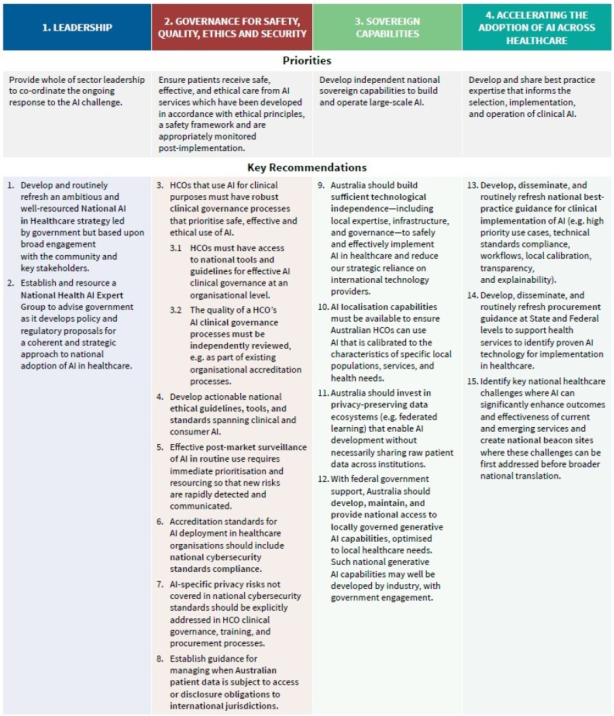
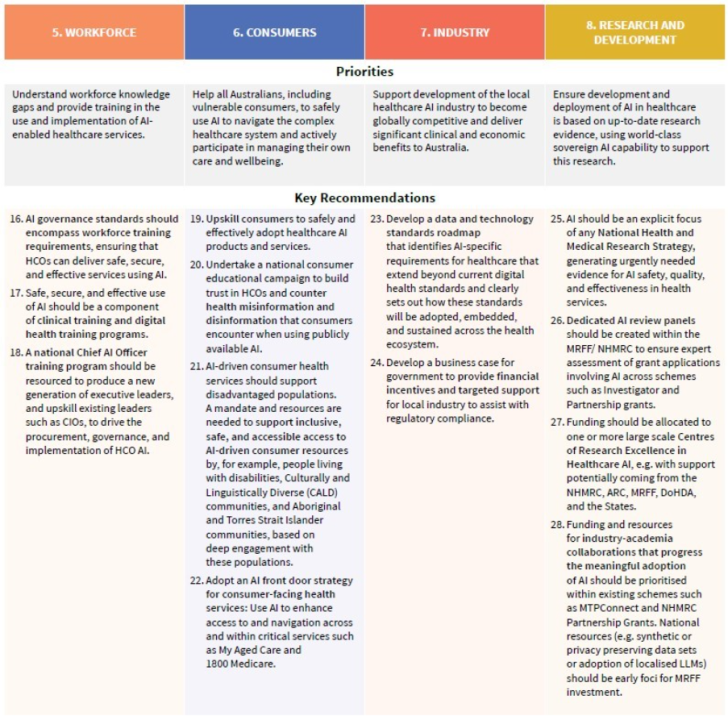
The roadmap contains 28 recommendations across eight priority areas and was developed over about a year, informed by around 90 detailed questionnaire responses and approximately 20 focus groups and interviews with agencies, governments and other stakeholders.
Professor Coiera said there would be no definitive finish line because AI would continue transforming healthcare for decades.
Success would instead mean Australia had effective safeguards, a skilled workforce, consumers benefiting from the technology, a vibrant domestic health AI industry and control over the systems on which healthcare depended.
“If we have robust guardrails and processes to keep patients safe and their information private, an engaged and expert workforce, consumers effectively accessing services using the technology, a vibrant health AI industry, and control of our own destiny, we will surely have much to be proud of – and perhaps the world’s best healthcare system,” he said.
“The time has come for Australia to define its own AI future in healthcare,” the roadmap concluded.
