


Find out how participating practices across the country – and your PHN – performed over the last 12 months.
New data from the AIHW shows that general practices have more diabetes, CVD, and cancer-related information on file, but that records around influenza immunisation status have decreased.
Yesterday the Australian Institute of Health and Welfare released the sixth national report relating to the Federal Government’s Practice Incentives Program Quality Improvement (PIPQI) Incentive, a scheme where general practices are paid to undertake activities that “support continuous data-driven quality improvement in patient outcomes and the delivery of best-practice care”.
The PIPQI Incentive revolves around practices submitting deidentified data on 10 key quality improvement measures selected to improve the government’s understanding of how chronic disease is managed across the country.
“[The measures] are not designed to be prevalence measures, assess individual general practices, or assess general practitioner performance,” the report reads. “[And] there are no prescribed targets associated with any of these improvement measures.”
The 10 measures cover topics such as whether diabetes patients have a HbA1c result recorded within the last 12 months, whether influenza immunisation status has been recorded in the last 15 months, and whether there was a record of female patients undergoing a cervical screening test within the last five years. Data for the 2025-26 period was reported and compared to performance from July 2023.
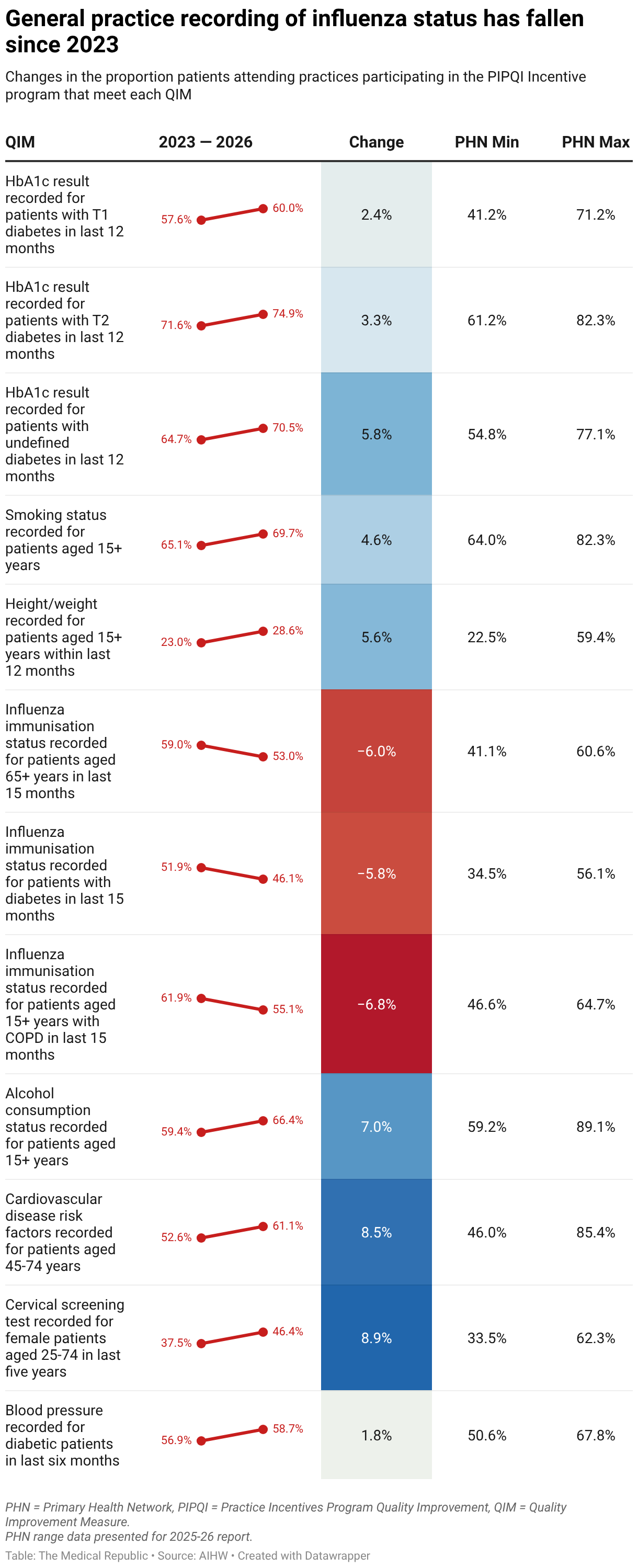
Data for the first measure – the proportion of diabetic patients with a HbA1c result in the last 12 months on record – was presented separately for people with type 1, type 2, and undefined diabetes. Increases in adherence to this measure were observed for all three subgroups, with the largest increase coming in patients with undefined diabetes.
“Clinical definitions for diabetes vary across [clinical information systems], as estimates that rely upon single or multiple markers to ascertain and define cases may differ across data sets,” the report said. “This may lead to some variation in the number of clients who will be picked up by different systems.”
Patients with gestational diabetes as well as type 1 or 2 diabetes were included in this measure, although patients with secondary diabetes, gestational diabetes mellitus, previous GDM, impaired fasting glucose, or impaired glucose tolerance were excluded.
There were also increases in the proportion of patients whose smoking status had been recorded in the last 12 months (for individuals aged 15-29 years) or at least once since turning 30 (for individuals aged ≥30 years) – 69.7%, up from 65.1% in July 2023 –the proportion of patients with an alcohol consumption status recorded (66.4%, up from 59.4%), and the proportion of patients aged 45-74 years with risk factors for cardiovascular disease assessment on file (61.9%, up from 52.6%).
“As of July 2026, nationally, 12.4% of regular clients aged 15 years and over whose smoking status was recorded in their GP record were classified as current smokers. This varied from 6.0% to 18.0% across PHNs,” the report read.
“21.6% of regular clients aged 15 years and over whose smoking status was recorded in their GP record were classified as ex-smokers, and 65.9% of regular clients aged 15 years and over whose smoking status was recorded in their GP record were classified as never having smoked.”
However, the three measures relating to the proportion of high-risk patients with their influenza immunisation status recorded in the previous 15 months has fallen over the past three years. There was a 6.0% decline in influenza immunisation status recording among patients aged ≥65 years, a 5.8% decrease among patients with diabetes, and a 6.8% decrease among COPD patients aged ≥15 years.
“The administration of the influenza vaccine to people at risk of complications is the single most important measure in preventing or attenuating influenza infection and preventing mortality,” the report read.
“While best practice guidelines recommend annual immunisation, a 15-month interval allows for cases when a client decides to receive a vaccine earlier than recommended (for example, from a pharmacy), or delay and wait for the release of an ‘enhanced’ vaccine.”
This decline could be due to influenza vaccinations being delivered by providers whose clinical information system may not be compatible with the clinical information system of their usual general practice, the report noted.
“The number of vaccine-preventable diseases that community pharmacists can administer has increased rapidly since the beginning of the covid pandemic,” it read. “[Furthermore,] in January 2024, the introduction of the National Immunisation Program Vaccinations in Pharmacy permitted participating community pharmacies to administer influenza NIP vaccines in line with state and territory legislation, and eligibility”.
Related



The proportion of patients with a current record of their height and weight, as well as a derived BMI result, was the worst performing metric – with only 28.6% of patients having this data in their record – despite a 5.6% increase since July 2023. Adherence to this measure was highest in patients aged ≥65 years for both men (36.2%) and women (37.1%) and lowest for patients in the 15-24 years age group (14.9% and 19.9%, respectively).
The performance of individual PHNs varied both within and between the quality improvement measures included in the report.
The report claimed that a similar number of practices submitted data for the 2025-26 report compared to the previous year (6244). The AIHW relies on electronic health records, clinical information systems, and extraction tools to collate the data used within the report. The largest proportion of participating practices used Best Practice as their CIS (75.9%) ahead of Medical Director (21.3%). The number of participating practices using Best Practice increased between July 2025 and July 2026 (4399 [72.1%] to 4740 [75.9%]).
Access the complete report here.
