

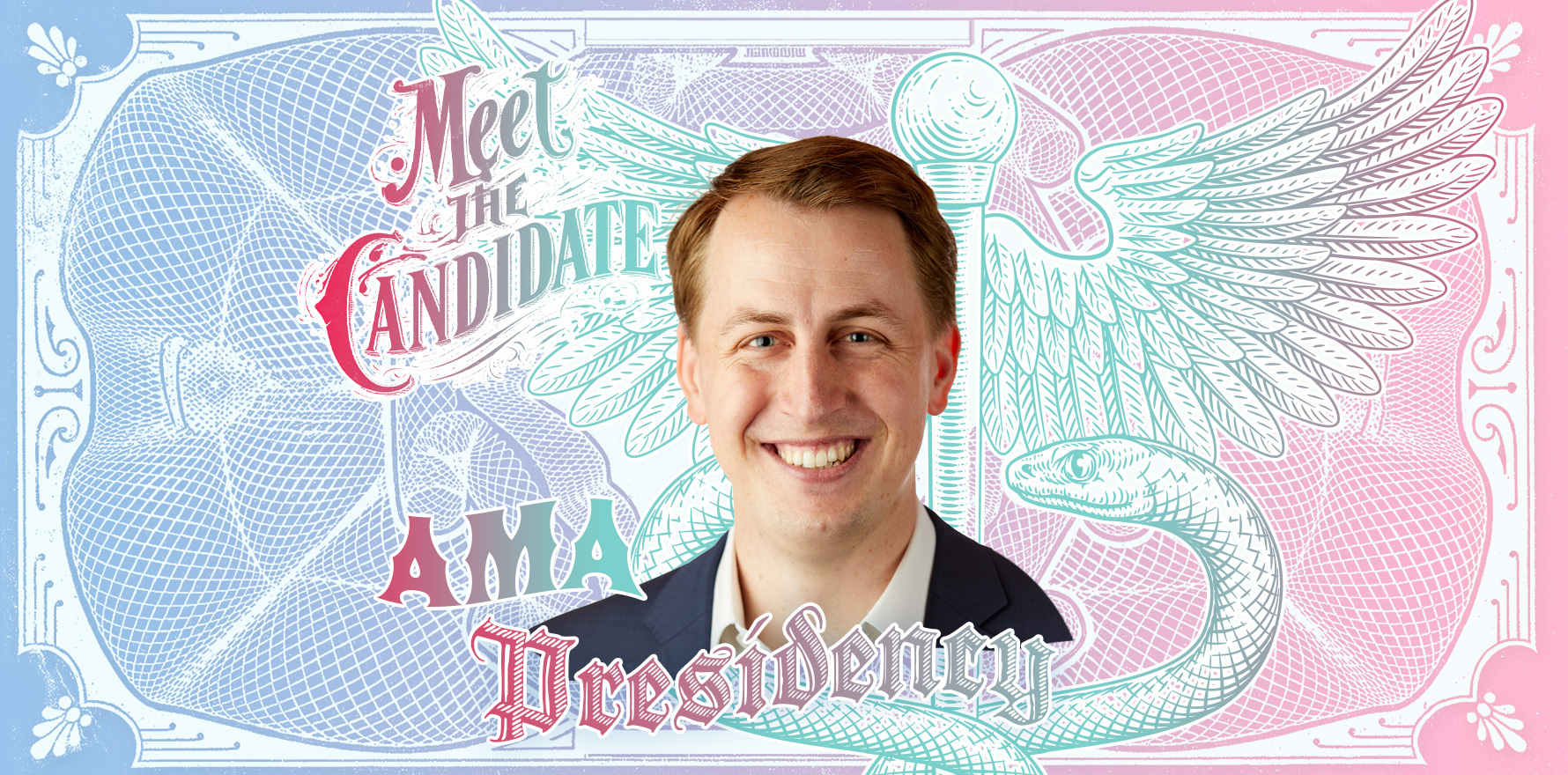
Dr Michael Bonning is one of the three doctors – all of whom happen to be GPs – running for AMA federal president this year.
As a former AMA NSW president (and, in his student years, AMSA president) Dr Michael Bonning is already a familiar face to doctors across the country.
Now, he’s in the running to be what is arguably the public face of the profession: AMA president.
Dr Bonning sat down with The Medical Republic for a chat about his leadership priorities and his vision for the association, which has dwindled in numbers over recent years.
TMR: I was taking a look at your LinkedIn before – I’ve always known you were very busy, but I didn’t realise how many different roles you’ve had. Going back to your medical school days, I see you were on the UQ Medical Students Association, then president of the Australian Medical Students Association, then a Churchill Fellow and then chair of the AMA Council of Doctors-in-Training. But you’ve also been in the Navy, worked as an expedition doctor, and served on the Ad Standards panel. Where have you found the time?
Dr Bonning: The Ad Standards, that was a fun one. That was definitely a fun one.
I got involved with Beyond Blue when I was a medical student, when I was the AMSA president. Through that, my Churchill Fellowship [project] was on doctors’ health.
That then led to Beyond Blue commissioning the national survey of doctors and medical student mental health.
But out of all of that, on the Beyond Blue board I became very good friends with Natasha Stott Despoja, the politician, and through that process she introduced me to AdSense, or the CEO of AdSense at the time.
They were like, “We need a doctor and we need someone to think about these problems”.
There’s lots of claims that are made in advertising that involve medical or para-medical things.
It was great. I spent about six or seven years there, and it was really interesting because it’s just such a different way of thinking about health as a whole.
Lots of the questions I would get asked were about the community’s – and I mean community very broadly – take on how people advertise about health claims.
Doctors are the ones that are regulated when it comes to making claims, and so are pharmaceutical companies, but there’s lots of people in between. That, obviously, is a massively growing space – through social media, testimonials, and things that would generally be described not as a medicine, but as probably more of a vitamin product.
These are much laxer areas of regulation, and so one of the key ways in which there’s some oversight of them is through advertising standards. It was a bit of a random thing that turned out to be quite useful for understanding all of the other stuff that goes on out there.
These things that, in you know strictly medical regulation, we never see because it doesn’t come before the medical board and it doesn’t go to the TGA.
There’s a lot of stuff that goes on well outside our view and purview that we don’t have any power to regulate. If you’re a registered medical professional, or a registered nurse, or a registered physiotherapist, you have your board – but that’s it.
If you’re just some person making claims and shipping pills in a box and it’s not a registered pharmaceutical, it’s a very big grey area.
TMR: Can you tell me some of your history with the AMA?
Dr Bonning: I’ll start way back in history. In 2006, as a medical student, I was appointed to AMA Queensland Council.
I was medical society president at UQ in 2007 and 2008, and then I was the Australian Medical Students Association (AMSA) president, which also meant that you were a member of federal AMA council and you were part of the organisation.
That was, you know, a great opportunity and very different because you brought along a whole team with you, so I did it with a whole bunch of people who still remain some of my best friends.
Student organisations are always fun, but AMSA is also a great advocacy organisation.
Then I became involved, as a doctor-in-training, in medical politics through the AMA Queensland and subsequently then at the federal level.
The AMSA president from the year before me, Dr Rob Mitchell, he and I went on and co-chaired the Council of Doctors in Training federally. He was, and still is, this phenomenal character.
I think lots of the journey that I’ve been on to this point has been because of the great people who have helped me.
Dr Alex Markwell, she’s a great emergency physician, she was a Queensland state AMA president. She’s been heavily involved in lots of things for her college about medical ethics, and she was one of the people who helped me along the way.
Around that time, I moved from Queensland to New South Wales.
I was in the Navy. I joined as a medical student through the graduate med scheme and then proceeded to have a career based out of Sydney, but then deploying, or spending time in Darwin, or doing a number of things overseas; things like the search for [Malaysia Airlines flight] 370 and the centenary of ANZAC.
I was also [working as part of] the counter-piracy, counter-terrorism role that we have with NATO, off the Arabian Peninsula.
I did quite a bit with the Americans over in Pearl Harbour and border protection stuff with the Indian Navy up north as well. It was all bilateral and multilateral stuff.
I got to deploy a lot, which was great. And during that time, I was what you would describe as an AMA state councillor, a branch councillor in New South Wales, but I generally had lesser involvement.
I stepped up towards the end of that time to be the AMA New South Wales chair of council, which is a role in setting agenda and working on policy, and then I went to the UK and then the United States.
I came back to Australia just before the pandemic, running a general practice in Sydney. Out of that, I took on the responsibility of running a covid 19 respiratory service for the commonwealth government and extended that quite significantly to run a standalone vaccine service during the pandemic as well.
One of our unique value propositions was that we actually developed great clinical insight into respiratory medicine.
We diagnosed psittacosis – which comes from budgerigars – and we diagnosed lung cancers, and we did a truckload of asthma.
I had a good relationship with a number of respiratory physicians, and we were often sending them interstitial lung disease.
No one with a cough, shortness of breath, anything else like that, could see a doctor because of covid. It was really difficult to see your GP face to face, and so we essentially coalesced all of that service into one site.
We wouldn’t hold ourselves out to be anything other than a bunch of GPs who took a special interest in that, but I think the group of doctors we had there, and the nurses especially, became very good at it.
There’s a lot of reasons that are not covid to be coughing or to be short of breath, and we were able to do that really well.
Through all of that, I was still around. I was involved with and chair of council at the AMA New South Wales, and then I became the AMA New South Wales president in 2022.
Subsequently, I’ve been the chair of the public health committee for the federal AMA and have returned to being a board member and chair of council for AMA New South Wales.
Related



TMR: Now that we’ve arrived at the present – one of the big issues that gets brought up in discussions about the AMA is the declining membership levels. What would you do as president to address these?
Dr Bonning: The presidency is an opportunity to invigorate doctors everywhere to care about what matters to them, but also to see that organisation is going into bat for them.
One of the challenges that I think has broadly affected the AMA has been that there are hundreds of voices now that speak for medical practice, and it is very easy for an individual to focus on a single issue.
If there’s an issue, there’s a small society or an association that’s focused on that issue.
My contention is always that medicine is such a complex space. Delivery of healthcare in Australia or anywhere else is such a complex space that you need large organisations that cover all of those bases.
But you also need to remember to do it in partnership with those organisations that are focused on just one thing.
And I suspect, in some ways, that is how the membership of the AMA has come to split away. We haven’t done as much with different smaller medical groups and associations. [We could try] partnership models to work with the society of ophthalmologists, or the Australian Indian Medical Association, or the association of rehab physicians.
There’s all kinds of groups there, and working with them makes sure that their members are aware of how much the AMA does, because I think there’s an issue of visibility.
One of the things I have been lucky enough to maintain pre-New South Wales state presidency, during that presidency, and subsequently has been the ability to both reach members through media, but also the public.
And one of the opportunities there is to, you know, continue to grow that public presence through traditional and social media, to say to doctors, hey, we back you, and we support your independence in clinical practice, and we’ll fight the battles for you.
Because I think a lot of what’s happened over time is that doctors have lost sight of the battles that the AMA does fight for them.
In many of those battles, you end up fighting for things not to happen.
So when people say, you know, what is the evidence of your activity? – well, it’s hundreds of things that didn’t happen. And how do you tell that story?
I think there are ways in which we can tell that story better.
TMR: Can you give an example?
Dr Bonning: The recent assignment of benefits debacle was something where there had been discussion with the profession in times past, and then all of a sudden, with eight weeks to go, there was an announcement of: these are the new rules.
And, rightly, the profession of medicine identified many situations where the implementation of assignment of benefit would leave people vulnerable and would undermine the delivery of care.
Now, that wasn’t us being obstructionists. We could, and should, ask a politician whether they would say to anyone else that they should just do a service for free because they can’t get the payment system to work.
The government hadn’t, at that time, been able to even say what enduring assignment of benefit looks like.
I think there will be a reckoning in this over the next 12 months.
We’ve still got a lot to work through with government, but it’s a good example of something that didn’t happen.
At least it was visible, because members of the AMA – whether that’s doctor representatives or staff members – were either on the phone or at the department or at the minister’s office, literally every day from when that proposal came out.
The claimed win in this was that the government said it will push the changes back by 12 months. But at the end of that you, have we done a good job of quantifying the effort that was put in to achieve this result?
There were 50, 70, 80, 100 interactions with the department, with the minister’s office, with various other members of parliament, with Services Australia, with everyone you could think of to get to a point of a solution, and a recognition that the system was not yet fit for purpose.
And that is essentially contained in one email that goes out to members or to doctors everywhere which just says, oh, it’s solved.
That one was visible, but there are so many of [these quiet wins]. There’s one today where the DVA put out the schedule of fees, and it, unfortunately, wasn’t indexed to the new rates.
A number of people recognised that and said, hey, this is this is wrong. And the DVA has come back and they’ve been apologetic. All claims submitted from 1 July will be paid at the updated rate, even if the claim amount was for the pre-July rate, and you’ll still get paid at indexed amounts, even though the publication was late.
It’s that kind of stuff that most people [don’t hear about].
TMR: The AMA has to be on the front foot when it comes to advocacy. What do you see as some of the opportunities or openings in the political landscape?
Dr Bonning: What, genuinely, are we seeing from a federal opposition or anyone else who is not governing at the moment?
I’ll put to one side the Teals and Senator Pocock, because I think they are actually doing a lot.
But everyone else…
The coalition is doing its own thing, and when we have a good government and opposition process – and that can be true for whichever [side is in power] – what we get is a clash of ideas about what’s good for our health system.
What we have at the moment, I think, is an opposition in relative disarray; a government who wants doctors to be pliant and just follow the rules, follow the bouncing ball.
And you have a group like the AMA, which is one of the few that is big enough and recognised enough that we can hold the system – not just government, but the system – to account, and take on things that we see are undermining our ability to take care of our patients or that limit the application of good public health, or that undermine the value and function of a good private health system, or that don’t take into account the views of the rural and regional members of the community.
It’s all of that which brings the AMA together.
Some of that also means being more assertive and being more prominent, because as governments and other stakeholders have evolved, I think we need to evolve more as an AMA.
We are unashamedly for doctors. We are there to represent the best of what our profession can do and does do on a daily basis.
Doctors are busy reopening arteries in people’s hearts, and clipping things in people’s brains, and ensuring that people with chronic health conditions don’t end up in our hospitals, and making sure kids get their vaccines.
All of these other things that go on essentially like clockwork, because people are conscientious and work very hard in the system – we need to show them that, at every turn of the corner, we have their back.
TMR: And what about threats – what do you see on the horizon which doctors might be dealing with in the future?
Dr Bonning: There’s an opportunity to be working better across the whole profession.
The government finds ways to wedge us if we’re not working well together, and that includes all the big organisations, big colleges, big societies, big associations, and big groups, as well as the small groups who wouldn’t have the ability to advocate on things without the support of a group like the AMA.
The big challenge, I think, is the rate at which medicine and healthcare is changing.
I think one of the things that has flooded the space is that there’s so many things going on. And as an AMA, we need to lock in and focus on five or six big things.
There should be a functional and well-regulated private health system – not hospitals or private health insurance, a private health system.
I’d want to take up the fight much more on specialist fees, but also on GP cost of service.
It’s just as bad that there are MPs that write to general practices and say they should be bulk billing as there is a minister who says he might look at the constitutionality of capping specialist fees.
The flip side of that is there should be a functioning public environment which says that if you’ve got a problem, you should be able to get public care for it as well.
Now, having a balanced public and private system is phenomenal. Australia has a phenomenally flexible and reliable system.
We saw what happened in the UK, with the NHS kind of imploding over the last decade.
But on the flip side, we see what happens when you have a rampant, uncontrolled private system like the US.
We’re in the Goldilocks zone here, and we should fight really hard to defend that.
Underpinning all of that, we have to focus on prevention and on true public health.
How do we do screening and diagnosis better? How do we stay ahead of things? How do we make our environment healthier?
The last thing most people want is to spend time chatting with a cardiologist because of things that they did in their 30s, 40s, and 50s. What they want to do is live well and have a good environment in which to live well.
This interview has been edited for length and clarity.
The 2026 AMA Federal president and vice president election will be held at the AMA26 national conference in Melbourne on Saturday 29 August.
TMR has published long-form interviews with the other candidates, Dr Anchita Karmakar and Professor Magdalena Simonis.
Interviews were published in alphabetical order of each candidate’s first name.
