

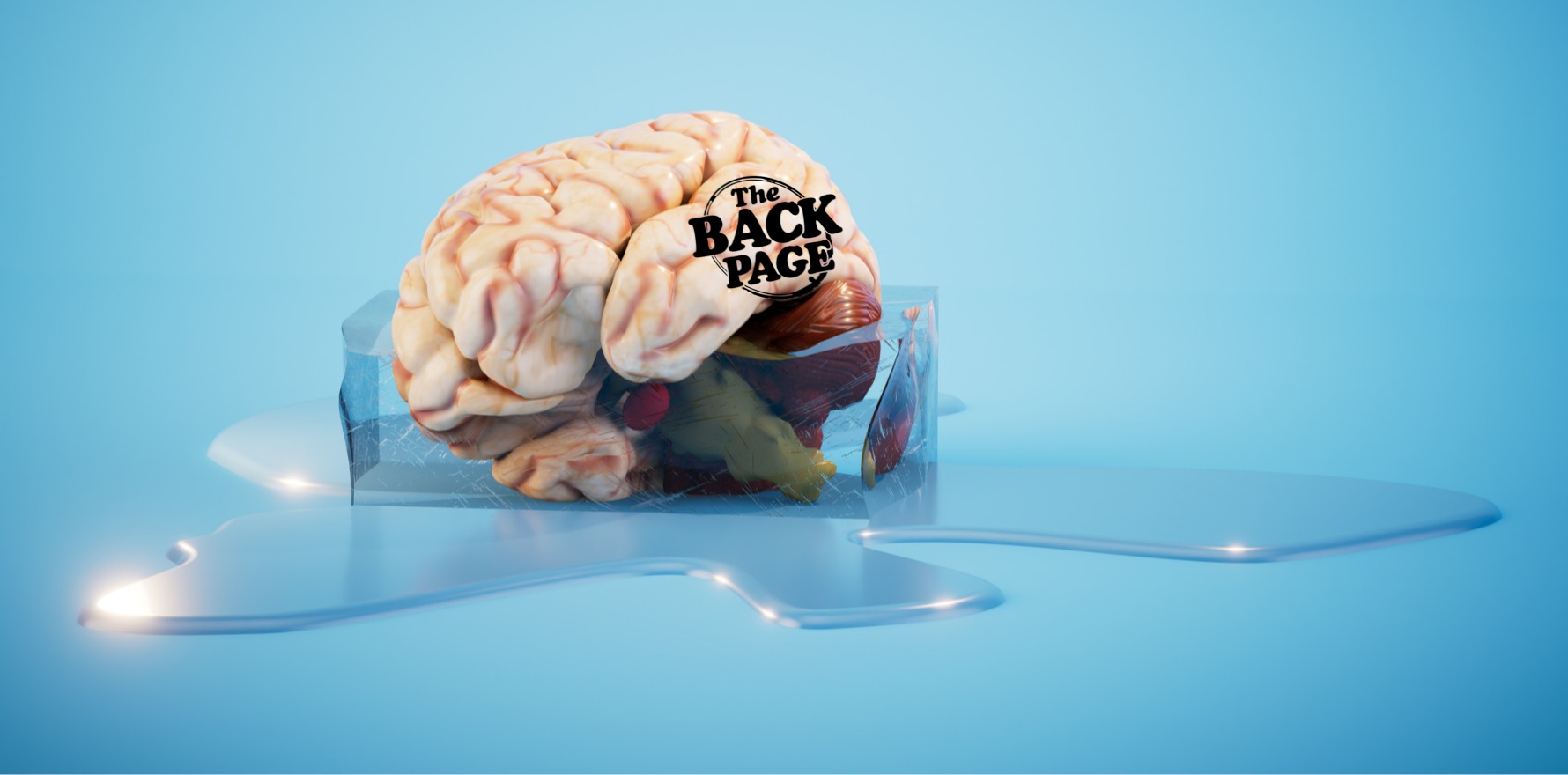
Proponents of ‘neuropreservation’ get a little ahead of themselves.
Your Back Page scrawler has no desire to live forever.
For starters, imagine still being sentient when poodle-perms and fair-isle tank-tops come back into fashion. Doesn’t bear thinking about.
Some folks, however, seem so hellbent on regenerating their days on this mortal coil that they will go to extreme measures on the remotest chance they will get to celebrate New Year’s Eve 2099.
One popular strategy for those with more money than they really need is to have themselves decapitated and their heads and brains stored at temperatures approximating deepest Antarctica on a very bad day.
The idea is that, at some indeterminate time in the future, human technology will have advanced to that stage where the head can presumably be taken out of the freezer, re-animated and successfully attached to a fit, young body.
Other brain-freezers, such as biogerontologist Dr L. Stephen Coles, have more noble motives, however.
Dr Coles did arrange to have his bonce lopped off and popped in the icebox (to be specific, it was sealed in a vat in Arizona and preserved at minus 146 degrees Celsius) once he was declared dead back in 2014, but it was all in the name of science.
So, a bit over 10 years later, a friend of Coles’ – an acryobiologist called Greg Fahy – defrosted chunks of his cobber’s brain and had a bit of poke around to see how the grey matter was holding up.
This biopsy was all part of a previously agreed-upon plan between the two to help assess the viability of the “neuropreservation” process.
According to Fahy, the results were pretty positive.
Speaking to MIT Technology Review, our boffin said his friend’s brain was “astonishingly well preserved”.
“We can see every detail [in the structure of the brain biopsies],” Fahy is quoted as saying, adding that he hoped this meant that Coles’ brain still stood a chance of reanimation at some point in the future.
At this point we need to point out that Fahy happens to be chief scientific officer at two biotech companies, called Intervene Immune and 21st Century Medicine, which focus on “reversing human aging through thymic regeneration”. So, it does appear he has a dog in the fight when it comes to this whole let’s-live-forever malarkey.
And before anyone gets too excited and races off to the local abattoir to check out their life-after-death facilities, even Fahy admitted in a yet-to-be peer reviewed research paper that the brain tissues hadn’t survived the process entirely unscathed.
He also concurred that there was “no evidence to suggest the cells could be brought back to life and regain electrical activity and a functioning metabolism”.
Not that this reality check is likely to deter fans of cryogenics. At last count there were more than 600 corpses being stored in facilities mainly in the US and Russia, although Wikipedia informs us there are also two currently deceased Aussies chilling out in a locally based deep freezer.
Now we totally accept that our scepticism over this brain-in-an-ice-bucket fad may prove to be unfounded, but even if we are one day proved wrong, we certainly won’t be in a fit state to eat our humble pie.
Defrost your best story tips and send them posthaste to Holly@medicalrepublic.com.au.
