

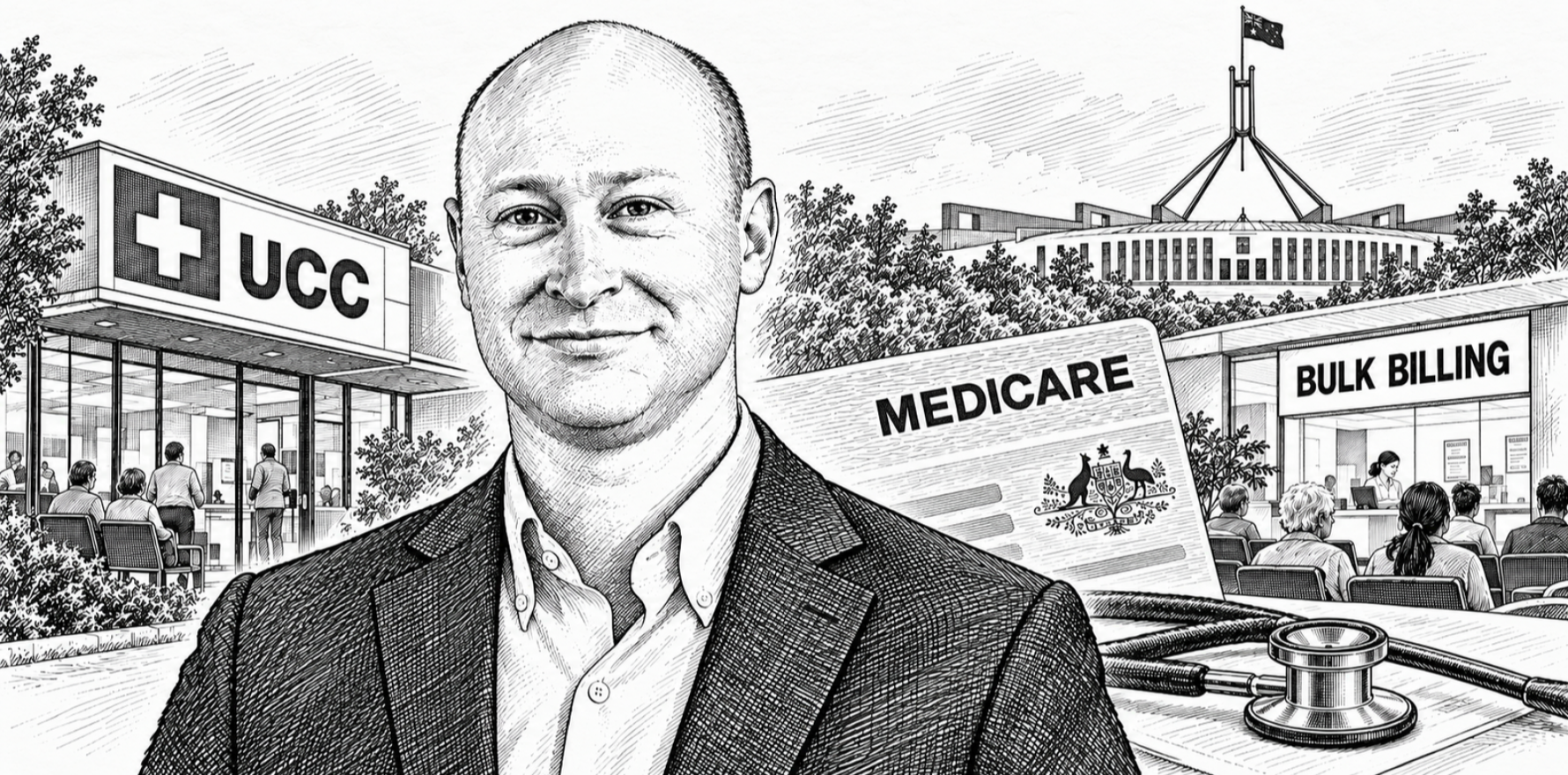
Imagine if the Department of Health regularly called the president of the RACGP for advice on primary healthcare policy and how to best sell it to the public? Instead, they call ForHealth boss Andrew Cohen.
At last week’s Burning GP conference, I was approached at the tea break with a question I get a lot: why has the pharmacy guild always been so much more effective at lobbying government than the college?
It’s a good question and this isn’t the whole answer but it’s part of it: pharmacists are business people whose number one objective is making money, and GPs are doctors whose number one objective is making their patients healthier. Those are two very different types of people, differently motivated.
This isn’t a very satisfying excuse for a lot of GPs. They can’t keep doing what they do if they go broke.
Enter the somewhat enigmatic CEO of one of our largest and fastest growing GP network operations, Andrew Cohen.
Cohen, who was dux of his MBA class at Cambridge and who has a past in consulting and the odd stint turning around failing companies for his management consultant bosses, finds himself haunting both worlds: make money, serve patients well.
He came to ForHealth (previously Healius Medical Centres) just over five years ago from baby powder company Bellamy’s. When he was parachuted into that failing Tasmanian-based outfit it was within a few weeks of insolvency and facing a massive shareholder class action over mismanagement. Cohen kept the business solvent, secured Chinese regulatory registration for Bellamy’s products, and rebuilt enough investor confidence to attract a strategic buyer at a price of $1.5 billion.
But Bellamy’s was probably more a survival story than a true turnaround story.
ForHealth is a turnaround story.
Although a major PE firm had paid $500m for the asset, it was a mess when they got it. It had essentially been treated as a cost centre to feed patients to Healius’s upstream pathology business. It was operationally fragmented, ran on ageing centre and IT infrastructure, had very poor staff culture, low GP satisfaction, and at the time of acquisition was incurring losses of $18–23 million per year.
Cohen is coy about whether he fully understood what he was getting himself into initially, but he admits it took him a full two years to get his head around the business and the healthcare sector itself.
If you read the financial papers, Cohen is given credit for a strategy involving rebranding and repositioning, investment in infrastructure with a focus on doctor retention, and expanding into a new synergistic urgent care clinic business.
But this analysis misses the real ingenuity of what Cohen did to facilitate this turnaround — at least, once he understood what he was doing.
Very early on he went to the government, made friends with the right people, earned himself some brownie points and trust for taking a stance of just wanting to help and then helping, got to understand those people’s biggest problems intimately, and set about solving them via his business.
The FOI that said it all
Just how deeply Cohen established himself with the department was revealed in a series of 40 or so FOI documents released by the Department in August. The documents reveal a sustained flow of data, policy proposals, and media material between Cohen and the health minister Mark Butler’s office on urgent care clinics and bulk billing.
A senior advisor to federal health minister Mark Butler asked ForHealth for help on how to “combat” an argument challenging the impact of Medicare Urgent Care Clinics on hospital emergency departments. ForHealth repeatedly supplied the office with data and analysis, proposed policy and workforce changes, and offered material that could be used to respond to criticism of government policy.
In March 2025, Cohen sent the office what he described as a “top-line analysis of UCC impacts”. A primary care and workforce advisor in Mr Butler’s office responded that the analysis was “very interesting”, before asking how the government could best demonstrate the impact of UCCs.
The minister’s office was also working directly with ForHealth on media material promoting the government’s tripled bulk-billing incentive, with a staffer asking Cohen to review drafted language and telling him: “Feel free to tweak or change”.
In January 2024, Cohen proposed using senior emergency department registrars to address workforce shortages at regional UCCs, including a possible exemption from section 19AA of the Health Insurance Act. In April 2025, Cohen sent the minister’s office a copy of ForHealth’s “UCC Workforce thoughts”, flagging further work on GP workforce problems in complex urban areas including Western Sydney.
This is not how the RACGP engages with government. It’s not how the Pharmacy Guild of Australia engages. The guild is renowned for blunt force political blackmail. The college is more polite and has recently had some success with political levering. But neither has taken Cohen’s path of coming to the middle as much as practically possible with Canberra on problem solving.
The timed consult question
Take the timed consult debate as a live example today.
The RACGP has long argued, in formal submissions, that current consultation item structures don’t adequately fund the longer, more complex consultations that managing chronic and complex disease requires. It is a reasonable argument, well evidenced, and largely ignored for two decades.
Cohen was asked about this at Burning GP directly. His answer was telling.
“I actually share a view that we need different funding for long consults,” he said. “If we really want GPs to treat ADHD, if we really want Thriving Kids to come back into mainstream medicine, if we really want women’s health to be successful, we have to change the law of consult.”
He agrees with the college. But he frames it differently: not as a funding grievance, but as a workforce and access problem the government already wants to solve. That reframe is everything.
The college says: you’re underfunding us to do our work. Cohen says: here’s a data-backed solution to your problem that also happens to require better consultation funding. One is advocacy. The other is a service.
The fragmentation problem nobody is fixing
The deeper structural argument Cohen is thinking about — and where the college finds itself somewhat in alignment, although they don’t talk that much of course – is around fragmentation.
The Australian government now funds all kinds of walk in and digital health mental health centres (Medicare, Headspace and more), spends a fortune on Primary Health Networks running their own programs, routes primary care money to hospitals and pharmacists, telehealth-only platforms (including Health Direct), and a growing list of category-specific services that general practice once absorbed as part of whole-person care.
GPs still do most of this work. But much of the funding has migrated to the margins.
This represents decades of well-intentioned but disconnected policy decisions, each one creating a new silo, each one pulling funding away from the place where longitudinal, coordinated care actually happens. But it’s now patently inefficient.
And the government does not have a single view of what all this is costing, relative to what it is delivering.
Cohen’s instinct here – consistent with his ForHealth strategy of providing integrated multi-disciplinary care under one roof – is that the answer is less fragmentation, not more. That the funding needs to find its way back to the patient-centred, GP-anchored model, not because GPs deserve it, but because the evidence shows it’s cheaper and more effective.
This might be the most important live example of an alignment of interests between the big (some would say bad, because they are owned by private equity) scaling network provider, and the college.
Both rightly see the fragmentation and the problem with it, for the system, the doctors and the patients.
But so far both are taking a very different approach to coaxing the government towards a genuine transition back to a GP led model that could deliver them savings.
Yes, that would be great business for Cohen and his company.
But it would also be a great win for all GPs and the college.
Related



The college is structurally hampered
None of this means the college is incompetent or unserious.
It is structurally limited in ways Cohen is not. But maybe it’s about time the college had a look at those limitations if it wants to be serious about affecting change in Canberra.
The most obvious structural issue for the college is the two-year presidential term. The college’s president is its spearhead of advocacy – the person who is meant to have the minister on speed dial, who is meant to be building the kind of trusted, longitudinal relationship with departmental officials that Cohen has spent five years cultivating.
But they only have two years. By the time a new president has learned the political landscape, built relationships, understood the policy machinery, and started to have any real conversations in Canberra, their term is almost over. What Cohen has done took five years of sustained, consistent, relationship-based engagement. And even he admits he didn’t really start to get on top of things until the two-year mark.
The college resets its starting point back to zero every two years.
The other structural reality is that the college was never designed to be an advocacy body. It was formed to do education, training, continuing professional development, and professional governance.
It is generally good at those things. Its revenue and its legal legitimacy rest on the Medical Board of Australia granting it the authority to run GP training and education – a government-conferred right. And one which gives them a forever revenue base.
But it creates a structural tension that no college president can fully escape: you cannot be too uncomfortable for government, because government holds the keys to the funding of education and training program, that funds almost everything you do.
The Guild has no equivalent constraint. Nor does Cohen.
This doesn’t mean the college can’t advocate. It means advocacy will always be bounded by a structural dependency that Cohen simply doesn’t have.
A better middle ground?
So what would a better model look like?
The college probably needs to separate its advocacy function more clearly from its educational and governance function – perhaps with a dedicated advocacy CEO or executive director who is not a doctor, not a two-year appointment, and whose sole job is sustained, relationship-based engagement in Canberra. Someone who can stay in the room for five years, as Cohen has.
At the same time, Cohen and ForHealth – and other large GP operators – could be more explicit about the fact that their commercial interests and the profession’s advocacy interests overlap significantly on several key issues.
Timed consults. Fragmentation. Chronic disease funding. Workforce. On all of these, some sort of negotiated coalition between the college and major GP network operators, presenting government with joint data, joint modelling, and joint solutions, might be considerably harder to ignore than either acting alone.
You suspect Cohen and other major network operators may have given this some thought but abandoned the idea quickly based on the above structural limitations the college has.
The college is not going to turn itself into ForHealth. And Cohen is not going to become the RACGP president.
But the model of engagement Cohen has demonstrated – go in, listen, find the problem, align your solution with their need, and keep showing up – is available to anyone willing to be patient and data-disciplined enough to use it.
That’s probably the most useful thing Cohen can teach the college. Not advocacy tactics. The willingness to see government not as an adversary to be lobbied, but as a partner with a lot of problems to be solved.
