

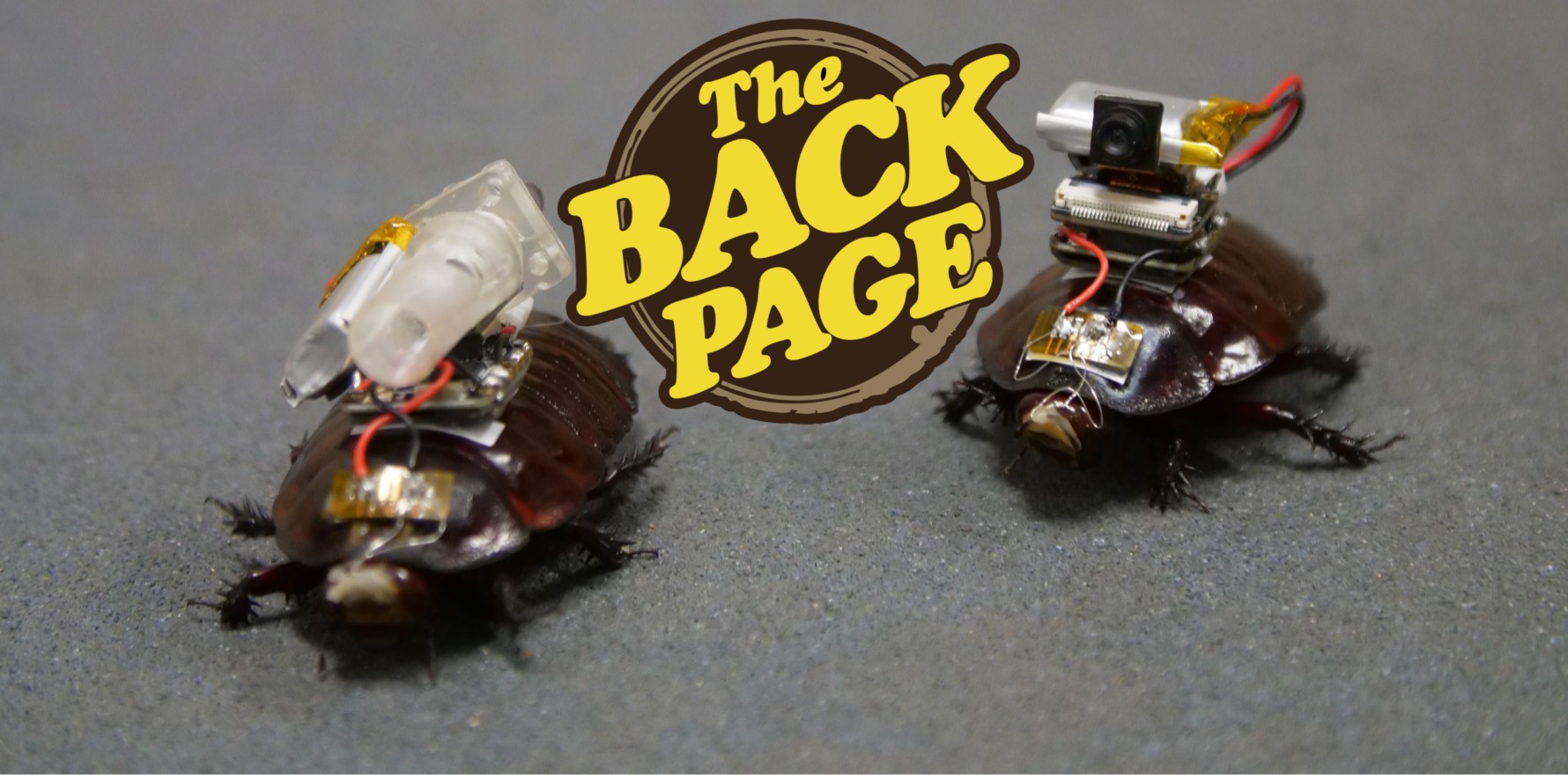
Giant burrowing cockroaches mounted with auto-injection systems could deliver care to people trapped in collapsed buildings or caves while they await rescue.
One of Australia’s tiniest critters could play a big role in the next frontier of disaster medicine, with University of Queensland researchers claiming a 95% success rate for injections delivered by cyborg cockroaches.
Growing up to 8cm in length, Queensland’s giant burrowing cockroaches are the world’s heaviest species of roach.
Five of these cockroaches have become unwitting test subjects for UQ’s biorobotic engineering research team, who have mplanted the small beasties with electrodes at both antennae and fitted them up for wee harnesses.
The electrodes allow the researchers to prompt the cockroaches into several actions. Stimulation of the right antennae results in the bug turning left, stimulation of the left antennae results in the bug turning right, and stimulation of both antennae immobilises the roach.
Some harnesses carry video equipment and others carry a drug-delivery mechanism.
Cockroaches are deployed in pairs, with the video cockroach supplying real-time images to the researchers, who then manipulates the drug delivery cockroach into place.
The complete navigation-and-injection task has been completed successfully in 18 of 25 trials, and the injections have only completely missed on two occasions, during which the cockroach has turned while launching the injection.
“Cyborg insects have been designed for ‘search and explore’ missions for the past couple of decades,” UQ researcher Dr Thang Vo-Doan says.
“We wanted to take the next step. Once they find someone, can they actually help?”
According to Dr Vo-Doan, the future may see ‘swarms’ of paramedic cyborg bugs being deployed into disaster zones.
“Some could carry cameras and environmental sensors, while others could carry specialised emergency or medical equipment,” he says.
“The vision is not to replace first responders, but to give them another way to see, reach and potentially help people when direct access is impossible.”
All cockroaches are anaesthetised during electrode insertion and are fed on what the researchers say is a “decent” diet of dry gum leaves and (as a special treat) apples.
Unlike their more abundant German counterparts, giant burrowing cockroaches – sometimes called rhinoceros cockroaches – cannot fly, are not generally considered a pest, and can live up to 10 years.
In fact, they are quite different from the regular house cockroach in most of the ways that matter.
For those readers still irked by the concept, this humble scribe has but one question for you: would you want to be judged by your worst relative?
Send your creepy, crawly story tips to Holly@medicalrepublic.com.au.
