


Just kidding (so far). But this headline isn’t far short of the misinformation and hysteria starting to foment out there in the wake of Heidi II’s launch last week.
Last Friday, our favourite LinkedIn stirrer Dr Max Mollenkopf posted what was probably the first real-world test review of Heidi II’s new agentic functionality, and within a short time he had lit up what was previously a fairly pedestrian corner of the platform: GP practice management system aficionados (nerds).
It wasn’t entirely surprising, given some of Max’s first impressions – the man definitely needs a YouTube channel.
“Sitting here watching Heidi moving my mouse and sifting through my PMS (completely independently) is an amazing and terrifying experience,” he wrote.
“This workaround has its own scary results — an agent acting under my login performing tasks inside my PMS. The agent is moving between records and there are multiple points where it could inadvertently alter or change data.
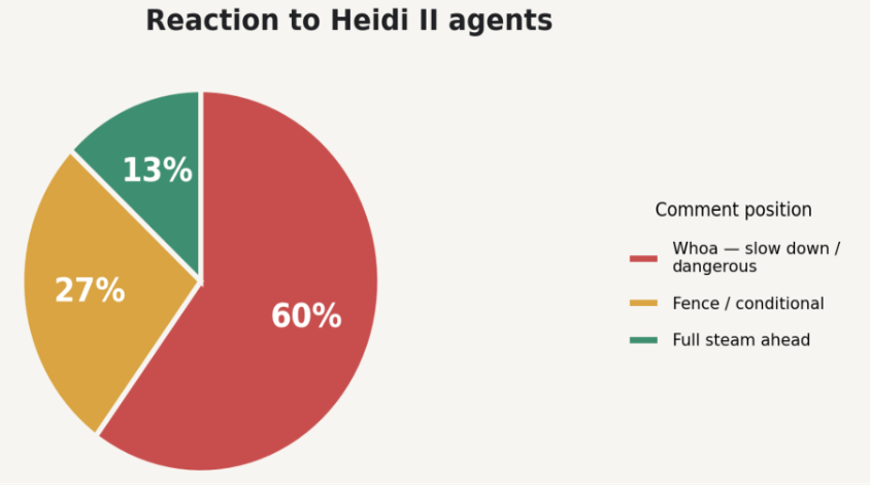
“I have absolutely no doubt I’m actively breaking all the T+Cs of the PMS software I’m using.” (On this front, see our story on the T+C question — it’s a real issue).
The comment stream ran hotter still.
“You are stuffed and indefensible if it ever makes a decision that you would never have made!”
“Whilst the possibilities are exciting, this absolutely terrifies me.”
“Screen scraping has traditionally been associated with some rather less desirable industries.”
Not exactly a statistically valid sample. But an early read on what GPs are feeling – even those mostly in the know. Some are freaking out.
There’s a kinder interpretation, though: this is a massively disruptive technology dropping into a massively tightly governed, risk-averse market. What does one expect?
So why release it?
Heidi co-founder Dr Thomas Kelly is banking – openly – on the “full steam ahead” gang to do his research for him.
He told The Medical Republic this week that Heidi ran an alpha pilot with around 100 customers using the agentic features every day for two months before public release. In that time, across more than 100,000 agent runs, the safety harnesses never once triggered a clinically significant action – no record altered, no irreversible step taken.
Dr Kelly says the system has a dedicated safety agent running in parallel – “basically just built for safety” – that checks every action before it is taken and asks: could this effect patient investigation, diagnosis or management? Could this be irreversible? Should I be waiting for approval?
“Never seen Heidi take one of those actions,” he told The Medical Republic.
A clearer sense of what Dr Kelly is thinking comes in this comment from him: “It might just be too sci-fi for some people. That’s fine. You can turn it off”.
Dr Kelly also acknowledged at least, that he is pushing the bleeding edge:
“Part of this release is to show there’s appetite. It’s the same as scribing – when we started scribing, it was viewed as a bit sci-fi, a bit unsafe. What I’m hoping is that people see there’s a lot of latent demand.”
Translation: Heidi has released this publicly in part as live market research.
Every GP who fires it up and runs it through their Best Practice, Genie or MediRecords install is, functionally, a beta tester.
Heidi didn’t say that. But the maths is fairly clear. You can send them an invoice if you like.
One more important point here. Some technical folk who’ve looked at the robotic process automation (RPA) process believe it just wouldn’t be workable at scale. And if it was, the compute would be way to expensive.
Which would make the whole RPA play a sort of bluff on the part of Heidi. Look what we can do if you don’t play ball.
When asked about how slow the process is now and how much compute it takes Dr Kelly said it’s improving in speed and function really fast. I think he said six times faster in the last week or so of testing.
I think the point is, bluff or not, the RPA will show thousands of doctors what is possible and that will give them the appetite for that functionality. That should put a lot of pressure on the incumbent PMS vendors.
They will not attempt to access anything not already open and authenticated. And you can turn the whole thing off.
Dr Kelly is pretty clear on this: for GPs who find the autonomous screen navigation too confronting, the scribe and knowledge layer functions work exactly as before.
The question nobody can answer yet – not Dr Kelly, not the PMS vendors, not the government – is where the first genuine incident occurs, what it looks like, and who carries the liability when it does.
This story is still being written.
Probably by a rogue AI agent, roaming off range somewhere, wondering how they got lost and trying to get back home to mama (Heidi).
