

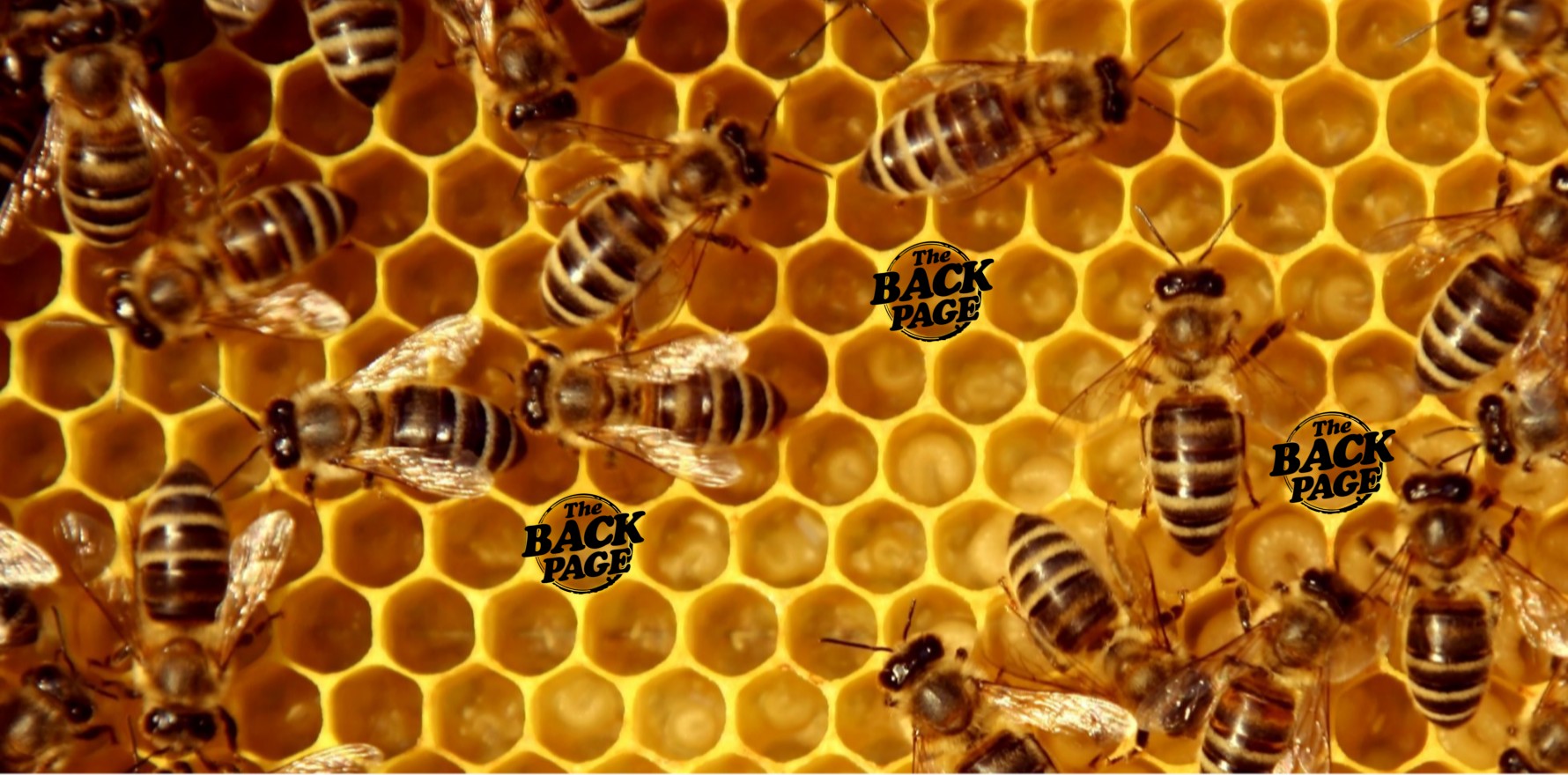
Honey bees have long been believed to have sweet vision, but smaller, native Australian bees may see even better.
It may not always seem like it, but this humble Back Page scribe actually does put a lot of thought into how to fill this weekly column.
Strictly speaking, it’s meant to highlight an unusual or frivolous piece of health research.
But some weeks it’s harder to find the light in the never-ending darkness of World Events.
On those weeks, we cover research about a fuzzy, wet or particularly woeful critter. This is one of those weeks.
Until now, the eyesight of honey bees – the classic yellow-and-black striped variety from Bee Movie – has been held up as an important model in comparative physiology and neuroscience.
And there’s a reason for that. Bees are vital to agriculture and are found across all continents bar Antarctica and climates which range from rainforests to tundra.
“Throughout these environments, bees rely greatly on their visual abilities to accomplish biologically necessary tasks such as finding food, mates, nests, and escaping predators,” a Swedish-Australian research team writes in Neuroscience.
“… Not only did bees adapt to tremendously diverse visual environments, but also to varying photic conditions throughout the day, with certain species adapted to being active at dusk or even at night.
“This tremendous diversity has sparked interest in how the compound eye morphology and physiology adapt to such diverse photic environments and ecological demands.”
The bigger the bee eye, as the general thinking goes, the better they are able to see smaller objects (due to less diffractions-induced blur and improved angular sensitivity of the photoreceptor, duh). What stops bees from growing bigger eyes is, of course, the biological constraint of their head size.
Basically, bees have good eyesight, and that’s kinda cool.
One of the blind spots, though, is that researchers have only really been marvelling at the biological wonder that is the honey bee (Apis Mellifera), even though there are more than 20,000 other species of bee at which one can marvel.
Researchers from Adelaide University and Sweden’s Lund University have duly collected and measured the eyesight of four other bee species, including the Australian blue-banded bee (Amegilla murrayensis).
This native bee has even better eyesight than a honey bee drone, and scores highest on detectability of small objects – a particularly impressive feat considering that it is comparatively smaller.
“Honey bees have shaped much of what we know about insect vision, but they are only one of thousands of bee species,” says co-author, Adelaide University Associate Professor Steven Wiederman.
“By studying a greater diversity of bees, we’re finding that there is no single blueprint for good vision – even very small bees can have remarkably sophisticated visual systems.”
Now, isn’t that nice?
Buzz your story tips to Holly@medicalrepublic.com.au.
