

Do what you can, be honest about what you can't and don't be afraid to make the call to recommend that they land the plane.
I recently jinxed myself by reading an article about doctors responding to inflight emergencies, stupidly reading it in the departure lounge at JFK.
I feared I was tempting fate … ED staff are the most superstitious healthcare workers – who else has a list of prohibited words? Like the Q word.
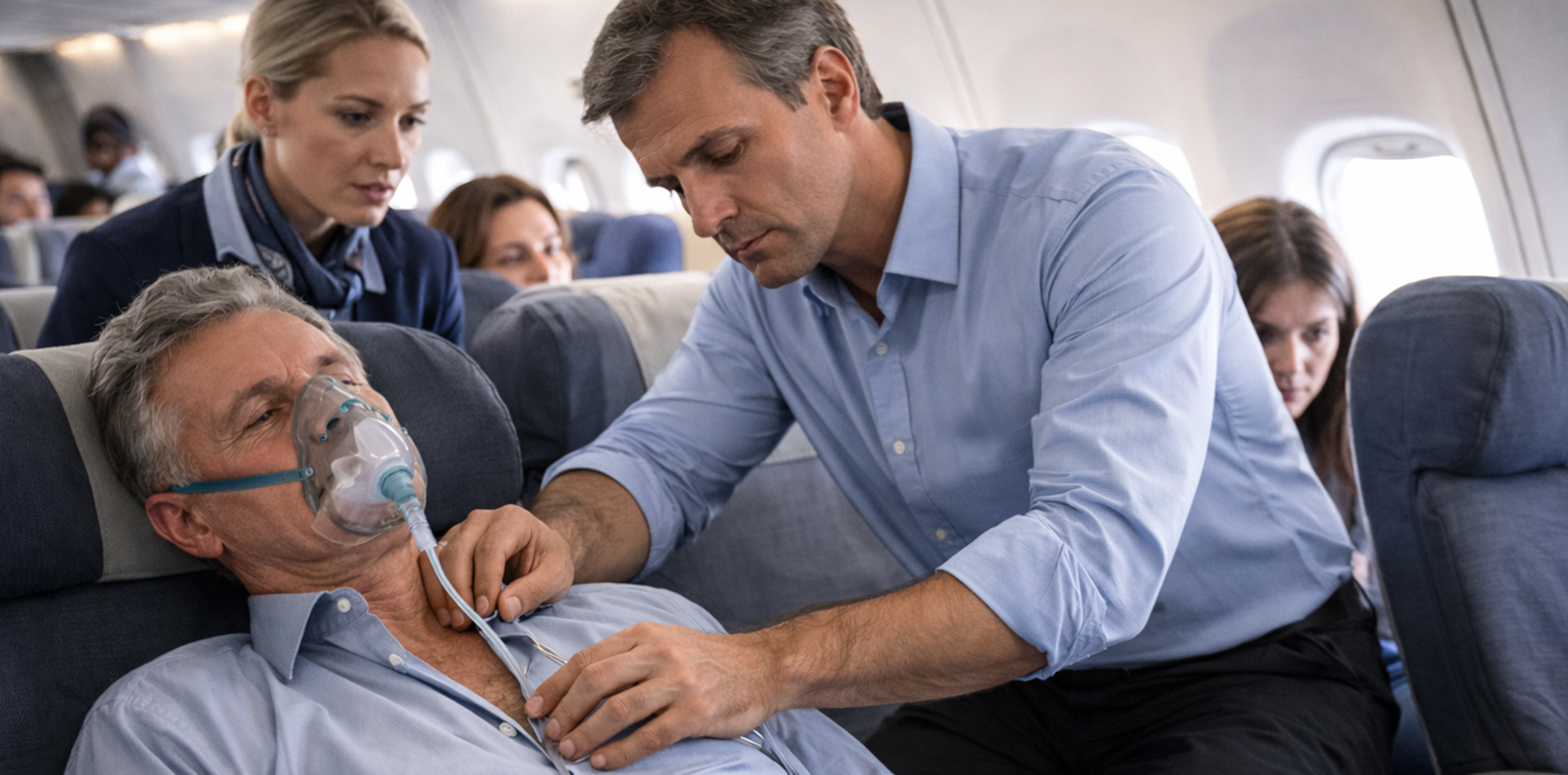
It happened. There was an emergency, and I was “it”. The patient was critically ill with an O2 sat of 73% and GCS of 11 when I got to them.
Here are some practical points that I learned.
I am certainly no aeromedical expert – there is much that others might have done differently, and there are courses you can do if you’d like to be really prepared. But I thought to share these points to maybe help others respond – because really, you don’t have to be perfect to be useful.
- Check if the airline has access to a medical support service – you may be able to get advice from someone on the ground who is familiar with the equipment and meds on board. Not all have this, but check – it can help a lot!
- If you own a head lamp, carry it in your carry-on bag.
- If you have a mask or N95 (preferably), have it in your carry-on bag – you might be responding to respiratory pathogens, and it’s possible that nobody is going to offer you respiratory protection (or gloves). Grab these before going to the patient – because once you get there it might be too hectic, and you might get distracted from looking after yourself. Remember – DRSABCDE – the D is a reminder to protect yourself.
- Do a rapid seat-side assessment of the patient – if you can safely leave their side go somewhere quieter and see what equipment the plane has. They will have a box, and a list of what it contains.
- If it is possible to move the patient out of their seat and into the galley or staff seating area, this will be much easier than managing them in a cramped economy seating area.
- Get clarity from staff about where you are: over land or water and how far from safety you are.
- Grab all the equipment you need to get a set of vitals – this flight had a pulsimeter, as well as a manual sphygmo, thermometer, and glucometer. Once I had that full set, it was clear that a trans-Pacific flight would be far too high a risk, and I made the recommendation to divert and offload within 10 minutes of meeting the patient.
- If it’s more than a trivial issue, set up a team, composition determined by what you need to do. Mine were
- If an interpreter is needed – allocate a staff member to find crew or passenger who can be an interpreter.Allocate one of the crew to hold and keep track of all the gear – don’t put it on the tray tables (as I did) because it will all get knocked on to the floor or into the seat pocket and you’ll be rummaging around when you want to repeat.IV access may not be necessary – but it can be done. If not by you, there may be a nurse or paramedic on board who is willing to do this. (NB – the cannulae may not be valved, so be prepared for free bleeding when you withdraw the trochar – a bit of a shock if you have become accustomed to valved ones.
- If there is no accompanying family member or friend, and if the patient is too unwell to give a history, allocate a crew member to review their luggage to look for a medication pack and their phone for a med list and allergy information (there may be a specific In Case of Emergency app that can be accessed even when the phone is locked).
- There will be a very limited amount of fluid for resuscitation, but a 250ml bolus can work wonders for a short duration. (My crew rigged up an IV “pole” by creating a loop with headphone wires, threading through the hole on the IV bag, and clamping the headphones into the door of the overhead bin – brilliant!);
- The drug list may be full of unfamiliar meds, and odd doses of others, and stuff you expect might be missing. You may not have internet access to look stuff up. But you may be able to get advice from a ground-based doctor. (See point 1, but even if they don’t have a formal service arrangement, there may be the ability to convey a question and get you an answer. For example, I was able to confirm that none of the meds I did not recognise were antibiotics.)
- Oxygen cylinders are available but may not be full. And on my flight, the flow rate had only two settings – high and low. The mask will likely have a reservoir bag, a bit challenging if managing a CO2 retainer. It’s likely you will be given a stethoscope, almost certainly of no use. They are the cheap plastic ones, and you can’t hear a thing over cabin noise. BP has to be by palpation, chest assessment using chest expansion and TML.
No matter how crummy you are feeling about your adequacy in the situation – remember you may not be the “best” doctor, but you are the best who is there, and that is what matters.
I handed my patient off to a ground crew approximately 90 minutes after the call went out for “is there a doctor on board”. On the scale of inflight emergencies, it did not require any legendary heroics, just application of the basics (ABCDE) and I handed him over in better condition than I found him.
Related



I don’t know what was actually wrong and probably never will – but that’s a lesson too. Supportive care does not require a diagnosis to be effective, so don’t be intimidated that you can’t tell exactly what’s going on.
Do what you can, be honest about what you can’t and don’t be afraid to make the call to recommend that they land the plane.
Dr Jillann Farmer is a GP and medical administrator. She is former medical director of the United Nations, currently working as a rural emergency department locum, and as CEO of A Better Culture.
This article is an expansion of one first published on Dr Farmer’s LinkedIn feed. Read the original post here.
