


The whole thing is beyond disturbing.
I’ve been thinking about NSW Health’s recent announcement regarding pharmacist prescribing of the contraceptive pill, and it’s made me think.
It’s often not well known, but the Australian Health Practitioner Regulation Agency is overseen by the Health Ministers Meeting, acting as the Ministerial Council. The Ministerial Council may issue AHPRA and National Boards with binding policy directions.
So I think AHPRA’s guidelines on advertising must be changing.
AHPRA’s advertising guidelines sounded clear this week, until the staggering announcement by the NSW Premier Chris Minns that the first 5000 consultations will be “free” “as part of a $4.5 million state government investment”.
I’m assuming that doesn’t mean it costs $900 per person, but in this day and age, you never know.
After that, a consultation will cost … pretty much the same as it costs to see a GP.
“Mr Minns said consults were expected to cost between $20 and $60 after the free appointments were exhausted, with pharmacists to set their own prices.”
So get in quick, ladies.
I wonder if there will be any “naming and shaming” if pharmacists “overcharge”, the way non bulk-billing GPs have been criticised by various politicians.
Public health and marketing have always been uneasy bedfellows. Nevertheless, I can’t imagine Chris Minns spruiking an arthroscopic repair, and suggesting the surgeon will do the second knee for “free”.
AHPRA advertising rules
I thought AHPRA guidelines were pretty clear. Their guidelines state:
If you are advertising a regulated health service, your advertising must not:
- be false, misleading or deceptive, or likely to be misleading or deceptive;
- offer a gift, discount or other inducement, unless the terms and conditions of the offer are also stated;
- use testimonials or purported testimonials about the service or business;
- create an unreasonable expectation of beneficial treatment;
- directly or indirectly encourage the indiscriminate or unnecessary use of regulated health services.
But this particular program around “pharmacy prescribing” (which is really pharmacy diagnosing and managing) seems to raise alarm bells.
Related



The false, misleading or deceptive bits
The clearest statement here is from Bridget Archer, the Tasmanian minister for health, who offered pharmacists $7000 scholarships for their (mostly) online short course so they could offer “GP level care”.
I can’t even begin to describe how misleading this is.
I wish it was that easy to become a GP, but it really isn’t. That hasn’t stopped the advertising implying that a pharmacy service is a perfect substitute.
The gifts and discounts
This one is (almost) amusing, if it wasn’t so dangerous. To get an idea of how bizarre this is, I thought I’d make a few posters.

I’m thinking how we could step up to meet this standard. “Skin cancers removed, 20% off the second mole” or “we’ll throw in a FREE breast exam with each cervical screening test!”.
The purported testimonials
I’m sure the politicians wearing their Pharmacy Guild ties would say they are simply doing a public service announcement. However, it cannot be an accident that every single MP I could find had their public flu vaccine in a pharmacy.
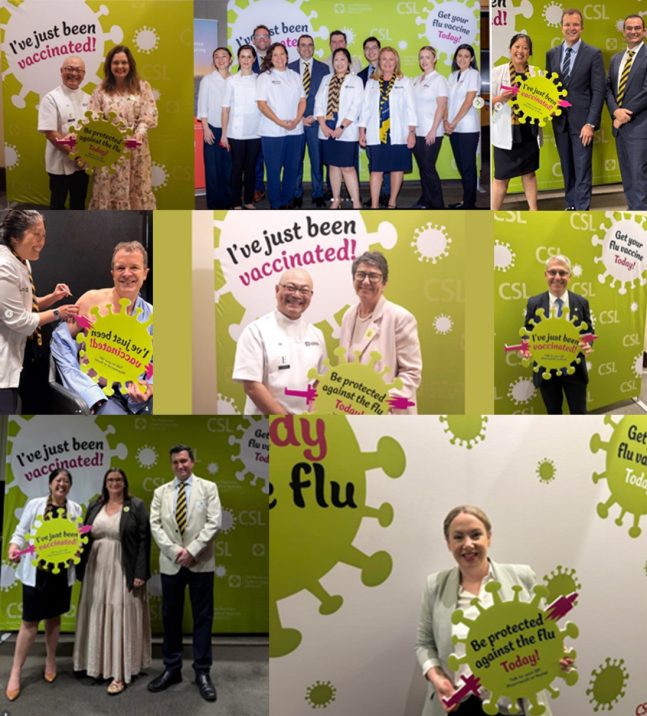
I’m not sure when a public service announcement becomes a testimonial, but I’m placing my bets on the presence of a branded tie, a trusted politician and a large cardboard sign endorsing the service.
Of course, there is this cardboard sign below, which in my view didn’t get enough respect. I can see how a branded uterus could easily be used to advertise a contraception service, with Dan Repacholi clearly demonstrating the correct site for the insertion of a Mirena.
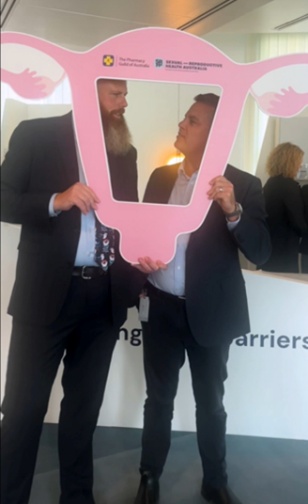
I can’t wait to see what the urologists will now do in Men’s Health Week.
The unreasonable expectation of beneficial treatment
Their training is “formally recognised by the Victorian government”. NSW health minister, Ryan Park is also “confident” in their training to prescribe. Chris Minns goes further, describing contraception prescribing as “safe and effective” even though the results of the “trials” haven’t been released.
The primary outcome was the “self-reported seven-day accessibility and acceptability of the service”. They are measuring ED presentations and MBS data for the whole population, but given the number of confounders, it’s hard to imagine the data showing anything particularly useful.
Don’t get me started on the whole “it will free up GPs and save you time and money”. There is no evidence for any of this, but it’s a ripping endorsement, and the implication that pharmacists are providing “better, higher, stronger” Olympic-level care is heavily implied.
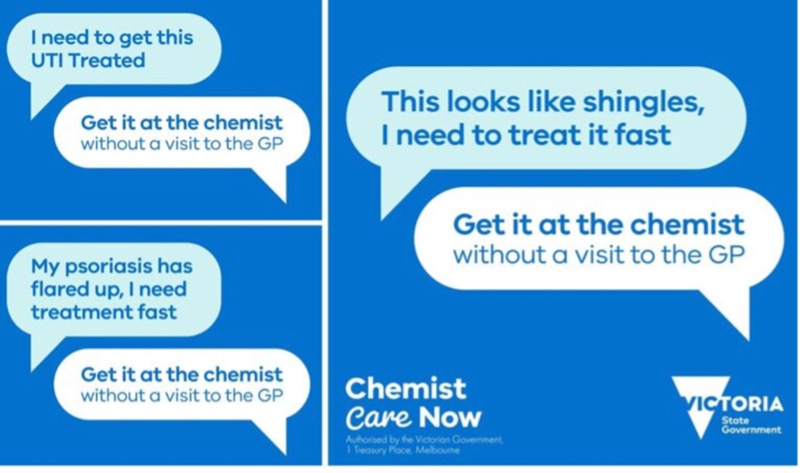
Don’t forget the Guild has pitched its readiness to provide termination of pregnancy and cervical screening tests.
Given the spruiking of AI delivered training and assessment of communication skills (note the formative and summative assessments for communication skills here) I just don’t get how they think they’ll cope with the most vulnerable people, including survivors of violence.
But maybe that’s not the target audience. I suspect this program targets the most privileged and the most urban, given nearly 80% of pharmacies are in capital cities.
The advertising does, however, open up new opportunities for us GPs. If this is the new standard, the mind boggles on what we could do.
Here’s my first attempt: evidence-based and completely defensible. But, I suspect, unacceptable for us.
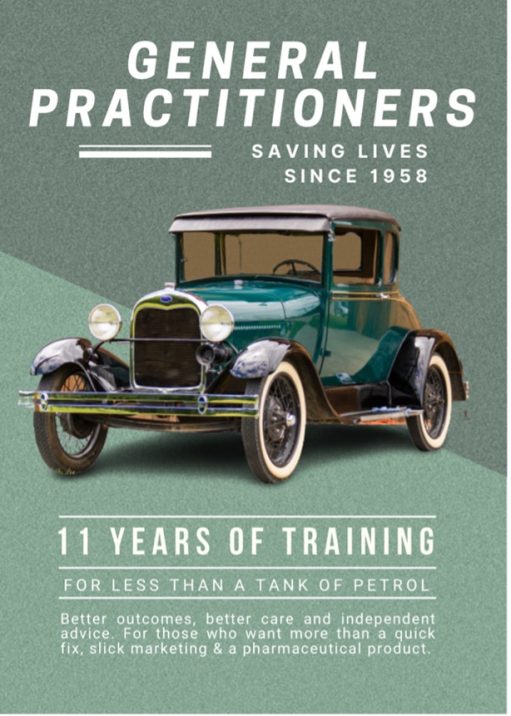
I suspect we wouldn’t be welcome to provide public advertisements advertising free services with a side order of upselling. And, frankly, I wouldn’t want to.
However, the bigger problem is cost.
We are not good at doing end-to-end costing in health. An inappropriate script can lead to a very expensive hospital admission. Even if we discount the pain and suffering element, the cost of managing an ectopic pregnancy treated as a UTI, or iritis treated as conjunctivitis is significant.
It just isn’t measured. We also don’t measure the community cost.
It would be an overreach to say that opening up prescribing has caused widespread trimethoprim resistance, or plummeting vaccination rates, but we should at least be investigating what happens when consumer choice drives provision of publicly funded goods.
And then there’s medication shortages.
The whole thing is beyond disturbing. Women, and their uteruses, deserve better.
Professor Louise Stone is a GP in Canberra and an academic at Adelaide University. A collection of her research, policy and teaching materials can be found at drlouisestone.com.
