


Your service fee calculator and accounting systems can create evidence against your own practice, or prove you are doing it right.
“This is a bit like putting gold plates on a Mazda,” a GP told me when I suggested checking his service fee calculator.
My reply: “It’s about putting brakes on a valuable car.” After Uber, your practice is that valuable car.
The Uber warning for medical and healthcare practices
The High Court’s Uber decision ([2026] HCA 40) is a warning about control.
In my view, using the RACGP Accreditation Standards or practice policies to direct practitioners, setting their fees, or controlling their money through a practice bank account can see contractors treated as employees for payroll tax.
The key to avoiding an Uber outcome: correctly implemented service entity arrangements that follow the ATO’s ruling (TR 2006/2), which we call Tenant Doctor™ arrangements, with practitioners truly independent and free to practise.
Start with your service fee calculator and accounting systems. That’s where revenue offices and auditors usually look first. Your practitioners’ BAS and tax returns should match the practice’s records and reconcile to the bank. Reviewed by registered tax agents and lawyers, these systems can help you.
The bottom line
A technology label won’t decide who is an employee; how the arrangement works in practice does. Let your practitioners present their own independent practice to patients, for example through their own practitioner website or profile.
The good news: this is fixable.
Getting it right also gives you clean numbers for the practice valuation you may need when the capital gains tax changes start on 1 July 2027.
In Australia we have observed what works and what does not since 1992.
Eight quick checks: is your practice Uber-ready?
Most arrangements were set up before Uber, software disclaimers usually leave compliance to you, and calculators often sit outside an adviser’s scope.
This isn’t a criticism of any provider, practice or adviser. It’s simply the easiest place to make a big improvement. Time to check the brakes.
- Compliance review: has your service fee calculator had an independent legal and registered tax agent review, or been submitted to the ATO or a state revenue office?
- The books: do its calculations match the tax and accounting records?
- Invoices: are “disbursement” invoices valid tax invoices? If not, practitioners may lose deductions.
- Bank reconciliations: automated, or done by hand each pay run?
- Reimbursements and consumables: recovered, or are practitioners overpaid?
- BAS and tax figures: can each practitioner reconcile them?
- Pooled payments: do practitioner payments run through one practice account or ledger? That can suggest the practice controls the money.
- Fee setting and billing prompts: does the practice set fees for practitioners, for example switching everyone to bulk billing overnight? Does your software monitor billing or push care plans? If practitioners are not seen to be free to set their own fees and billing, it can look like control.
Not sure about some answers? That’s normal, and most gaps are simple to close. The fix is set out below.
Why it matters after Uber
Uber argued it was just a technology platform and the drivers’ payment agent.
The High Court ([2026] HCA 40, 4 November 2026) dismissed that, confirming that it owed about $81 million in NSW payroll tax.
A service fee calculator is also a technology platform handling practitioner payments, so the label alone won’t decide the outcome.
Some will say Uber wasn’t about software. But the whole arrangement ran through Uber’s app: riders and drivers contracted through it, the fare was set in it, and the money flowed through it.
A medical centre’s app or website can work in a similar way. Reviews can start with the practice website: who sets the fees, and whose practice the patient is told they are visiting.
Accreditation is the other place to look. As a former AGPAL general practice accreditation surveyor for ten years, I noted in the same article that the RACGP Standards for general practices (6th edition) are written for “the practice”, and I have seen accreditation manuals undo good service agreements. The simple fix: use accreditation for quality and safety, and have practitioners instruct the practice in writing if they want it to help them meet the standards.
Who sets the fees matters. A practice-wide fee decision, such as moving every doctor to bulk billing overnight, can be used against a practice if doctors are not seen to be free to set their own fees (see check 8).
Joined the Bulk Billing Practice Incentive Program? Since 1 November 2025, every GP at a participating practice must bulk bill all eligible services for all Medicare-eligible patients (Department of Health program guidelines). That doesn’t have to be a problem. The easy fix is for each practitioner to make, sign and record their own decision to take part, rather than the practice deciding for them. The Department itself says payroll tax is a state and territory matter and encourages practices to do their own due diligence before joining (Department of Health webinar, program FAQs).
Remember Thomas and Naaz. The Uber judgment refers several times to Thomas and Naaz Pty Ltd v Chief Commissioner of State Revenue [2023] NSWCA 40, where a NSW medical centre paid doctors a percentage of patient fees and the payments were taxed as wages. Read the judgment
What to watch: Fair Work. In Weddall & Ors v Rasier Pacific Pty Ltd & Anor (VID427/2021), the Federal Court has been asked whether Uber drivers are employees under the Fair Work Act, and judgment is reserved. Across the Tasman, New Zealand’s Supreme Court has already found four Uber drivers were employees (Rasier Operations BV v E Tū Inc [2025] NZSC 162).
‘Our bigger competitors use the same software’ won’t help much if the arrangement is reviewed, so it’s worth checking your own setup. Payroll tax rules and GP exemptions vary by state.
Your accountant will be looking more closely. Since 1 July 2024, registered tax agents must report their own significant breaches, and those of other tax agents, to the Tax Practitioners Board, even when software contributed to the error (TPB(I) 43/2024). So expect more questions about the numbers your calculator produces. Clean, reconciled records make those conversations easy.

The fix: simple and solvable
The good news is that most practices can close these gaps in four practical steps, without rebuilding the business. The foundation is a correctly implemented service entity arrangement in line with the ATO’s ruling (TR 2006/2), what we call a Tenant Doctor™ arrangement, where the practice provides services and the practitioners run their own independent practices.
- Let practitioners control their own money. Patient fees flow to the practitioner, and the practice charges a service fee backed by a valid tax invoice. No pooled accounts.
- Let practitioners set their own fees. Each practitioner decides whether to bulk bill or privately bill, including whether to take part in the Bulk Billing Practice Incentive Program, and records that decision. Avoid practice-wide fee changes made on their behalf. Let each practitioner present their own independent practice, for example with their own practitioner website or profile.
- Use accreditation and policies for quality and safety, not to direct practitioners. The RACGP Standards remain valuable. Just make sure your policies, procedures and software prompts don’t dictate how practitioners bill or practise.
- Automate the numbers. Reconcile service fees to the bank automatically, recover reimbursements and consumables, and give each practitioner figures that match their BAS.
Whatever system you use, look for an independent legal and registered tax agent review, bank-reconciled calculations, valid tax invoices, practitioner-set fees, no pooled payments and automatic recovery of costs. Getting this right is far cheaper than a tax audit or employing an army of highly trained back-office staff.
Related



A live example
I’m using the Doctors Pay (Service Fee) Calculator (DPC) as a live example, not to market the software, but to show you there is a viable solution. Since founding Health and Life in 1992, I’ve watched practices struggle with spreadsheets, especially once GST arrived in 2000. I built the DPC in 2001 to close these gaps, and the approach has been tested:
- Independent legal opinion: Hamilton Bailey lawyers (May and August 2024) advised that, on the face of it, DPC arrangements would be “not-eligible for PAYG income tax, superannuation/employment obligations, and State based taxes that may involve employees and/or relevant contracts.” The opinion is general guidance, not advice tailored to your practice.
- Submitted for review: a 262-page national ruling submission to the ATO and state revenue offices (2024).
- Audit tested: clients have passed payroll tax audits with no liability on their practitioner payments, because their arrangements were established correctly.
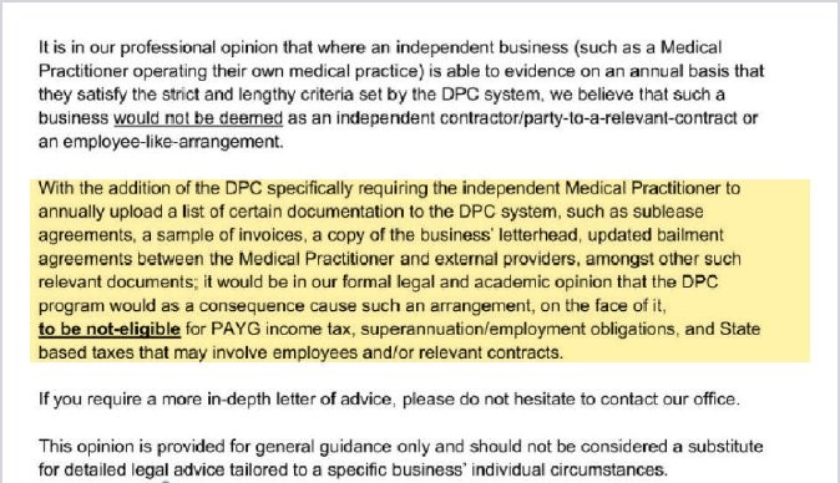
Extract from the Hamilton Bailey letter of advice, 28 May 2024 (key paragraph highlighted).
More detail is on the DPC page for practices and managers.
Your next step
Check your brakes before anyone else does. Work through the 8 checks with your accountant and lawyer. Most practices find the gaps are small and quick to close, and the result is less admin, cleaner numbers and peace of mind for the whole team.
Join the live chat: Could Uber turn your contractor practitioners into employees?
Wednesday 18 November, 1pm AEDT (12:30pm Adelaide). A relaxed one-hour Practice Alert coffee chat on Facebook Live with Lukasz Wyszynski (Principal Solicitor, Hamilton Bailey Lawyers), Jonathan Lee (GP practice founder and owner) and David Dahm (Chartered Accountant and Registered Tax Agent).
We’ll cover how to stop accreditation, policies and procedures becoming an employee trap for Fair Work, payroll tax, income tax and super, with simple fixes you can put in place.
Join the event and send your question
Disclaimer
General information only, not tax or legal advice. Please seek independent legal and taxation advice and use this document for discussion purposes. Ask your accountant and lawyer whether reviewing your service fee calculator is within their scope and expertise.
Health and Life offers the Doctors Pay (Service Fee) Calculator, an efficient calculator with automated bank reconciliation, designed to support tax-compliant service fee arrangements and reviewed by registered tax agents and lawyers, and therefore declares a conflict of interest.
David Dahm is a chartered accountant and registered tax agent specialising in medical and allied health practice advisory since 1992. Find a full copy of this article, including references, here.
This article is general in nature and does not constitute legal, tax, or financial advice. Every practice should obtain tailored advice from a qualified lawyer and a registered tax agent before acting on the matters discussed.
