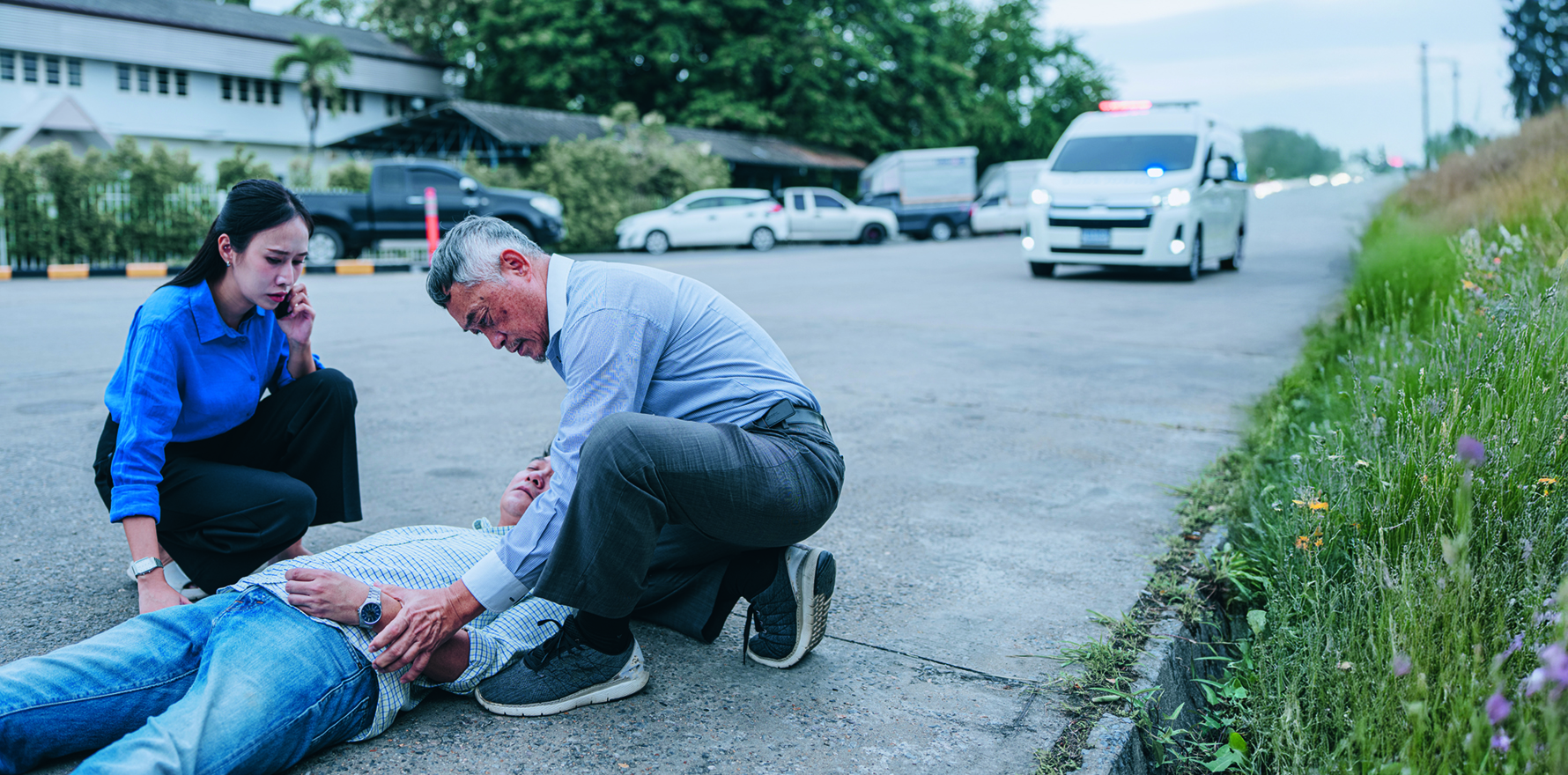
The ethical and legal realities for doctors caught in emergencies outside the clinic.
Actual claims arising from good Samaritan care are extremely rare in Australia.
This summer Australia has seen its fair share of tragedies – from road accidents, drownings, shark attacks and a deadly terror attack in Sydney.
But amidst this there have been some remarkable stories of everyday people doing extraordinary things to minimise the loss of life.
Among them are health professionals who didn’t hesitate to jump in and offer their skills and training to make a difference.
But it’s not just the headline-making events where lives are saved. Incidents on planes, public transport and in community spaces frequently place doctors in situations where they must decide, often within seconds, whether to intervene in a medical emergency (while off duty and often without equipment or support).
When the patient is handed over to paramedics and the adrenaline fades, doctors are often faced with some lingering medicolegal questions – the biggest one “am I covered”.
The good news is that the law generally protects doctors when they act as good Samaritans outside the scope of their usual formal clinical setting.
Anthony Mennillo, Head of Claims and Legal Services at Australian medical indemnity insurer Miga, says it’s also important for doctors to know that they are not legally obliged to step in.
“In Australia, whether you’re a medical practitioner or not, you don’t have a legal obligation to render assistance in an emergency, unless you’re in the Northern Territory where legislation creates an offence for ‘callously’ failing to render assistance to someone urgently in need of it ,” he explains.
However there could be an ethical obligation.
“The Medical Board’s Code of Conduct does create an ethical duty for doctors to help patients or treat patients in an emergency,” says Mr Mennillo.
“It does say you need to take into account your own safety, skills, and the availability of other options. So it’s not just a blanket “you must assist”, it’s having regard to the circumstances that you’re in.”
As an example he cites a case where a doctor might be on a plane travelling overseas when there is a call for a doctor. Given the fact that the doctor has had a couple of glasses of wine, he chooses not to put his hand up as he felt he might be impaired by the alcohol.
Miga provide automatic cover for members who render assistance in an emergency or in the scope of being a good Samaritan. Furthermore, legislation in each state and territory provides a legal immunity to good Samaritans.
“The civil liability legislation around the country is pretty similar, where good Samaritans, including medical practitioner good Samaritans, cannot be sued for anything that they might do incorrectly or negligently while providing emergency medical assistance,” he says.
“There is some exception to that. If they are affected by drugs and or alcohol while rendering assistance, then the immunity doesn’t apply.”
Another common concern for good Samaritan doctors might be whether a formal doctor–patient relationship is created during assistance.
In most cases, legal advice indicates that such a relationship does not arise in the conventional sense, particularly when care is brief and focused on emergency support until professional services arrive.
This means obligations such as follow-up care or comprehensive documentation do not generally apply once handover has occurred.
However, Mr Mennillo says it’s always a good idea to keep some sort of record, even if it’s informal.
“In terms of just good practice. I always encourage doctors to keep a record, even a short note, in terms of anything they did, and obviously not at the time they’re rendering emergency assistance, but once the emergency has passed,” he says.
Actual claims arising from good Samaritan care are extremely rare in Australia, and successful claims rarer still.
When issues do arise, they are more commonly related to poor communication, acting outside competence, or continuing involvement beyond what is reasonable in the circumstances.
There is a well-known Western Australian case involving a health professional who faced professional scrutiny for not offering assistance after witnessing the aftermath of a serious car crash.
The matter concerned Dr Leila Dekker, a radiologist who was involved in a near-miss car accident on a remote road near Roebourne in April 2002.
Dr Dekker narrowly avoided being hit by another vehicle that subsequently left the road and rolled. Although she heard the impact and reasonably inferred that someone might have been injured, she did not stop to assess or render assistance.
At the time it was dark, she was distressed from the near collision, and she had no torch, mobile phone or first aid kit. Instead she drove immediately to a nearby police station to report what had happened.
More than a decade later, the Medical Board of Australia brought disciplinary proceedings against her in the Western Australia State Administrative Tribunal, alleging she was guilty of “improper conduct in a professional respect” for failing to stop and make any attempt to assess or render first aid to occupants of the crashed vehicle.
The tribunal initially agreed, concluding that a medical practitioner who is aware an accident may have occurred and that injuries may have resulted – and who has the skills to help – would reasonably be expected by the medical profession to at least make an assessment and offer assistance.
On appeal, however, the Western Australian Court of Appeal overturned the tribunal’s finding. The court held there was no evidence that such a specific professional duty to stop, assess and render medical help in the circumstances was a generally accepted obligation of doctors in 2002. Consequently, the earlier finding of improper professional conduct was set aside.
Mr Mennillo says it’s not mandatory to report good Samaritan acts to medical defence insurers but urges health professionals to pick up the phone if they have any concerns.
“We encourage doctors to talk to us about any situation they find themselves in which they are uncertain about, and these emergency situations tend to take doctors out of their comfort zone” he says.