

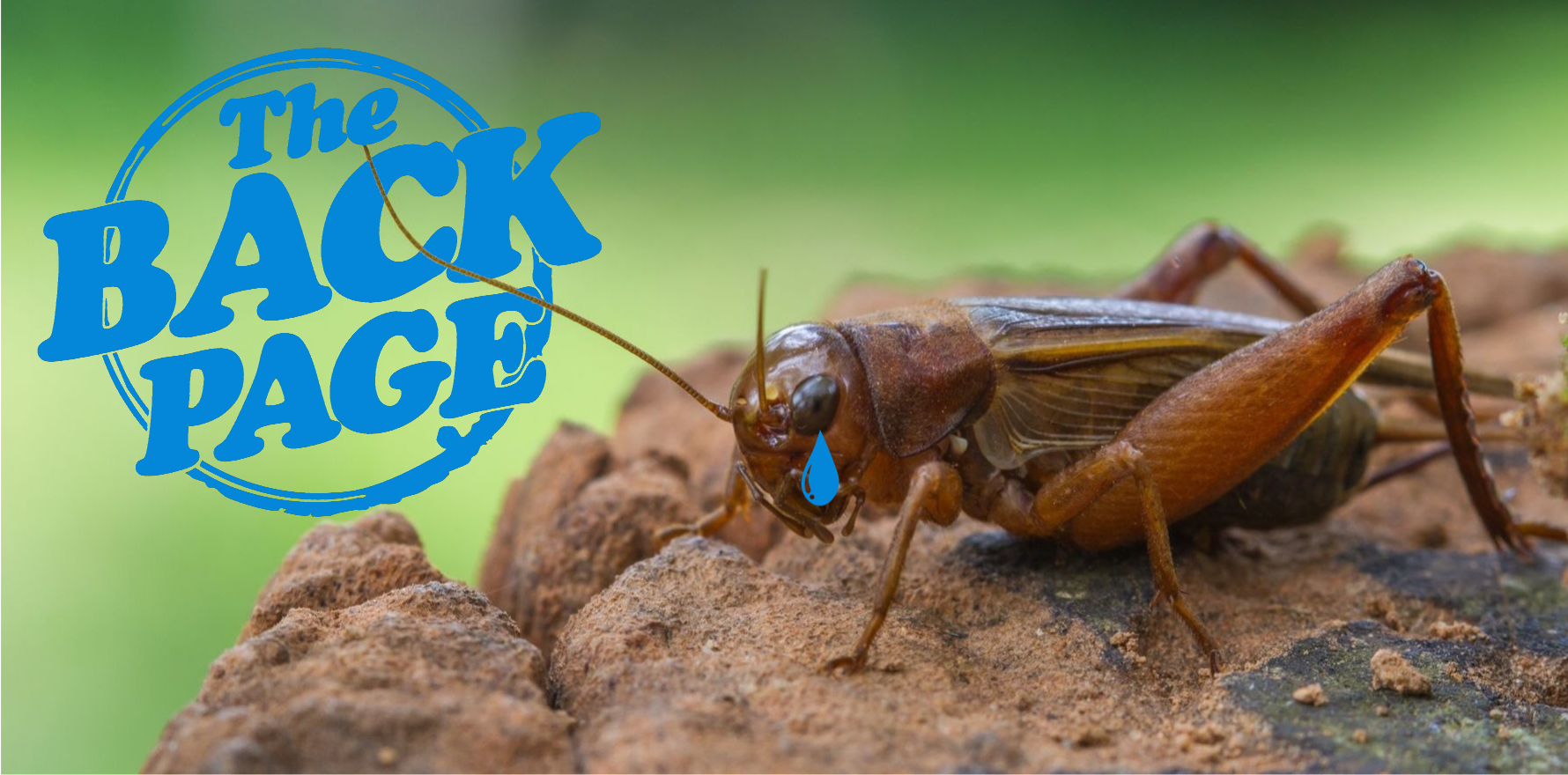
Time to put away the pins and magnifying glasses, I guess.
While your Back Page scribbler spent much of their childhood playing outside in various backyards across regional Victoria, hunting and collecting insects was not something they did a lot of.
As a result, there was no grabbing bugs with grubby little hands, or pinning them to pieces of card and writing their proper scientific name underneath before framing them.
And based on the findings of a recent study, which suggests that crickets can feel pain just like you or I, it turns out young me deserves a pat on the back for not torturing countless little critters.
The study, conducted by researchers from the School of Life and Environmental Sciences and the School of History and Philosophy of Science at the University of Sydney and published in the Proceedings of the Royal Society B, came from the notion that while there is evidence to show that other types of insects – primarily honeybees and bumblebees – show signs of pain when poked and prodded, members of the Orthoptera order (covering grasshoppers, locusts, and crickets) have featured less prominently in research.
To right this wrong, our group of intrepid scientists ducked down to their local Petstock and picked up 80 adult house crickets. The little Acheta domesticus-es were subjected to three different experimental conditions: noxious (where a soldering iron that had been heated to 65°C for five seconds was held to one of the crickets’ antennae), innocuous (where the unheated soldering iron was put on the antenna) and no-contact (where the critters were handled but otherwise left alone).
Particular attention was then paid to the crickets’ grooming habits, and whether there was any change in how often and how long they touched their antenna with a prothoracic leg or tried to bring their antenna towards their mouth (like how a child sucks on a sore thumb).
“If a pain-like experience underlies protective grooming, then theory predicts that noxious stimulation should elicit greater, more sustained and more targeted grooming than either tactile or control conditions,” the team noted.
Lo and behold, the theory was correct.
The crickets groomed the antenna that had been poked more frequently in the noxious condition than the innocuous condition (59% of grooming time compared to 44%) and spent longer grooming after being touched by the hot soldering iron compared to when it was at room temperature (an average of 13.5 seconds of grooming versus 6.1 seconds, with the control condition leading to 3.4 seconds of grooming).
“Together, these results support our prediction that noxious stimulation elicits both more frequent and more persistent grooming – a behavioural profile suggestive of flexible, experience-guided self-protection,” the scientists concluded.
The boffins stressed the real-life importance of showing “that orthopterans exhibit the same conjunction of features – nociception, integrative processing, learning and targeted self-protection – that are taken to warrant serious consideration of sentience”.
“Acheta domesticus is reared by the millions for food, feed and research, often under conditions that assume an absence of felt experience. If insects can respond to injury in a way consistent with pain – as our findings suggest – then the ethical landscape shifts.
“Under a precautionary approach, the burden moves towards reducing harm in farming, handling and experimentation. This shift is not only moral; it reflects the accelerating recognition, across fields, that sentience may be evolutionarily deep and taxonomically widespread.
“The expanding frontier of behavioural evidence is not just pushing disciplinary boundaries; it is also redrawing ethical ones. As more insect taxa exhibit traits once thought exclusive to vertebrates, the phylogenetic perimeter of likely sentience continues to creep.
“Our findings join a broader movement towards reassessing long-held assumptions, urging not premature conclusions but a recalibration of care in the face of uncertainty – one that may prove transformative for how we regard the smallest of animals.”
Send pictures of your neatly labelled insect collections to Holly@medicalrepublic.com.au.
