

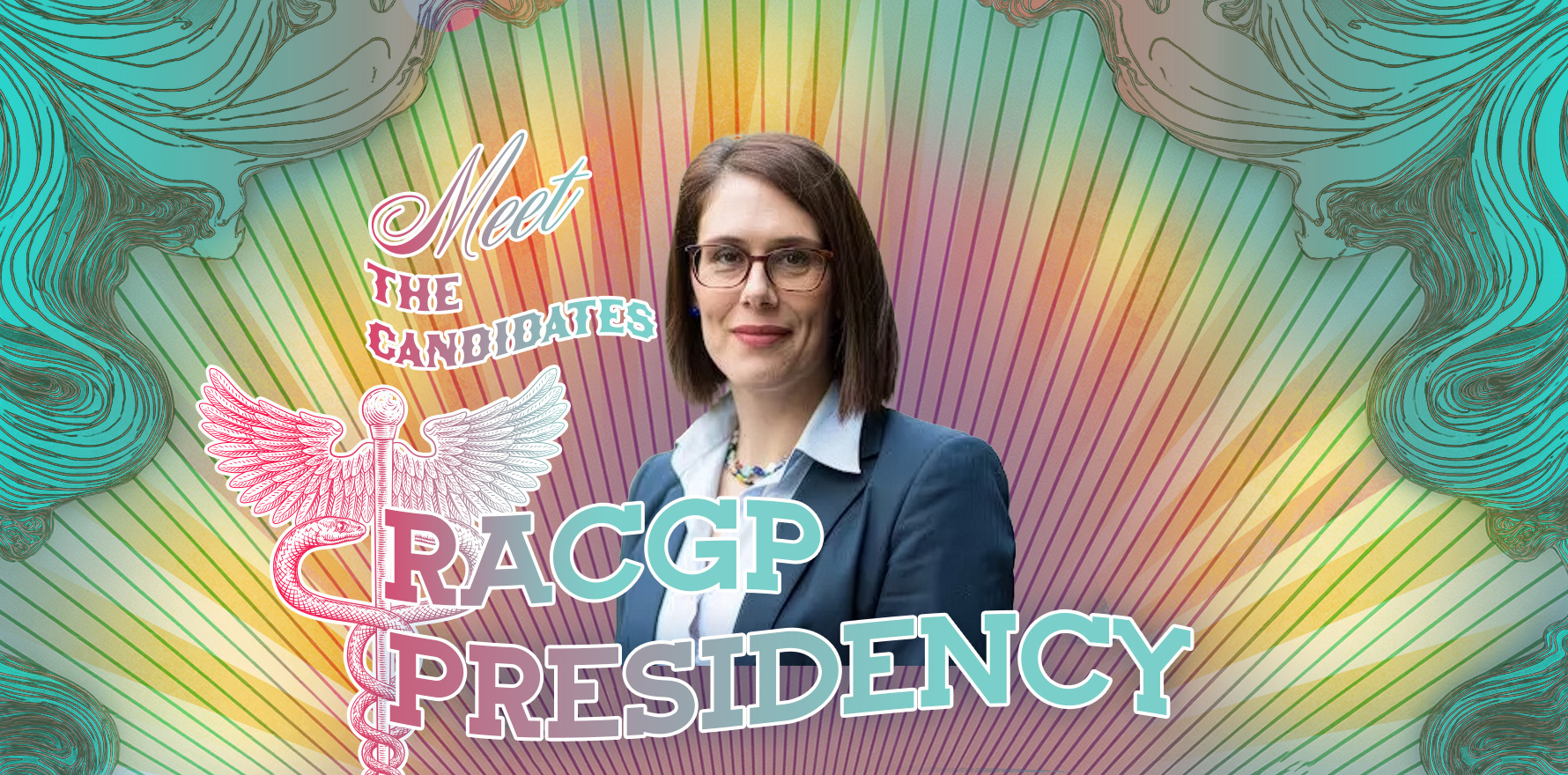
Dr Anita Muñoz is one of three GPs in the running for RACGP president.
Long-time Victoria faculty chair turned RACGP presidential candidate Dr Anita Muñoz promises to bring sustained, evidence-based advocacy and ensure the college is “open for business” should she win the top job this month.
With the campaigning period underway, Dr Muñoz sat down with The Medical Republic for a wide-ranging conversation about her vision for the RACGP.
TMR: Let’s start at the beginning. What got you interested in general practice?
Dr Muñoz: My interest in general practice came from my experience of being taught by Professor John Murtagh, who was teaching at Monash at the time when I was still a student.
I realised that I wanted to be a generalist, I didn’t want to go into any specialty or subspecialty, and I had a love of general medicine, so I didn’t want to reduce the scope of my practice.
I also knew I wanted to work in the community, and I wanted to treat people for the duration of their lives. And I liked the fact that GPs have so many skills and such a broad breadth of knowledge.
But in particular, it was having positive general practice experiences as an undergraduate and then as a junior medical officer as well, that made me decide that that was a specialty for me.
I knew very early on that hospital medicine did not suit me or my personality, and I like to have long-term relationships with my patients, which is easier for me.
TMR: Just picking up on what you mentioned there – there’s been a lot of discussion in recent years about how that first impression of general practice is vital. What would you change or improve about the GP placement system for medical students?
Dr Muñoz: We need to be supporting supervisors with appropriate information, workflows and logistics, so that practices can help students to have very hands-on, meaningful interactions with their patients in general practice and learn actively, not passively.
There are some fantastic examples of practices doing very, very high-quality work with medical student populations already around the country, but we also know that we [as a college] need to help.
We need increased capacity, because we are going to be training more medical students. We need to support general practices to be training practices, and that means appropriate funding and recognition and celebration of the fact that expert GPs are willing to give up their time and their energy to train the next generation of doctors.
But also, I think, in order for non-GP specialists to truly understand what our specialty is and what it’s capable of, having mandatory placements for junior medical officers into general practice would be hugely beneficial.
A lot of the issue that occurs when we’re talking to people who work in hospitals is a confusion about what we do.
Every GP has spent time in hospital. We’ve all done surgery, emergency, and medical placements. But the majority of non-GP specialists have not spent time in our context.
That lack of understanding, I believe, is part of the reason why hospitalists and GPs struggle to collaborate as effectively as I think they need to.
So, placements to junior medical officers and exposure to what general practice is would be hugely beneficial for the whole health system.
TMR: You referenced the fact that the Commonwealth is expanding medical student places. Combined with the uptick in general practice training, there is a looming supervisor shortage. What needs to be done there?
Dr Muñoz: We have to pour much more energy, recognition, funding, and celebration of our supervisory cohort into the training programs into the future.
Relying on general practice to always fill the gaps in our health system with altruism is no longer a feasible prospect.
Like every other professional in health, supervisors deserve to be paid for their expertise and for training and investing in the future of medicine in our country.
We need to get more supervisors per practice, so that we’re not relying on just a few in each practice, but we also need to recruit more practices.
We need to make the process of becoming a training practice simpler and easier to achieve, so that it’s not perceived to be a bureaucratic barrier to being involved in teaching in in general practice.
TMR: I believe you are at a teaching practice, correct? Tell me about your registrars and what you enjoy about supervision.
Dr Muñoz: My first love was medical education.
I went into medical education about 15 years ago, and that was what started me on my journey that took me into the college, to become chair of Victoria and now to stand as president.
From when I graduated, I knew I wanted to be a medical educator. At that time, I had to wait five years post-fellowship to become a medical educator, and I did that as soon as I could. And it brings me the greatest joy.
Having registrars in practice is a very personal and one-on-one way to influence and support people to become GPs.
It’s about helping with not only their medical education, exam preparation, learning skills, learning new knowledge, but also supporting people during their personal journeys, helping them to overcome things like imposter syndrome, fear of failing exams, managing some of the things that are occurring in their lives, like becoming parents.
All those challenges tend to bottleneck around the time that people are doing their fellowship.
Being a supervisor is a fantastic opportunity to support not just the medical education and learning, but also support people socially and provide a pastoral care role, and that that brings me enormous satisfaction.
TMR: What do you see as the biggest threats facing general practice right now?
Dr Muñoz: I think that there is a hidden agenda to bring in an NHS-style way of running our healthcare system, and I do not believe that that is in the best interest of our country.
The threats within that include a loss of clinical and business autonomy for general practice, a reduction in the respect and recognition of the expert generalist, and having non-GP clinicians doing small components of patient care.
This will increase fragmentation, and what bothers me most is that that model has been proven to be a catastrophe in the UK, and I do not believe that we should allow that model to be rolled out in our country.
TMR: What do you envision your leadership style being when presenting arguments to the government and interacting with other stakeholders?
Dr Muñoz: My approach is to be resolute and definitive and forthright in my advocacy for my profession, but you can be assertive and resolute and maintain respectful, sophisticated discourse.
I can also recognise that relationships and long-term investment in advocacy is what’s required to deliver change for our members.
I do have the courage and the capacity to have difficult conversations. I do accept that we can disagree with stakeholders and still have working relationships with them that will deliver results.
I will not shy away from my responsibility to advocate for my profession and to defend its role in the Australian healthcare system.
I also have a profound knowledge of the industry, of the history of how we’ve gotten to this point, and I’ve got over 20 years of experience being a GP, medical educator, and a practice owner. I’m deeply versed in the subject matter and politics, and I certainly will not skim across the surface of these issues.
I will interact with stakeholders with intelligence, but also with conviction.
Related


TMR: Internally, what are some of the changes you’d like to see within the college?
Dr Muñoz: I think we need to look at our own bureaucratic processes and simplify them.
We need to make things like accreditation, supervision, and managing the achievement of fellowship as streamlined, fair and transparent as possible.
I think the college has a role in managing the clashes between some external systems and fellowship, and that includes things like AMC accreditation, AHPRA accreditation and visa requirements.
We can and we must make sure that where certain systems and deadlines clash to the detriment of our candidates, that we advocate for them to make the system work for them and not against them.
I also believe that the college needs to be open for business.
I hear over and again that the perception is that it is very difficult to collaborate and work with us.
My attitude is that we must throw the doors open because I believe that there is strength in numbers, and I believe it is very difficult to ignore us when we stand with our allies, being other peaks and other organisations.
I want the college to be seen as a place where we are very open-minded in terms of collaboration and ways to advocate for a more sustainable health system and a better general practice for the future.
TMR: We noticed in your candidate statement that you mentioned international medical graduates. What are your plans there?
Dr Muñoz: I’ve observed for more than 20 years that Australia has a vexed relationship with its international medical graduates.
It is irrefutable that Australia’s healthcare system would have collapsed decades ago were it not for international medical graduates coming to our country and making the decision to serve Australian patients for their entire careers.
I believe that that is something that should be celebrated, and I believe that racism in our healthcare system need to be addressed and called out for what it is.
I also believe that if an international medical graduate comes to Australia to practise, we should provide more, not less, support and training. We should be doing everything that we can to help them to thrive in environments that they have made commitments to.
TMR: Looking to the future, what are some of the threats you see on the horizon?
Dr Muñoz: I think we need to be very proactive and future thinking.
In terms of technology and AI, there is no doubt in my mind that general practice will change dramatically in the next 10 years.
It has already changed from 10 years ago.
But wherever there is an opportunity, there is a commensurate threat.
We need to have the wisdom to look at the unintended and unanticipated consequences of all of the technologies and tools that have the potential to be deployed in the healthcare system and in general practice.
I embrace technology and I think it can be labour-saving and it can create efficiencies. But the practice of medicine is much art as it is science, and we are human beings dealing with human beings, and we cannot write out of our healthcare system the inherent human need for human care and interaction.
All of the doctors who exist currently in general practice and in the healthcare system go to work because they want to treat people and because they care for the patients that they are treating. We must not allow ourselves to be coaxed into thinking that all of those elements can be replaced by AI or other robotic mechanisms.
We also need to understand that in some instances where technology is deployed, it creates more complexity and doesn’t reduce it, and we see that over and again.
So, we have to be very wise in what we deploy, and if we observe that there are adverse consequences, be prepared to change our mind and start again.
TMR: You’ve been Victorian faculty chair since 2020. What have you learned in those six years which would make you a strong candidate for president?
Dr Muñoz: I’ve learned that you can advocate strongly, you can defend your profession resolutely – and rather than having a negative impact on your relationship with your stakeholders, that it is seen as a strength.
My relationship with the Victorian government and the Victorian Department of Health, has only increased over the six years.
For every project that’s undertaken in terms of system reform in Victoria, I have been sought out as a voice in general practice because they have come to recognise that my motivation for being there is genuinely to create a better health system, to create a safer health system with greater quality, and to speak to the role of expert generalists in the future of healthcare in this state.
The more I have advocated and given clear and correct feedback, the more that feedback has been sought.
I am concerned when it comes to leadership in medicine that we are very fearful of speaking honestly and truthfully about situations, and we are fearful of disagreement, and that means that golden opportunities for true system reform are lost, because we’re inclined to agree with our stakeholders rather than present them with opposing views and diversity of views.
I don’t have that fear. I believe that you can have conversations with diversity and opposing views, and that has been proven in what I’ve achieved in Victoria.
I have had some very strong conversations, particularly when it has come to the issue of payroll tax, and it was as a result of being prepared to have those conversations that I achieved what I did with payroll tax in this state.
If I had politely agreed with the points of view at the time, the payroll tax threat would have closed many tens of businesses in our state already, and I was not prepared to let that happen.
Our stakeholders respect thoughtful intelligence, sophisticated argument, and they’re willing to hear other sides of the story.
TMR: We like to end on a bit more of a light-hearted question. I understand that you are an active choir member – what do you love about music?
Dr Muñoz: I’m in an alumnus choir for my high school, and I play the classical guitar.
Music brings me this amazing joy because it fills your heart up, and one of the fantastic things about it is, you can’t think of anything else when you’re engaging in music.
You must concentrate. You must be absorbed. You must let it take over your mind, and that is a huge relief: to allow your mind to rest and think of something that is only there to bring you joy.
That’s what music means to me.
It’s also a personal challenge. It is not easy, particularly the classical guitar. It’s not an easy instrument to play.
But as you probably know – I love a challenge, and I love to keep developing myself.
This interview has been edited for length and clarity.
Voting for the 2026 RACGP election begins on Tuesday 11 August and ends on Friday 21 August.
TMR will be publishing long-form interviews with the other candidates, Dr Gavin Colthart and Dr Ramya Raman over the coming weeks. Interviews are being published in alphabetical order of the candidates’ first names.
