

HotDoc's new platform fee is for patients paying HotDoc for a service only, but its own communication to practices today doesn't really say that
HotDoc has confirmed a new $2.45 “Platform Fee” will apply from 1 October, but only when a patient actually pays through HotDoc’s own payments product, not on every booking made through the platform.
The trouble is, that’s not remotely clear from the notice HotDoc actually sent to practices that this is the case.
The other problem might be, where there’s one flat transaction fee, like smoke, everyone thinks “fire”, something exacerbated by ownership passing from a committed founder to a private equity firm.
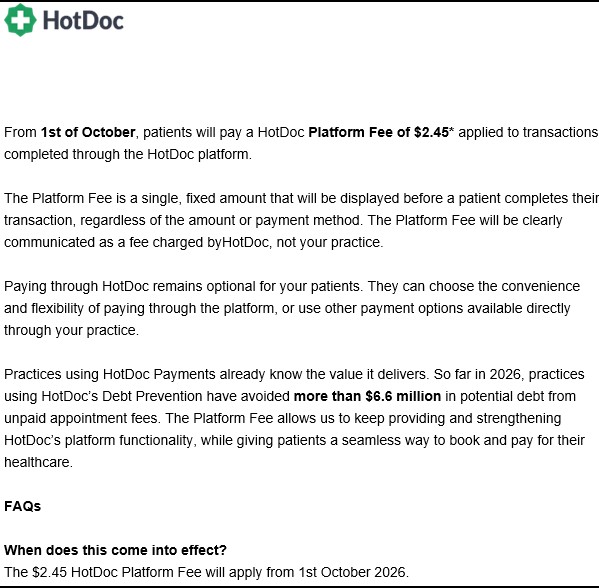
The communication, sent to practice owners this week (see below), reads: “From 1st of October, patients will pay a HotDoc Platform Fee of $2.45 applied to transactions completed through the HotDoc platform.” It goes on to say the fee “will apply… regardless of the amount or payment method,” and that “paying through HotDoc remains optional for your patients”.
HotDoc processes roughly 25 million bookings a year. If a $2.45 fee applied to every one of those, HotDoc’s revenue would jump from its reported $30 million to something closer to $80 million overnight.
Maybe they should try that?
But a change of that scale would not actually be one of the boldest monetisation moves in Australian health tech, it would almost certainly be customer alientation.
But that’s how a number of practice managers and GPs read the notice this week,.
It’s a reasonable reading: nothing in the wording limits “transaction” to a monetary payment. The dictionary definition is fairly clear “an agreement or event where two or more parties exchange goods, services, or money” – a booking is a transaction whether or not money changes hands.
The Medical Republic asked HotDoc what the actual scope of the fee would be now it’s clear they are restricting only to a transaction involving the exchange of money with a patient.
A HotDoc spokesperson provided this statement in response.
“The HotDoc Platform Fee is applicable when the online payment option is enabled by the practice for the patient’s chosen appointment type,” they said.
“Currently, less than 10% of bookable appointment types on HotDoc have online payments enabled. For appointment types where the online payment option is enabled, paying via HotDoc remains optional for the patient. If they do not wish to pay the fee via HotDoc, they are able to pay via any other methods the practice makes available.
“Please note that the Payment Processing Fee (1.75% + $0.30 per payment), which is currently charged for applicable payments, will no longer apply as of 1 October 2026.
“The Platform Fee allows us to keep providing and strengthening HotDoc’s platform functionality, while giving patients a seamless way to book and pay for their healthcare.”
How many transactions in other words are involved?
HotDoc told TMR that the fee only applied when a patient used HotDoc’s own payments service and that was described as a small proportion of the platform’s overall usage and revenue.
This isn’t HotDoc’s first communication misstep.
The booking engine paused and apologised for a “Telehealth on Demand” pilot last year after practices said it risked diverting their own patients to other clinics without adequate warning.
And a controversial new payments feature earlier this year drew a sharper warning from at least one industry accountant, who flagged that shifting patient payments away from the practice management system and through HotDoc directly carried real payroll tax and GST implications for practices that hadn’t thought it through.
So HotDoc’s payments push has already been read by parts of the industry as an attempt to become the dominant payment layer sitting between patients and practices, taking payment upstream from the PMS vendors, vendors HotDoc still depends on for its core booking integration, without paying those vendors a cut of the transaction.
A flat platform fee that only bites when patients use HotDoc’s own payment rails would be entirely consistent with that strategy, even if it isn’t the sweeping per-booking charge some practices feared this week.
The more interesting question, once the “every booking” reading is put to one side, is how much this actually raises for HotDoc over and above what they are replacing, which is the credit card surcharge on the same transaction.
It isn’t nothing.
HotDoc already charges a fee on its Routine Requests product, which handles repeat prescriptions, referrals and medical certificates – typically privately billed services in the $20–$40 range with no Medicare rebate.
HotDoc’s own documentation shows a worked example with a $2.07 booking fee on that kind of transaction. The new $2.45 platform fee represents a straightforward 18% increase on that existing charge, applied every time a patient requests a repeat script or certificate online.
It’s also a meaningfully different cost structure to how HotDoc currently prices card payments generally.
Practices can already opt to pass on a “Provider Processing Fee” of 1.75% plus 30 cents to patients paying by card on a $30 Routine Request payment, that works out to around 82 cents.
A flat $2.45 fee on the same transaction is close to three times higher.
On larger payments – a $200 specialist gap payment, for instance – the flat fee is actually cheaper than the percentage-based alternative. The practical effect is that the new fee lands hardest on the low-value, high-frequency transactions Routine Requests is built around, not on the occasional big-ticket payment the credit-card-surcharge comparison implies.
HotDoc has also been promoting the value of its payments product this year, telling practices that its Debt Prevention feature has helped avoid more than $6.6 million in unpaid appointment fees so far in 2026 – a figure that suggests more real money is already moving through HotDoc’s payment rails than “a very minor part of the business” might imply.
