

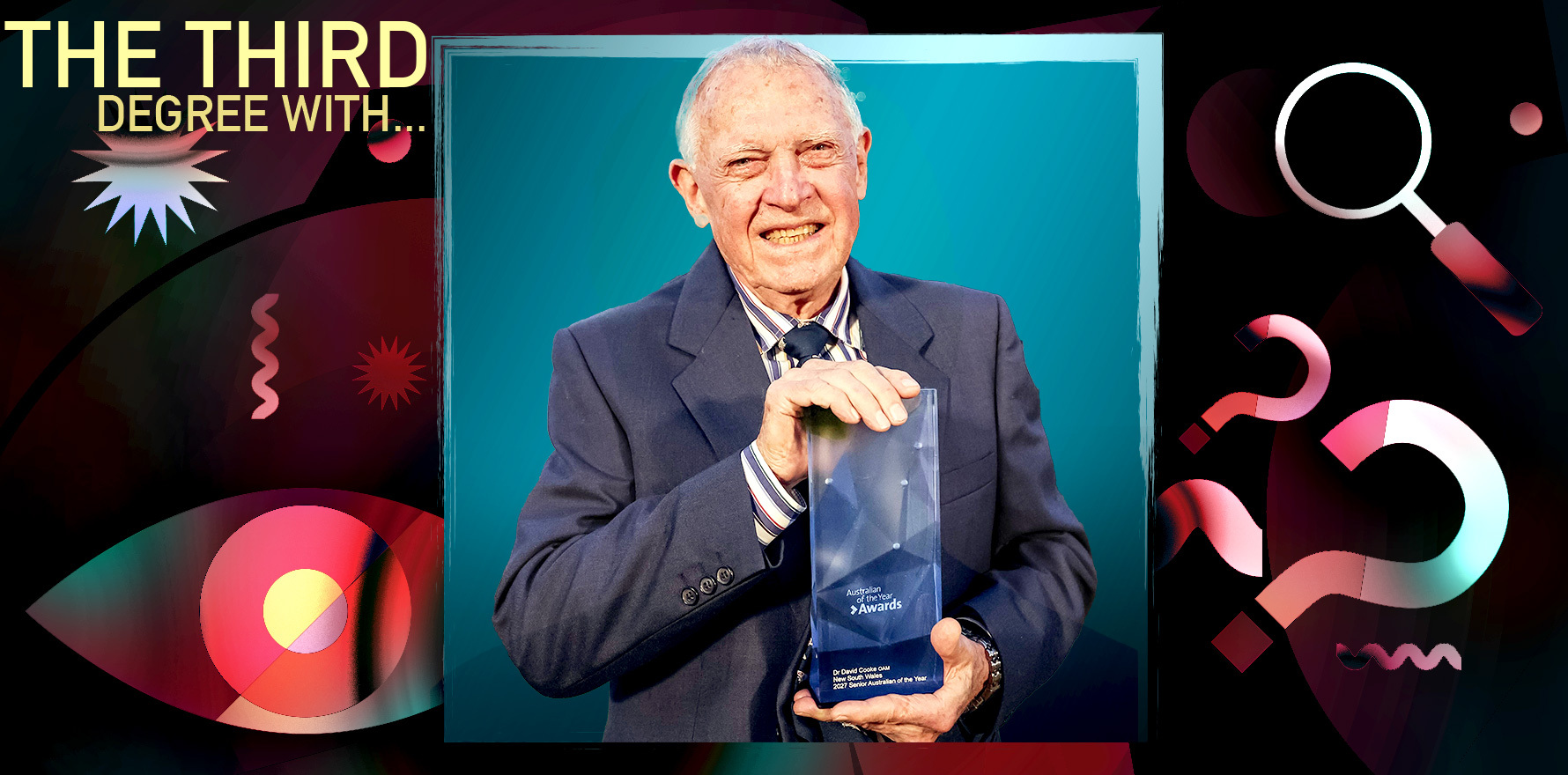
He may be well into his 80s, but this New South Wales mid-north coast GP and aviation enthusiast has no plans to put on the brakes anytime soon.
In 2020, Dr David Cooke received an Order of Australia Medal for his service to aviation and medicine. This year, the 84-year-old Port Macquarie-based GP and pilot was named the 2027 NSW Senior Australian of the Year.
Dr Cooke dialled in for a chat with The Medical Republic to discuss rural and remote medicine, what almost six decades in the sky has taught him about the ever-changing world of medicine, and what keeps him going.
TMR: You’ve described yourself as a “black sheep” in your family. You come from a four-generation flying family dating back to 1915, and coincidentally, the day we are having this conversation is Remembrance Day. Can you describe your experience growing up?
Dr Cooke: My grandfather was a pilot in the Australian Flying Corps in 1915. And then in 1940, my father was a fighter pilot. He went to England and was killed a month before I was born in 1941, and then Mum married another pilot in 1945, and he was killed.
And then she married a third pilot in 1949, who brought me up. He survived, and we were great mates.
[My boys and I] started a company [Avcair aviation services] in Port Macquarie about 25 years ago, which has since relocated to Queensland. The boys fly small jets and conduct evacuations worldwide.
If you get covid in Uzbekistan, you can’t fly back on a [commercial] airline. Your travel insurance pays for them to come pick you up, so that’s what they do.
So, four generations, and I’ve been flying since 1958. I’m still flying.
TMR: Your passions are both medicine and aviation. What drew you into general practice specifically?
Dr Cooke: I initially started training to be a neurosurgeon in Sydney in the mid ’60s, and then I left Sydney, [where] I grew up in Mosman. Instead, I became a [GP and] flying doctor in the Northern Territory.
My family all said, ‘You don’t know what you’re getting into,’ and I said, ‘No, but I just feel I’m going to love it,’ and I did. I just loved it.
Although I wasn’t the pilot in the operation, they used to let me do a bit of the flying unofficially, and the pilots sometimes helped me operate.
In the 60s and 70s, the Royal Flying Doctor Service had bases in Mount Isa and Cairns.
I was based at Mount Isa for four of those years. I was covering an area the size of Texas, or about the size of the British Isles, on my own, 24 hours a day, seven days a week.
It was all fairly primitive, and often you’re a long way from a city.
Well, there’s only one city, Mount Isa. But it was just lovely because the people loved you for what you were doing.
You were enabling people in the outback to live there, secure in the knowledge that there was this character who would come and rescue them. They were living in temperatures often as high as 45 degrees. It was a very harsh climate.
We were all working about 80 hours a week, and you’d be working all day, on call at night, and then at midnight you’d be doing a caesarean or something to deliver a baby. But that’s what it’s all about – the shortage of doctors in the bush, and that’s what I really champion [addressing].
I just loved it and did it for many years up there.
TMR: You’ve spent nearly 60 years as a flying doctor, including six years in the Royal Flying Doctor Service (RFDS), witnessing immense changes in technology and practice. You’ve described life-or-death moments when the aeroplane had no weather radar, doing ‘everything by eyeball’, and how you even began training as a parachutist to reach the most remote of patients. Looking back, what do rural and regional doctors take for granted today, and how have the challenges in this field changed?
Dr Cooke: We didn’t have specialists readily available. We originally did all those things, like delivering the babies, removing appendixes and performing caesareans. In the outback, you’d be setting a fracture without an X-ray to guide you.
We didn’t have cardiographs or blood tests either, so you’d be treating heart attacks without them. They’re now readily available to all of us, so it certainly made it easier.
When faxes came in – they have come and gone now – we could send a cardiograph to a specialist and get a report on it, even though we had trained ourselves to read all these things.
You’d find yourself operating in a little grass shack with the rain coming down through the roof, and you’d take a few primitive instruments out to perform the operation.
It’s not as primitive as that now. The aeroplanes they use now are like mini emergency wards on wings. Nowadays, with much better transport, [and] people able to see doctors online, it is a lot better than it was in my day.
We’re very lucky, and we’ve got world-class specialists in Port Macquarie, for instance, but there aren’t many of them. We might have to wait months to get you in, so we, as the GPs, have to cope with and learn how to treat people to get around the delays that sometimes happen in the country.
TMR: What does that mean for how you approach your practice going forward?
Dr Cooke: The country would kill you if you didn’t respect it. You must always tell people where you’re going, when you’ll be back, and what route you’re taking.
We do continuing medical education, and I still devour it. We’re required to complete 50 hours every year. Well, the year isn’t over, and I’m already up to 150 hours because I just go online and listen to conferences.
Last night I was online for two hours until 9 o’clock, being educated, because [medicine is] changing all the time.
TMR: Is there a moment from your RFDS years that stands out?
Dr Cooke: Part of my beat way back in 1968 was as the doctor in what was then called Gove, now Nhulunbuy, on the Gove Peninsula. There were many Aboriginal settlements in Arnhem Land.
I loved looking after the [Indigenous communities] – they’ve got a most marvellous sense of humour.
We had a typhoid epidemic in 1968 in Arnhem Land at a couple of Aboriginal settlements. I said to the director of health, ‘What do I do about this?’ He said, ‘We don’t know. Go out there and don’t come back till you fix it and then write it up for the medical journal’.
So I did, and we fixed it. The Indigenous peoples were so grateful that they gave me a tribal name, which I was very honoured to receive.
There were quite a few interesting events in the RFDS.
I was urgently called to a rodeo about 200 miles [322 kilometres] from Mount Isa, and they said, ‘The bloke’s fallen off his horse, and he’s knocked unconscious, and he’s convulsing’.
So, we hopped in the aeroplane at great speed, raced out there, and arrived about an hour and a bit later.
A truck came roaring up in a cloud of dust, and I thought they were bringing the patient out to me. They said, ‘Oh, the patient woke up. He’s competing in the next event. Would you mind waiting?’
That’s the sort of hardy people we were dealing with.
TMR: In 1999, you moved to Port Macquarie. What inspired you to settle there?
Dr Cooke: It was the 80 hours a week. You talk about burnout; it’s more than burnout.
It just totally wears you out, working and not being able to get anybody to replace you when you went on holidays, and you couldn’t get anybody to cover for a weekend off if you wanted to go away somewhere.
My kids grew up not knowing me because even when I was at home, I wasn’t worth talking to because I was so tired.
After some years [up north], I returned to a small country town in Western New South Wales, Gunnedah [approximately one hour from Tamworth], where we needed 10 or 12 doctors but had only about five.
My dear old [practice] partner, who was actually younger than I am now, died sadly, and I was sort of left on my own.
And I thought, well, I don’t know how much longer I can keep this up.
So, I saw there was a vacancy for a doctor in Port Macquarie, came over here, and I’ve been here ever since, [as well as] attempting to help the medical manpower in Southwest Rocks.
It’s a lovely place to live. I go for a walk every morning. I’m a great believer in exercise, and I start work at seven, but at six o’clock I’m belting along beside the beach here where I live doing a power walk.
I sit in my surgery, looking out at the whales going by along the coast.
Related

TMR: Many doctors struggle with burnout, despite their best efforts and factors beyond their control. What has been the most rewarding experience of your career, and what advice would you give to younger doctors, particularly registrars?
Dr Cooke: Until recently, I was teaching final-year medical students here in Port Macquarie. I would tell them it’s not just knowing the [medical] stuff. It’s about compassion.
In general practice, your ability to practise well is directly proportional to how well you know the family and the people.
You know [a patient’s] family situation is such and such, and when they come in tired, you know it’s not just ordinary tiredness. They’re worried about their aunt or uncle who might have cancer.
When you’re in general practice, you know all those things, and that’s what’s lovely.
I still do house calls. It’s not that common anymore, but I still do, and it’s a privilege to treat people.
It’s been 27 years since I left Gunnedah, but I’m still getting people from there to come see me over here in Port Macquarie.
My dream is to get more doctors, particularly more specialists, into the bush. They tend to stay in the big cities where they’ve got better facilities.
A girl from my clinic at Southwest Rocks comes to mind. She flew with me, and then we hopped on a little motor scooter into town, where she watched me see patients at Southwest Rocks.
And I asked her at the end of the day, ‘Well, what have I taught you today’?
And she said, ‘You can have fun being a doctor’.
TMR: What was your reaction to receiving the NSW Senior of the Year award?
Dr Cooke: So, so surprising. It’s been a bit daunting and a bit overwhelming. When they announced that I was the winner, people said the look on my face was one of amazement.
My wife always says, ‘Behind every successful man is a very surprised woman’.
She’s totally supportive, and she’s [also] the reason I received the Order of Australia six years ago. I told everyone, ‘Liz should be getting it, not me’.
TMR: To end on a lighter note, you’ve spent a career looking at Australia from the air. Has any place overseas matched Australia’s view from the cockpit?
Dr Cooke: My wife is from Scotland. We go there a lot, and we love it.
Now, because there are more doctors where I live than there were out in the west and up in the north, we do get away a bit.
Every weekend, I lead a team of eight pilots in aerial formation over Port Macquarie [the Bobcats]. We’re quite touched that the town comes out to watch; it seems they’ve adopted us. In fact, they complain if we don’t fly. So that’s what we do to relax.
TMR: A last, perhaps cheeky question. Do you have any plans to retire?
Dr Cooke: [chuckling] Absolutely not. It’s so lovely sitting and talking to nice people all day, trying to make them better. I work with lovely people in my surgery and lovely staff.
Why stop?
This interview has been edited for length and clarity.
