

General practice registrars won big in 2025, but GP supervisors barely got a look in. It’s time for that to change, says GPSA’s new chair.
Health Minister Mark Butler has made no secret of the fact that he intends to increase the number of junior doctors going into GP training – but what will it take to keep the GP supervisor workforce on board?
Until GP supervisors get recognition and appropriate remuneration for the ‘in between’ moments that make up the bulk of GP training, General Practice Supervision Australia chair Dr Candice Baker says the role, though rewarding, can be a tough sell.
Dr Baker, who took over from previous chair Dr Srishti Dutta in late 2025, sat down with The Medical Republic for a chat about her career to date and where she sees GP supervision going over the next few years.
TMR: You work in regional Victoria. What’s your local community like?
Dr Baker: I trained as a rural registrar and have been in a rural training practice since 2012 in regional Victoria, so I don’t know what it’s even like to work in the city anymore!
I grew up rurally, in a town with a population of about 5000 people. So, very, very small.
I very much have [been involved] in rural medicine and the rural lifestyle since I was very, very small.
We’re located in between Melbourne and Bendigo, so it’s not super rural, but you certainly still get a chance to bite off a little bit more in general practice than what you might if you were right beside a major tertiary centre and had access to lots of allied health and specialist input.
I’ve been here for over a decade now. I think, [like it is for] lots of people, you become enmeshed in in the community. You get that multi-generational care across families, which really puts you in a unique position to understand, perhaps, reasons for presentation and some of that history that you might not have known otherwise.
TMR: We hear a lot about the rural workforce shortage and the difficulties in getting young GPs out into the regions. At the same time, it’s also important to highlight some of the bright spots. What are yours?
Dr Baker: I think you do have to be a GP that does like to extend your scope of practice a little bit.
I also am a visiting medical officer for our local hospital, so I’m still doing inpatient work. I have a huge passion for palliative care, so I do a lot of supporting patients to die at home and home visits.
We’re in a fortunate position, in that our location is not so rural that it makes impingements on lifestyle choices for registrars.
We don’t tend to have issues with securing registrars, so that has not been a struggle that we faced at my current practice.
Certainly, it’s something that we need to look at more broadly for the practices that do have difficulty with that. Because certainly the further we go away from those major cities, the more difficult it is to find and retain staff.
The colleges have been doing a lot to try to improve the uptake in those placements, but obviously, there’s still a lot to be done.
TMR: You’re not only fellowed as a GP in Australia, but you’re also a fellowed family physician in Canada. What has the experience of working across countries been?
Dr Baker: I grew up in Canada and spent the first 23 years of my life there, so Canada has always been very close to my heart. All of my family is still there.
We made the decision that we would go back in 2019 and spend a couple of years there, and so we did.
I was able to go back and immerse myself in what I’d obviously had some experience of as a consumer before I left but had not had experience of being on the other side of and delivering healthcare.
That was a wonderful opportunity, and one that was really eye-opening in terms of looking at the different models of care, which had lots of similarities, but also lots of differences.
I remember coming back and thinking, ‘oh, you know, we really need to do things this way’, so it was quite inspiring just to work in a different system and experience that.
We were there for about two years, all in all; covid obviously came along shortly after we arrived, so that certainly played a role in the duration of time that we spent there.
We were in Ontario, working very rurally in a small town, about two and a half hours from any major centre.
TMR: You touched on it just before, but what were some of those differences that you thought ‘wow, we should be doing this in Australia’?
Dr Baker: I think the Canadian system is very much built on family doctors being the backbone of the health system, so there’s an enormous amount of respect for family doctors from non-GP specialists, but also from patients.
Truly, what Canadians consider the biggest gift they can be given is actually having a family doctor, because there’s a huge shortage.
Lots of patients are without family doctors, which means that they need to access all of their care through an emergency department.
You’re actually allocated patients, so when I arrived I was given a caseload of about 1000 patients, and they just get given to you.
The patients … come in under your care, and the IT infrastructure is so fantastic that I literally have everything from their birth certificate to every single ultrasound they’ve ever had to every blood test and every discharge summary.
It just comes into my software, because it’s all government owned and mandated.
The continuity of care was really incredible. There was no chasing up an ultrasound that was done at this clinic last year or bloods at this place two years ago, it was all right there at your fingertips.
Very easy to access, and I think it allowed better patient care overall.


TMR: And why did you choose to come work in Australia in the first instance?
Dr Baker: It’s just one of those life events where you go, ‘wow, I didn’t really understand the significance that was going to happen from that one single decision’.
I’d sort of finished my first degree that I had done at the Canadian university I went to, and I came out of that, not exactly sure where I was heading next.
One of my good friends was applying to medical schools in Australia. And I thought, ‘huh, I could do that’.
So I did, and I got in, and I probably didn’t understand the momentous, cataclysmic life shift that was about to happen by saying ‘yes’ and relocating to Sydney in 2006.
It was an enormous change but has been full of growth and privilege and amazing experiences. I certainly wouldn’t change it.
TMR: Did your friend who applied first get in too?
Dr Baker: He came here, did a year, and went back to Canada! Funny story.
TMR: Moving on to questions about your role with GPSA – last year, we saw a large piece of investment into GP training in terms of added places and paid leave. What would you like to see happen for supervisors?
Dr Baker: I think the simple answer to that is that we need wider recognition and remuneration for clinical supervision and a real understanding of what clinical supervision is and what it looks like.
I think the sum of supervision is not really made up of those face-to-face uninterrupted teaching sessions.
It’s the catching up at lunch to discuss the hard patient. It’s the immediate debrief that your registrar needs after that challenging patient. It’s helping them with a critically unwell patient.
These things aren’t funded yet, but they’re actually where the connection and the growth come from, for both the supervisor and the registrar.
I think we really do need to see clinical supervision for what it is, and we need to start valuing it so that we maintain the supervisor cohort that we’ve got.
TMR: There’s a clear plan here to increase the number of GP registrars. If that happens, and it seems like it is, do we have the supervisor infrastructure?
Dr Baker: It’s not only the influx of the new training places for AGPT, it’s also our pre-vocational doctors and our medical students who need supervisors.
I think we’re finally starting to see the real value of students being embedded in general practice and having a good understanding of what primary care looks like.
We really need to start looking at the barriers for new supervisors to take on supervision.
It may very well threaten [supervision] sustainability if we’re not making it something that is attractive and showing the great things that can come out of being a supervisor.
I think lots of newly fellowed GPs are looking for flexibility, they’re looking for a role that’s got a part-time FTE fraction … so I think this is going to impact the robustness of the supervision pool over the coming years, as we see more learners coming into general practice.
Remember that, a decade ago, we had less trainees coming into general practice, and so therefore you can sort of assume that there’s going to be a bit of a delay in terms of seeing that impact in our supervisor numbers –if we only had 60% of the registrars that we’ve got now, that is going to feed down the pipeline for who’s becoming a supervisor.
Plus, we’ve got an ageing supervisor workforce. I do think that it is something we’re going to have to look really seriously at, if we want to use general practice as the training ground for so many different learners.
TMR: What are some of the barriers to GPs going into supervision?
Dr Baker: Part of it is the fact that it’s a fairly intense role, you don’t necessarily clock on and clock off as you would in in other FTE roles that have got perhaps more mandated hours, depending on where you are and how much support you have with other supervisors.
It may prove impossible [for some doctors, for instance] because they don’t work the same hours as their registrar, and therefore actually can’t provide the clinical supervision that they need.
I think we need to look at some of the rules around what we’ve got. Do registrars perhaps need to be involved in training other registrars? Do they need to be involved in training medical students?
Do we need to look at the vertical integration of teaching and learning? Or at our restrictions on when our newly fellowed registrars can become supervisors, to have some kind of supervisor succession planning in place so that we can actually start to grow some of those individuals that have got an early interest in supervision?
This was flagged as an enormous issue at our last supervisor advisory council meeting at the end of last year in Melbourne, where a lot of our senior supervisors were really concerned that they were just not seeing the uplift in their registrar trainees that were turning into fellows wanting to become supervisors.
[The newer fellows] really wanted flexibility, and that wasn’t offered through supervision. It’s going to need a lot of work.
TMR: Are there any specific actions that you’d like to see – if we’ve got all these incentives for registrars, for instance, could there be something similar for supervisors?
Dr Baker: There have been lots of ideas that have been thrown out and debated around the table, including an item number for supervision.
I think that whatever we put forward, we need to make sure is robust enough to have the longevity to keep up with supervision, but also to make sure that it’s sufficient for what we’re actually doing.
And I’m not convinced we’ve quite found exactly the right way to take that forward, but there’s certainly a lot of discussion in the mix about ways that that might go.
TMR: We like to finish up on a silly question. If you have any pets, what do you think they would do if they were a person?
Dr Baker: I was absolutely blessed to have just the most beautiful stumpy tail cattle dog in my life for 12 years, who was my absolute shadow and who I love dearly.
He sadly died a few weeks back, but he was truly one of a kind, and someone I truly miss desperately every day.
If he was a human, he would have been some kind of a ball sports superstar.
His ability to catch a tennis ball while being two metres up in the air was incredible. So either some sort of amazing sports superstar, or maybe a police officer, because he very much was protective in nature and was someone who followed the rules very well.
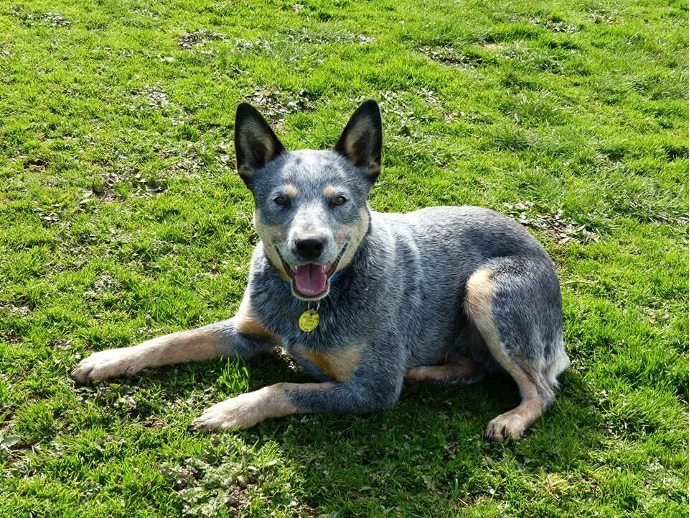
Joop the stumpy tailed cattle dog.
This interview has been edited for length and clarity.
