


If you didn’t make the Heidi Unlocked do in Melbourne this week, you missed a party. And a big announcement.
If I had to describe in one word what the Heidi Unlocked function reminded me of when I turned up (late – Jetstar did that) on Thursday and heard the blaring music coming from an old factory, it would be ‘rave’ (no drugs, despite all the doctors).
I’ve been to medical functions, summits, and exhibitions all over the world over the past 28 years. I’ve been to HIMMS with its three football fields of exhibition hall and 45,000 delegates and SMACC in Berlin, which was pretty party-like – it’s mostly ED doctors on R&R.
This wasn’t anything like anything I’d ever experienced at healthcare event before.
This article originally ran on TMR’s sister site, Health Services Daily. TMR readers can sign up for a discounted subscription.
What is going on? A few things.
As someone said to me recently about Heidi: “Jeremy, when was the last time you ever heard a doctor express delight over their medical software? I’ll answer for you: never. Until now.”
That’s maybe the biggest thing.
But you need money and good decision-making, even if you have built something cool.
Heidi is actually over six years old. But it didn’t really start getting its AI mojo until early 2024. Founder Dr Thomas Kelly was very early into medical AI, experimenting with LLMs when they first emerged around 2021.
From its first real scalable AI scribe product in early 2024 it really took off. In those two years it spread its wings to 116 countries.
Now I’m at an afternoon medical rave in the Melbourne Docklands. There’s about 700 people here. They’ve come from all over Australia. There’s a few from South Africa and New Zealand.
The people who’ve come sense the seismic nature of the change at hand, and they want to get a look at it firsthand.
The people taking the stage have just a tad of rock-star feel to them. They have been on tour, after all. The stage is like the early Apple conferences in San Francisco, when Steve Jobs ruled the creative roost, and Apple was actually doing amazing things.
Get on the bus… even if you don’t like buses
Medicine is almost certainly at a moment in history perhaps like no other, including the discovery of penicillin.
Welcome to healthcare AI.
If you’re a healthcare professional, whether a clinician, a hospital CEO, a government policy apparatchik, a private insurer, a health politician or the like, and you’re not anxious but excited, you’re very likely not in the headspace you should be.
According to New York-based healthcare AI and data analytics consultant Marc D Paradis, who spoke last week at Australian Healthcare Week: “[AI] is going to be the data set that will be the foundation to rewire and reimagine healthcare in a way that scales at the rate of silicon, because we simply can’t scale organic carbon.”
“Healthcare [today] no longer scales,” Mr Paradis told TMR this week.
“Redesign is not an option now. It’s an obligation. “We must align the rate at which [AI capability] expands with the rate at which the system can learn and adapt.”
Mr Paradis’ biggest message for Australian healthcare professionals on AI? Start now if you haven’t already and keep hard at it.
“Current clinical governance has been built to manage fixed, slow-changing interventions and a world of episodic care. That won’t work in AI medicine, which is dynamic, data driven and continuously learning.”
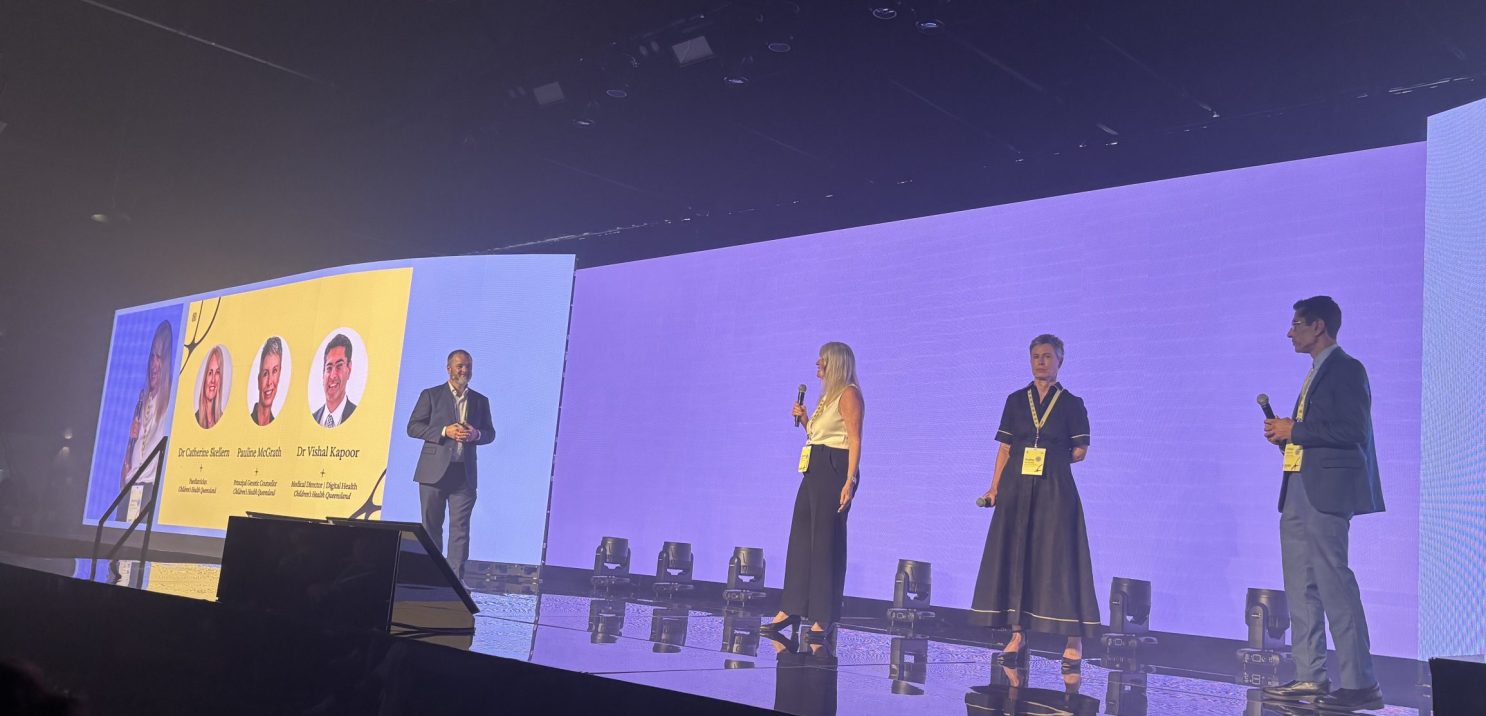
As if on cue, on stage Dr Katherine Skellarn from the Queensland Children’s Hospital is describing how transformational she thinks Heidi already is for her organisation.
But she’s quick to point out she feels she hasn’t scratched the surface.
“I switched to Heidi Evidence last week in private practice, and it, again, was transformational. So, the next step is to have that tool in the hands of specialists in our organisation so that we can deliver on improving the quality and safety of healthcare.”
That story is everywhere now, which explains the exploding growth, not just of Heidi, but of lots of healthcare AI-based initiatives.
Now Dean Mills, the director of information technology at Anglicare, a group you’d normally associate with conservative and slow technology assessments – for safety reasons – is saying that if he were to attempt to take away Heidi from those staff now using it in the group, “he’d be killed”.
If you’re out there and anything like me – an internet curmudgeon – you might be thinking “give it time, it’s a bubble that medicine will bring back to earth”, then you’re almost certainly losing precious time understanding a dynamic that is going to change everything around you over the next few years – in good and bad ways.
A couple of anecdotes for the cynics here.
I once ran a fast-growing internet lead-generation SEO business, which was also a media business, and new ideas and products were landing most days. My CTO approached me one morning and said I really needed to check out a thing called Twitter. I said I had, and it was a ridiculous idea that I gave a couple of years to fail spectacularly.
In a manner you just can’t afford to have any sort of closed mind here. In the case of Twitter, if not for Elon Musk, it would be a major information platform for news and journalism today – it once was. We missed a few tricks with my dismissive behaviour.
Another possibly interesting take on what is going on here with Heidi today:
I remember the first time that what is today Best Practice was demonstrated to me in 1994, in the back room of a small hotel in Melbourne, on a very small stand, with about two people on the stand (about 20% of the entire staff) with about five other exhibitors around.
It was pretty hard yakka for those employees. Virtually no doctor was interested. But in fairness, a lot of them didn’t even have computers on their desks back then.
Today Best Practice is probably the most important current medical software platform in the country because it is the gatekeeper to 80% of GPs in the country.
Now I look around the room at the equivalent stage of Heidi’s development – 700 people, all hungry to see what the bleeding edge looks like.
Heidi is integrated into Best Practice but Best Practice has its own scribe and AI admin agent called Lyrebird, so, although theoretically Lyrebird is first cab off the Best Practice AI rank, Heidi is still cutting through. It’s claiming 50% of GP share in Australia.
Related


Not an EMR but….
Best Practice is essentially an EMR which Heidi isn’t so it’s not like Heidi or its many challengers are going to oust this iconic long-term software brand.
Or not?
Best Practice will be around for a long time. It’s got share, it’s a pretty well thought of brand, especially for its customer focus, it leads entirely in the market for GP patient management system.
But when you watch a demo of Heidi, the first two things everyone watching says to the demonstrator are:
- “Is this an EMR as well”? And then, when the demonstrator says no but it integrates to a lot of big EMRs…something like…
- “Ok, but this is a lot of what I need though …especially the Evidence work after we get the session summary”
Notably the version being demonstrated is the one with Heidi Scribe and Heidi Evidence. Heidi Evidence was only introduced a few weeks ago, but watching the demos, it’s sort of what is making the onlookers’ eyes pop.
You talk to your patient, you establish some clear problems and perhaps an idea of diagnosis, and then you ask Evidence about options.
Heidi Evidence is an evidence-based, doctor-grade AI information agent, which Heidi is feeding a ton of professional medical guidelines and data, including information and data supplied by the British Medical Journal.
This is a huge jump for Heidi, from fairly ubiquitous scribing functionality, to hard core decision and knowledge support.
It’s impressing early users. And why wouldn’t it?
You talk a bit to your patient, you as a healthcare provider are thinking and making your own assessment of what is probably going on, and then you ask Evidence what it thinks … just like we all ask Claude or ChatGPT what they think doing work at the office every day.
The users are bug-eyed at the seamlessness of the process to the point where you have a range of options, which may or may not help you in what decision you next make for your patient.
Heidi is also already incorporating a lot of upstream admin and comms for its users, including an AI receptionist which knows the patient calling if they’re on file, can talk to the EMR and understand low-acuity questions to direct the patient in exactly the right way for a clinic and clinician.
It again begs the question of just how hard it might be for Heidi to one day walk backwards into some sort of EMR – not likely a hospital one, but one general one for everything outside a hospital.
The big league of doctor-grade information
But commercial science and medical data and journals, which all charge for access to their data, is the big league in terms of decision support and data evidence.
Heidi is up against the Reed Elseviers and the Natures of the world. Reed Elsevier owns something like 60% of the world’s medical and science journals, plus a bevy of medical data businesses.
They aren’t going to take kindly to a start-up like Heidi having a go at them in the field of medical decision support.
They already have a lot of AI products and partnerships. And they have a lot more money than Heidi. A ton more.
The only thing Heidi has is distribution and brand attractiveness – which isn’t nothing. Maybe it’s enough to start doing deals with the serious medical information people?
Heidi is not standing still.
What’s the big announcement if you remember the intro?
Dr Kelly thinks that what clinicians and healthcare professionals use for recording and transcribing – the hardware – simply is not well designed enough and good enough for Heidi clinicians.
So, he’s taking the business into hardware and has built a standalone recording and transcribing device, that fits onto a shirt or a top like a lapel mic and works anywhere without wifi, or even standalone, with four days of battery life if necessary.
Who knows what this means but it sounds pretty neat.
It’s interesting.
It goes to Heidi looking at the whole spectrum of its users’ needs and keeping up the whole “delight” thing.
I really don’t think Reed Elsevier is building stuff like this for people to use their journal data. They may have to do a deal with Heidi in the not too distant future.
That would be like Europe and the US making up – pretty unstoppable.
We’ll have some more on this next week when we digest everything at Thursday’s party.
Note: there’s no open bar at this party. Things really are different around here.
