

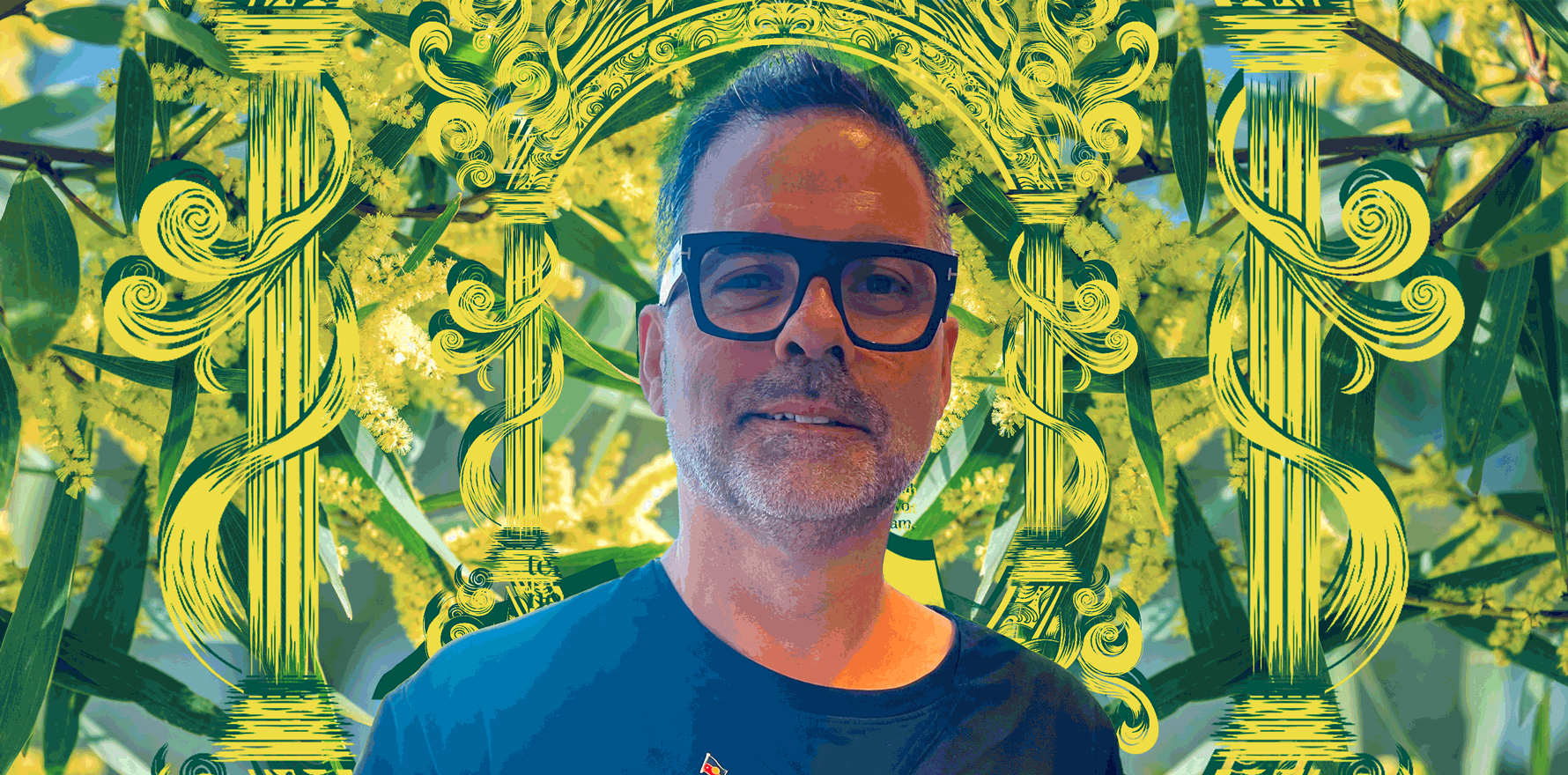
While he has your attention, Dr Fergus McCabe wants to address the increasing risk to health workers when patients fall through the cracks.
In 2023, GP Dr Fergus McCabe disarmed an axe-wielding attacker at his Perth clinic. Today, he has been commended by Australia’s governor-general for his bravery.
Dr McCabe had only bought into the practice a couple of months prior to the incident, and his consulting room was directly above another colleague’s. He was attending to a patient when he heard the first scream.
“It wasn’t a normal scream. It was a very shrill, distressing scream. So I immediately knew something was wrong,” he told The Medical Republic.
He said he could never have imagined the scene that he was about to find.
“I very quickly got up and left my room. As I was going down the stairs, my young receptionist had jumped up, and … was going to help,” he said.
As he turned the receptionist away, Dr McCabe saw a 12-year-old boy and his dad waiting at the bottom of the stairs to see him.
“I could see in his face the absolute terror,” Dr McCabe remembered.
By the time Dr McCabe had rounded the corner, the entire clinic was empty.
The waiting room was cleared and triple zero had already been called. By chance, one of the receptionists on duty had a part-time job with triple zero and knew which code to give.
The attacker, who was known to one of the GPs at the clinic – TMR will be referring to her as Anna – entered one GP’s room by accident before he located Anna’s consulting room.
That first GP saw him slam the door shut after attacking Anna.
“She knew Anna and the patient were jammed, trapped in that room, and she had the absolute bravery to come back in, run past the door and swing the door open,” said Dr McCabe.
“All that had happened before I got there.”
With the door open, Dr McCabe had a chance to take the offensive and disarm the attacker by complete surprise.
“He didn’t see me coming,” he said.
“He had struck her with the axe and then come back to swing again. But because the room was smaller, [and] because this patient, this woman, had been so brave to get up and get between the two of them and grapple with him, she slowed him down.”
Anna and her patient, who was 12 weeks pregnant, had fallen to the ground, grappling with the attacker when Dr McCabe reached for the axe.
“As far as I’m concerned, it was like taking a knife out of butter. It just came out with my hand. I can only imagine I must have reefed it off him,” he said.
“I pushed him across the room and grabbed the patient and shouted, ‘get out, get out!’”
Dr McCabe then stood between the offender, who lay on the floor against the wall, and Anna, who lay bleeding.
“At that point, very quickly, this man was no risk to me; he was a risk to women,” he said.
Everything until that point, he told TMR, had been purely reactive.
“Everything seems to slow down and go very, very slow for me. There’s no adrenaline; it’s like I’m in the Matrix.
“At that point I remember I actually made a conscious thought of going, okay, what do I do now if he comes at her [Anna] again, or if he comes at me again? That’s the bit that stirs me a little bit because I think I want[ed] to hit him with the axe.
“Everybody that I say that to [says] ‘yeah you would have been justified to’, but that would have changed my life, his life, everyone’s life.
“If you think about my childhood and why I chose to be a doctor, I didn’t like the part of me that thought I would have actually hit him.”
The clinic’s utter silence as he towered over the offender felt “surreal”, Dr McCabe said, and he began to call out for help.
“I realised there were lots of people around,” he said.
He recalls Anna crawling down the corridor, where she was rushed to the nurses’ station and aided by several clinic doctors and nurses.
From the start of the attack to the police storming into the clinic, Dr McCabe estimates it took only 10 minutes, though it felt like an “eternity”.
“This incredibly brave young policeman ran past a big bloke with an axe, because I’m six foot three, covered in blood, and secured this man in the room and left me behind him,” he told TMR.
“His colleague, a young female police officer, was, I think, very early in her career. I felt so sorry for her. She was very, very shaken.”
The offender, Christopher Bernard Healey, was sentenced to 23 years in jail for attempting to murder Dr McCabe’s colleague, following his exclusion from her previous practice in 2020 for sending inappropriate messages.
According to the ABC, Healey had a history of mental health issues and had developed an “obsession” with Anna.
In January 2021, she obtained a violence restraining order against him, which he repeatedly breached, including by lodging false complaints against her with AHPRA.
“We had not put Anna on our website because of that, and had only recently added her to our website with her permission, as everything had gone quiet for so long,” Dr McCabe said.
“She very rightly said, ‘I’m not letting this rule my life’. So it makes it all the more terrifying.”
Approximately nine months after her restraining order expired in 2023, Healey found where she practised at a clinic in North Perth.
On the morning of 28 September, Healey attacked Anna by concealing the axe in a cardboard sleeve. She sustained a large laceration that bled profusely and was later taken to hospital, where she was treated for her injuries and later released.
Related



Two reasons to ‘speak up’
“Before I agreed to have any of these conversations, I had a long conversation with Anna to make sure she was happy with this. Because I think Anna and the other patient in the room are the ones that really had that experience,” Dr McCabe said.
“The retelling isn’t traumatic for me, but it was obviously very traumatic for Anna, and I’m sure for the other patient in the room.”
Speaking with TMR just days after learning of his award, Dr McCabe said his instinct had been to decline media contact, but he agreed to speak for two reasons.
“If you turn your cheek the other way, bad things happen. But if you work together in a community, and that is actually what normally happens, then good things happen,” he said.
Dr McCabe commended everyone at the clinic – from the receptionist to the IT technicians, and the patients for taking action.
“The other message would be that health workers can be victims,” he told TMR.
“As we lose a grip on where we’re going in society, [health workers] are increasingly becoming victims of things they shouldn’t be, because we’re being placed in a role to deal with issues whose origins are far, far, far before they come to us.
“I was at a hepatitis conference in Fremantle, and we were talking about the revolutionary ability to be able to offer Hepatitis C treatment on the day to somebody with a fingerprint test.
“Somebody who’s got hepatitis C and [is living with] homelessness, mental health issues, and addiction issues. You can treat them with $35,000 worth of medication on the day, but I can’t turn to the system and say, ‘Can you use that medication to house this man and help his mental health?’
In Ireland, Dr McCabe’s parents, who are “self-funded retirees”, can receive 88 hours of free care each week at home, including disability devices, home adaptations, medication and GP consultations.
“That’s the Australia I came to, but we’ve now moved in an American direction,” he said.
“When I was a junior doctor… there was an element of respect, you weren’t victimised, and that’s now broken down.”
While he said the “simple political answer” would be to station a security guard or lock offenders up for longer, he urged addressing the root causes instead – children’s education, housing, addiction and mental health.
“It’s a lot more expensive than sticking a security guard in a GP practice,” he said.
The making of a GP
Dr McCabe grew up in a working-class housing estate outside Dublin, Ireland, in the 1970s – “it wasn’t very pleasant”, he said.
After his mother suffered a brain haemorrhage when he was a child, he set his sights on becoming a doctor.
“I was very lucky that I had very talented and gifted teachers who saw something in me when I was a kid and cultivated that,” he said.
A chance encounter with Noam Chomsky in Dublin steered him towards speech pathology, and he became the first man in Ireland to study it.
“I walked out of this long chat with Noam Chomsky, who was my sort of hero for his political polemics and philosophy rather than his linguistics,” he said.
After working as a speech pathologist at Royal Perth Hospital in WA for a time, Dr McCabe returned to medicine in 1997, entering Flinders University’s medical school in Adelaide.
He trained as a physician at Fremantle Hospital, developing an interest in infectious diseases, particularly HIV.
“We moved back to Ireland because my father-in-law died suddenly and tragically,” he said.
During those nine years in Ireland, Dr McCabe worked in the HIV and addiction service.
In 2013, Dr McCabe returned to Australia for GP training, working as an S100 GP prescriber specialising in HIV and sexual health.
He is now a partner at View St Medical with Dr Wozencroft, specialising in LGBTQIA+ and sexual health, and is currently the medical governor of the West Australian AIDS Council’s M clinic.
Thirty Australian Bravery Decorations were awarded to 54 people on National Wattle Day, marking the second year of a tradition begun in 2025.
See the full list of recipients here.
