


The sum of the repayments ordered by the Professional Services Review for the 2026 financial year was about 20% higher than last year’s.
The Professional Services Review handled more cases in the 2025-26 financial year than it had since 2020, ordering health practitioners to repay a combined $32 million in Medicare money.
Contrary to popular belief, the PSR does not pick its own cases; it can only investigate a practitioner if it is asked to do so by the chief executive of Medicare.
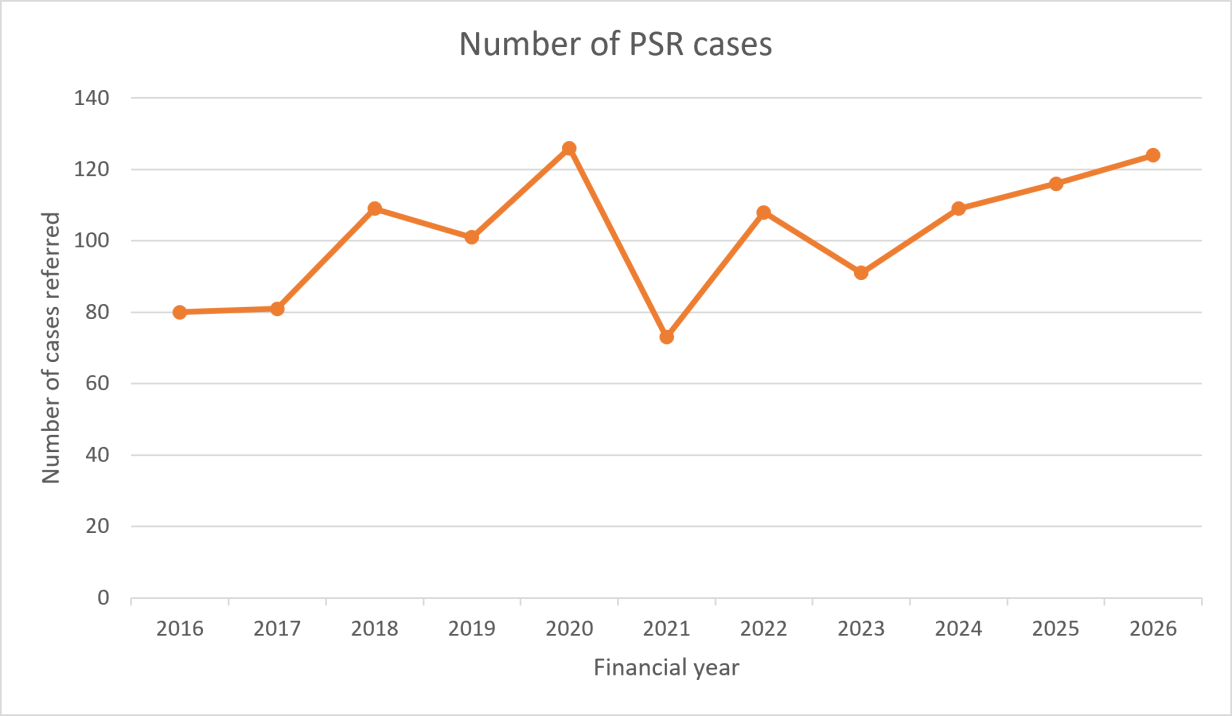
According to the PSR’s annual report, Medicare sent 124 cases the PSR’s way this year, just two cases shy of the 2019-20 high of 126 referrals.
It was not necessarily a significant increase when measured against the 2024-25 year, in which Medicare referred 116 cases, but it became more significant when considering that the average number of referrals over the previous five years was just 99.
Pre-pandemic, the number of cases rarely exceeded 100.
Of the 111 cases which the PSR completed in 2025-26, director Associate Professor Antonio Di Dio decided to take no further action in just seven cases.
This was the same number as the previous year, far below the 2022-23 high of 19 cases.
Source: PSR annual reports, 2015-16 to 2025-26
In the director’s analysis of performance, Professor Di Dio said that in most cases of inappropriate practice, the practitioner under review had not kept adequate and contemporaneous records, that they did not provide sufficient clinical input, had rendered a service which was not clinically indicated, or had not met MBS or PBS requirements.
“In 2025–26, as in previous years, commonly reviewed services included those relating to in-person and telephone attendances, chronic disease management, health assessments and mental health services, as well as services involving the prescribing of opioid medications, benzodiazepines and antibiotics,” Professor Di Dio wrote.
“There continued to be an increase in the number of telehealth and telephone services items reviewed, reflecting an uptick in the use of these items by the profession.
“The common areas for concern in relation to these services mirrored those for in-person attendances – most notably a lack of recorded information to reflect the clinical input provided.”
He also noted that a number of the GPs under review this year had been providing services at residential aged care facilities, and that it had been difficult to access medical records from the facilities.
“Given the voluminous material held by the RACFs (often in different systems or archived), and resourcing and operational pressures at RACFs, it often takes a significant amount of time to obtain relevant material for the Director’s and Associate Directors’ review,” Professor Di Dio wrote.
“Where records were produced by the RACF, the Director and Associate Directors often held concerns regarding the [practitioner under review’s] entries, or lack thereof.
“At times, a record of the reviewed service could not be located in the RACF records and there was no reference to the PUR’s attendance at the RACF on the date of the service.
“In these circumstances the Director or Associate Director often held concerns that the service was not provided or that, if it was provided, the practitioner had not maintained an adequate record.”
Where the 2025-26 year did break records was in the amount of money which it ordered to be repaid.
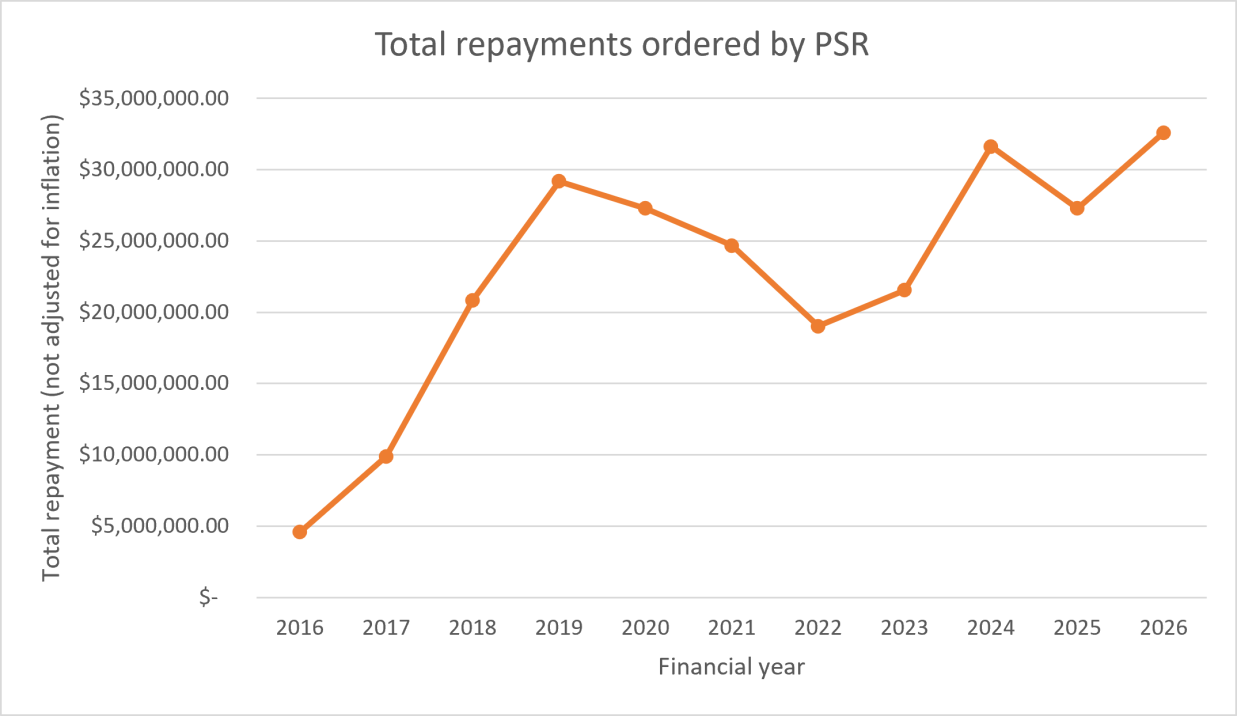
Between 92 negotiated agreements and 12 final determinations, the PSR issued repayment orders totalling $32,602,866.
This was a 20% increase on the 2024-25 total of $27,290,968, but only 3% higher than the 2023-24 record of $31,625,201.
Source: PSR annual reports, 2015-16 to 2025-26
As in all previous years bar 2021-22, every practitioner who went before a committee of their peers was found to have engaged in inappropriate practice.
These practitioners typically refused a negotiated agreement with the PSR director, which must include an acknowledgement by the practitioner under review that they have engaged in inappropriate practice.
While the practitioners who went to the committee stage were found to have engaged in inappropriate practice nearly every single time – again, just one person had gone before a PSR committee in the past 10 years and emerged with a finding of no inappropriate practice – the gamble did appear to have paid off for at least one practitioner this financial year.
According to the annual report figures, there was one practitioner who went through the committee stage and was ordered to repay just $647.
Others were not so lucky; the largest repayment order from the committee stage was $630,000.
Of the 126 referrals, 25 were for 30/20 breaches, where a practitioner appeared to have rendered 30 or more telehealth services in one day on 20 or more occasions.
There were also three referrals for 80/20 breaches, where a practitioner appeared to have rendered 80 or more services in one day on 20 or more occasions.
Three practitioners were referred back to Medicare under suspicion of committing fraud. A further eight were referred to AHPRA over concerns that they had not met professional standards.
