

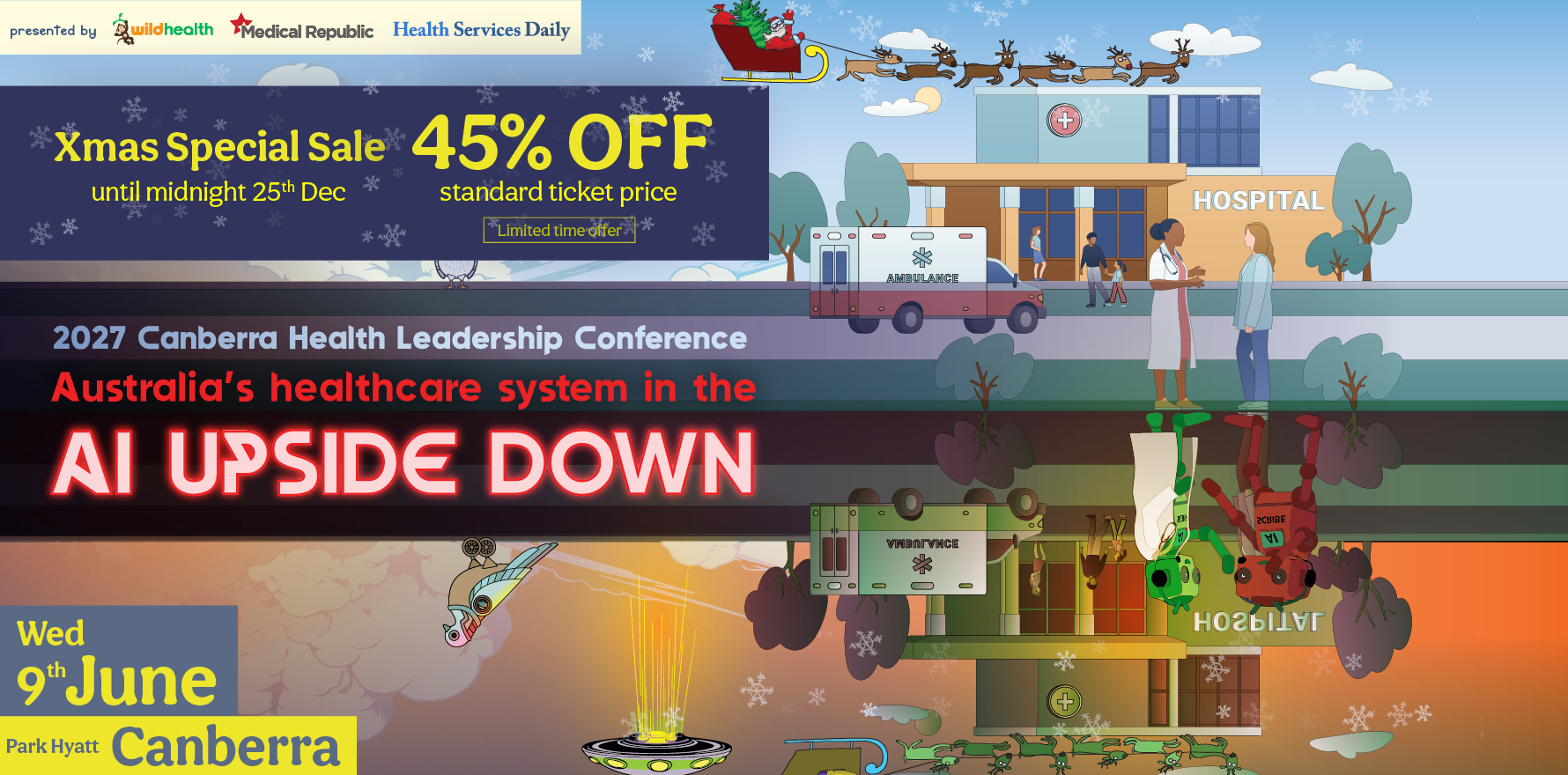
Xmas special sale running until 25 December: 45% off standard price tickets to the 2027 Canberra Health Leadership Conference.
On Wednesday 9 June 2027, Health Services Daily, The Medical Republic and Wild Health will be bringing Australia’s health leaders together at the Hyatt Hotel Canberra for a one-day summit built around a big question.
Tickets are on sale now, and we have a Xmas sale running. Book before midnight December 25th, 2026, for 45% off standard price tickets.
Sure, one by one some of us might start getting our heads around AI. Some might even start realising its potential for our institution, our practice, maybe even our state. But what about our healthcare system as a whole?
People love to quote how good our system is compared to others around the world, but the hard truth is that it’s a system that is now tired and not fit for the purpose of managing a chronic and aged care tsunami coming at us within the next 10 years.
We are fragmented and dysfunctional. And now we all have to somehow embrace the opportunity of AI while managing the threat it poses. What if we were fully on top of what AI can do as of today, and could somehow put it to work tomorrow in a practical way? How might we plan and start running Australia’s healthcare system differently?
More importantly, if we had the wherewithal to come together and co-ordinate across our fragmented system, what might we change now and over the next year or so that might help us get there?
AI is an imperative for healthcare: we need to organise
AI isn’t a project sitting off to one side of the health system any more. It touches national policy, funding models, regulation, infrastructure, the workforce, hospital operations and the patient’s path through care. And it is moving much faster than any of our planning cycles.
Yet, most of the conversation is still about single tools: scribes, chatbots, agentic pilots and point solutions, dropped into different corners of a system that was fragmented long before AI arrived. AI scribes spread through general practice and hospitals in months, not years. Patients are already using large language models en-masse as a digital front door to healthcare. We are at serious risk of building the same thing hundreds of times over, across nine jurisdictions, while the technology races ahead of governance and risks making our current federal digital health infrastructure plans redundant.
This summit is about starting a process to get in front of that.
We aren’t starting from scratch
We won’t be starting from scratch because one group has done quite a bit of work asking this question including bringing together stakeholders from every jurisdiction to get some form of agreement on a national healthcare AI roadmap.
If you haven’t read the Australian Association of AI in Healthcare (AAiH) roadmap, in a manner its required reading as the starting point for the summit. Even though this document was released only five months ago, a lot has already changed. We will be looking at those changes, how stakeholders have responded to this framework already, and see whether stakeholders from all the jurisdictions would find some more calibration useful.
How the day works
The day breaks into three steps.
First, we cross into the Upside Down: a mirror version of our system where AI is understood and deployed as fast as it develops. We’ll try to map how AI is already working for governments, health services, clinicians and patients, without the usual caveats about why it can’t happen.
Related

Second, we will attempt to break down what stands between today’s system and the upside down. Which barriers are technical, which are about funding or regulation, and which are about structure and culture? Which are political? Which ones can be wrangled, which ones can’t, and what can practically be done in the next 12 to 24 months, and by whom?
Third, the room goes to work. The final session is a facilitated workshop where delegates break into groups, take on the key issues of the day and report back. Their thinking will become a white paper with recommendations: the collective view of the people who actually run the system.
What’s on the table
The first draft of the program already covers:
- a federated system working as one on AI policy, procurement, safety and data
- agentic AI in hospitals, and how to avoid building the same infrastructure hundreds of times
- what AI means for sharing by default, interoperability and the national data plans already under way
- staying safe, with governance that keeps pace without strangling innovation
- patients and the AI front door, and who owns and controls their data
- the workforce, and where the productivity gains really land
- a bigger structural question: is AI the trigger to rethink how care is organised, including regional, vertically integrated system models?
Expect short, provocative keynotes, compressed panel sessions that put government, providers, clinicians and industry on the same stage, head-to-head “armchair fights”, rapid case studies, and a view from the US and UK, where things are moving faster than here.
Who should be there
Federal, state and territory health leaders and policy makers; health service, hospital and LHD executives and boards; clinical, digital and data leaders; primary care, PHN, aged care and mental health leaders; regulators, funders, insurers and researchers; and the companies building the tools.
Key speakers so far include:
- Dr Ramya Raman, President, RACGP
- Bettina McMahon, CEO, Healthdirect
- Prof Enrico Coiera, Director, Centre for Health Informatics at Macquarie University and Director, Australian Alliance for Artificial Intelligence in Healthcare
- John Sutherland, Chief Digital Information Officer, Calvary
- Dr Emily Kirkpatrick, Managing Director, EKology Health
- Tim Blake, Managing Director, Semantic Consulting
- Dr Robert Marshall, CEO, St Vincent’s Care at Home
- Dr Katherine Bassett, Head of Government Relations, Calvary Care
- Dominic Butler, Policy Officer, Catholic Health Australia
- Peter O’Halloran, Chief Digital Officer, ADHA
- Dr Rachel David, CEO, Private Healthcare Australia
- Dr John Lambert, Digital Health Consultant, Three Time Jurisdictional CCIO
- Simon Kuestenmacher, Co-founder and Director, The Demographics Group
- Prof Matt Sabin, Chief Clinical and Consumer Officer, Healthdirect Australia
- Prof Alam Yoosuff, Rural GP, Chair Murrumbidgee PHN
- Jacob Madden, Assistant Director-General & Chief Data and Analytics Officer, the Australian Centre for Disease Control
- Dr Andrew Rochford, Founder and CEO, Trakked Pty Ltd
- Alex McKenzie, Health Economist and Management Consultant
- Sarah Barter, Consumer and Community Advocate, and Principal, Sarah Barter Consulting
- Dr Michael Wright, Immediate Past President, RACGP
And many more.
Tickets are on sale now at a hugely discounted price. Book before midnight December 25th, 2026, for 45% off standard price tickets.
When: June 9th, 2027
Where: Park Hyatt Canberra
Program Here
TICKETS HERE
Hope to see you there.
