

Scientists at Cornell University have identified the first cases of a human-like Marfan syndrome presentation in two feline siblings.
Two domestic cats – littermates Gary and Shaggy – have become the first confirmed feline cases of Marfan syndrome to exhibit the cardinal features of human Marfan syndrome.
In humans, MFS is diagnosed based on the presence of a displaced lens inside the eye (ectopia lentis) and severe aortic dilation, or the presence of an FBN1 mutation.
Cornell University researchers have confirmed that both kitties, adopted from a shelter, exhibited these cardinal features. Whole genome sequencing also revealed a mutation in the FBN1 gene.
Physically, human patients with MFS are often tall and thin, with long limbs.
Gary and Shaggy both had unusually long legs; their tibia, radius and metacarpals were each about 40% longer than the average male domestic shorthair cat.
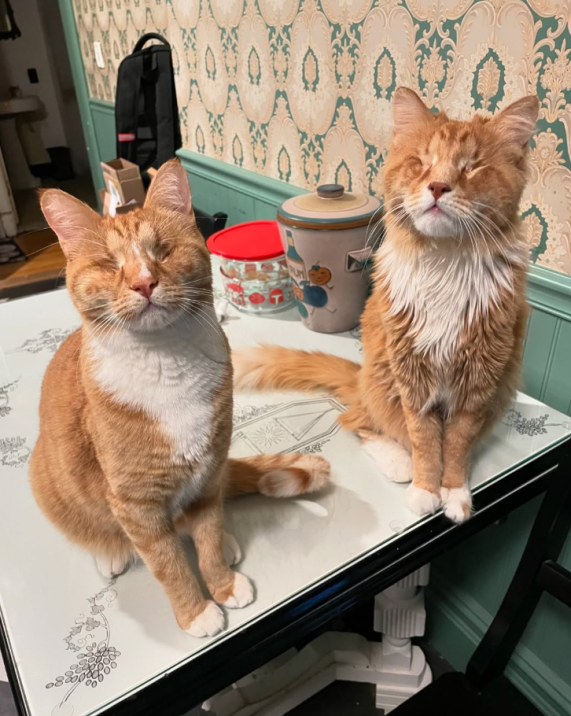
A photo of Gary (left) and Shaggy (right) posted by their owner on Instagram.
Writing in Scientific Reports, the researchers say the cats experienced bilateral lens luxation and were presented for cardiological evaluation at seven months of age, after Shaggy developed a cough.
Both cats survived into adulthood, despite possessing what the authors described as “a homozygous deleterious variant”, likely due to the production of a functional protein.
Shaggy ultimately died from pneumothorax, severe pleural effusion, coagulopathy, and severe regenerative anaemia.
Gary’s death is attributed to a ruptured aortic pseudoaneurysm, resulting in cardiac tamponade and obstructive shock.
“We found that many features are directly transferable to animals, with exceptions limited to skeletal criteria that differ substantially between humans and domestic animals,” the researchers write in Scientific Reports.
“The extensive post-mortem investigations performed provide valuable reference points for future cases. For example, we identified increased length of the lower limbs (including the tibia, radius, and metacarpals) relative to the reference intervals, analogous to human limb length criteria.”
While Gary and Shaggy are the first cats in whom MFS has been identified, they are not the only quadruped cases; spontaneous FBN1 variants have been reported in cattle.
Taken together with the bovine cases, the researchers say their findings suggest that MFS manifests with “striking phenotypic similarities across humans, cattle and cats”.
Manifest your story tips by emailing Holly@medicalrepublic.com.au.
