

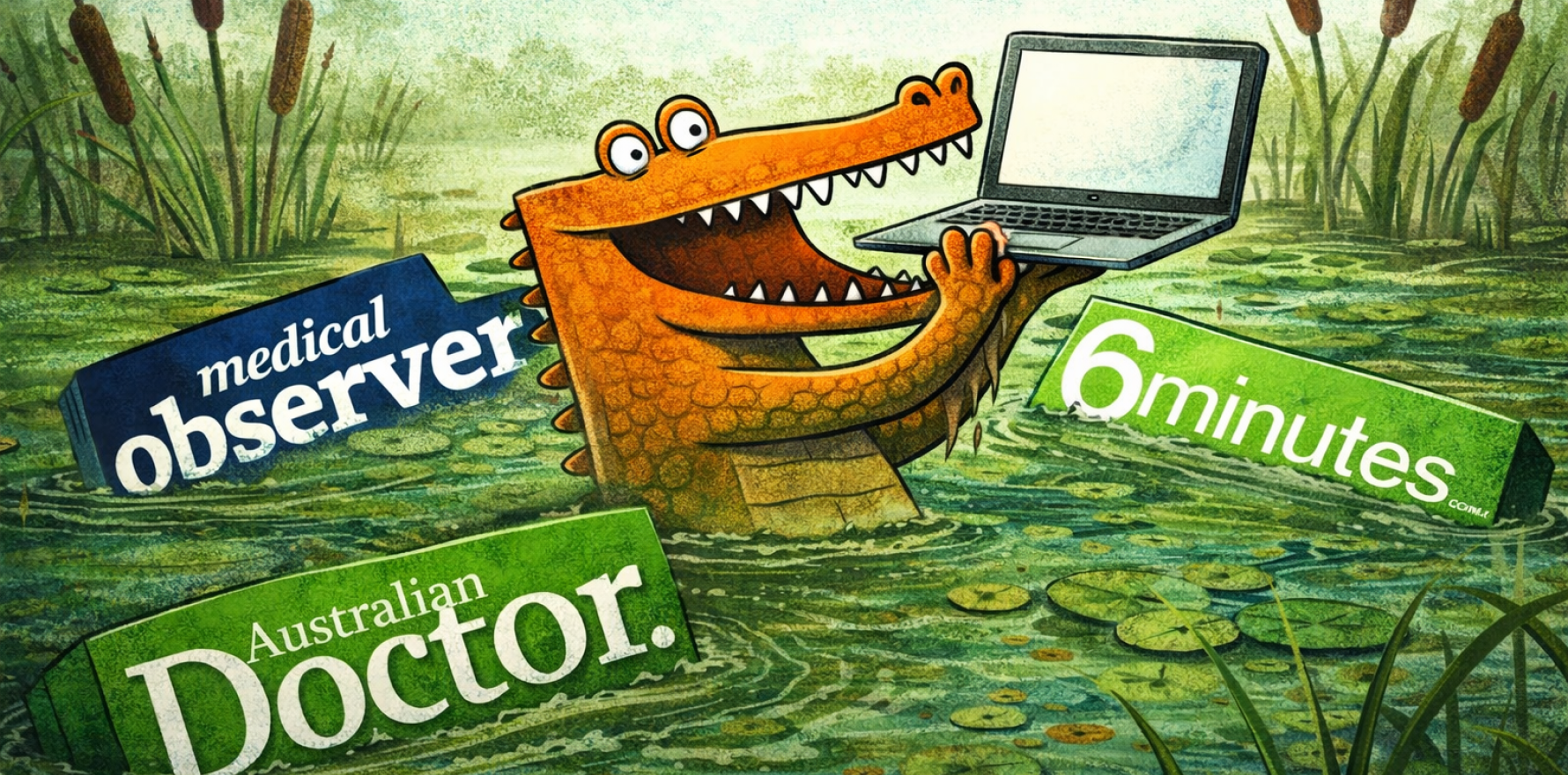
Last week, Australian Doctor quietly retired two past brand giants of Australian GP media, 6minutes and Medical Observer. This is our eulogy.
It was with a little surprise that I got an email from my Australian Doctor colleagues last week announcing that the 6minutes newsletter was being mothballed, to be replaced by the significantly less elegantly titled Australian Doctor, Morning Edition.
Immediately, a couple of old timers hit social media to reminisce on the ‘orange croc’ (we failed to pick up the big colour error in our original email heading before publication) and what it meant to them in its day – at the time it launched, more than 21 years ago, it was pretty out there and, probably unbeknown to most people today, was largely responsible for the beginning of quality daily digitally-focussed GP media in this country.
When mentioning the passing to our editor, I was told, “looks like Medical Observer (MO) has gone the same way…” and on closer inspection, yep, this once groundbreaking brand had been similarly put out to pasture and quietly absorbed into the Australian Doctor, Morning Edition.
The passing of 6minutes without a little fanfare is one thing. But ol’ MO? Too far.
The launch of MO in 1987 signalled the beginning of an age of great B2B medical journalism in Australia, particularly journalism focusing on general practitioners. A lot of the journos from MO and AusDoc have gone on to be great consumer medical journalists in the major metropolitan daily newspapers and TV.
The medical media story probably starts as far back as in 1957 with the launch of Modern Medicine, which you’ll recognise today as Medicine Today. The Medical Journal of Australia launched in 1856, but it’s a properly cited journal, not so much medical media (so I’m leaving it out).
Modern Medicine was a monthly clinical publication brand out of the US which took off in Australia and became a behemoth with issue sizes over 200 pages in the late 70s.
At this point of time there was really very little medical journalism in general practice. The sector was dominated by clinical magazines and journals – Modern Medicine, Current Therapeutics, and the RACGP journal, then called Australian Family Physician, which started in 1972.
Then a publisher – Simon Campbell – who was visiting from the UK, where there were medical newspapers, saw an opportunity and quite suddenly launched Australian Doctor as a fortnightly newspaper in 1983.
At the time, it was apparently said by the shocked members of the Medical Publishing Associationthat there was simply not enough news material to fill a fortnightly newspaper. The members, the incumbents, waited for its collapse within a year or two.
But the opposite happened.
Australian Doctor took off and started both growing the market and eating into Modern Medicine’s near-monopoly.
Doctors were hungry for news, it turned out.
They were so hungry and Australian Doctor was so successful that it took only four years before the sales director of Australian Doctor, Rex Simmons, left to start a competing newspaper, which he was calling Medical Observer.
Medical Observer was launching as a fortnightly with issues interstitial to the then fortnightly Australian Doctor.
At the time, people threw their hands in the air and said “ridiculous… okay, it turned out that there was enough news for one fortnightly newspaper, but two? That’s never going to happen.”
Before MO actually launched, the geniuses at Australian Doctor secretly decided to relaunch as a weekly newspaper, so effectively the market was going from one to three fortnightly newspapers.
Imagine what people said then (today there’s probably at least 10 daily newsletters to GPs as an idea of how extendable this idea actually was going to be).
So from 1982 with a couple of clinical publications (Modern Medicine, Current Therapeutics and Australian Family Physician) to 1987, GPs suddenly went from receiving mostly two clinical magazines publishing 11-12 times per year, to two newspapers and two to three clinical magazines publishing over 100 issues a year to them.
Sound familiar when you think about what eventually happened online?
Nothing collapsed with the so-called glut of information.
It all kept growing, in part because thethe 1990s was the first real decade of the general practice blockbusters – drugs like Lipitor, Crestor, Zoloft and Effexor – funding the expansion.
All these publications were published for free and monetised via pharmaceutical advertising, and the pharmaceutical industry was on fire.
Interestingly, all the publications were fiercely independent as well.
Though MO was the second newspaper in market, it was the catalyst for fierce competition for a feirce ongoing readership battle between the two newspapers.
Readership was dependent on a couple of things. Frequency was one factor, but by far the major factor was having the best stories. To do that you had to have the best journalism.
In a readership war that lasted nearly 30 years, both publications developed unusually high-quality teams of medical journalists in order to compete with each other.
They did a couple of silly other things along the way too. Like starting a competition war with BMW cars as the prizes.
And funding this amazing service to GPs? The pharmaceutical industry.
Over the years both publications fought with their major clients whenever those clients attempted to sway editorial, which to give them some credit, they didn’t actually do that much. It was a fairly unusual dynamic but a very serendipitous one for GPs. In fact the only time MO and Ausdoc stood together was whenever a fight like this was on.
MO can be credited with starting the arms race on good journalism to GPs and in helping maintain it for nearly 30 years.
It never won the syndicated readership though. It came achingly close a few times; within a couple of per cent on the annual independent survey. A few per cent on the readership survey, taking account statistical error margins, is the same or better.
In 2001, after being acquired by MIMs (Australian Doctor was acquired by scientific publishing giant Reed Elsevier in 1996) MO went feral and poached the long-time Australian Doctor editor, Kellie Bisset, got advice from the long-time and very successful publisher of Australian Doctor, Russell Norden, and went weekly in a final ditch big investment attempt to win the readership and take the market share spoils that would have followed if they had succeeded (millions of dollars were at stake if they won).

Russell Norden – one of the most iconic publishers in Medical Media history, and the man who came up with the idea of having a brand new car as a readership competition prize
MO didn’t succeed but it was easily as good – and sometimes much better than – Australian Doctor in those years as a publication.
GPs were spoilt for good news and journalism. Both papers were free and both were of a higher quality, like for like, than most of the metropolitan daily newspapers.
But the internet was coming.
Like all newspapers at that time, the internet was a conundrum for management and journalists alike.
Both MO and Australian Doctor started dedicated websites in 2001/2 but neither contemplated putting their best stories online before they published their weekly edition of the paper.
Enter the ‘orange croc’ – 6minutes – in early 2004.
The publisher of Australian Doctor at the time was also the CEO of Reed Business Information (RBI) – that’s me – and all sorts of weird and wonderful things were going on across the business with the internet.
Almost by accident RBI had inherited a band of English refugee internet experts and sales people seeking the sun and surf lifestyle of Australia.
In their spare time (when they actually came to work) they started building some very innovative internet products, so much so that RBI formed a completely new internet division, which used the data and promotional capability of its magazine markets to launch internet products.
RBI was split into two towers in Chatswood (yep, like Lord of the Rings) – one had the internet business, the other the older magazine business.
They hated each other.
But the new upstart internet division would take the company from about $40m Australian in print revenue to $90m within the next six or so years, 70% of it online revenue – but that’s another story.
Back in older magazine land – Tower 1 – the leadership of Australian Doctor, though a great band of journalists, weren’t too keen on online news. They, like most newspapers in Australia at the time, pointed out that while it’s a great timely way to get the news to everyone, there was no way to monetise it. Ironically the journos at Australian Doctor were invoking commercial principles in order to defend their competition moat.
But the CEO at the time was watching how fast the internet was being accepted by other clients in Tower 2. It all felt a bit unstoppable. So he and a few others felt that some sort of experiment was needed in the company’s biggest market , medical.
So was born the orange croc.
And the CEO was pretty sneaky (partly stupid too) in how he went about birthing that orange croc.
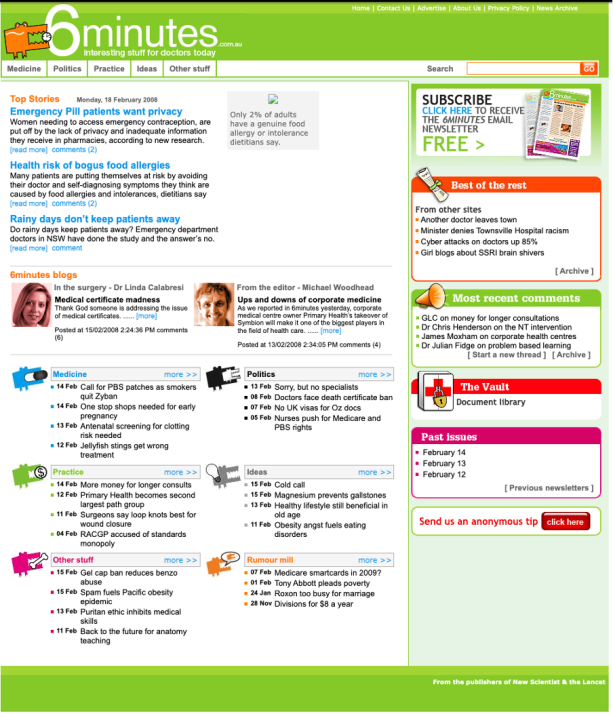
6minutes, circa 2004 – looks old but it was a lot more forward leaning that the equivalent sites at Australian Doctor and Medical Observer (see below)
He poached two of Australian Doctor’s most talented staff, who he knew were also energetic and left field, to start a new online daily brand, entirely dedicated to good daily online news.
That was 6minutes.
The two people in question were Dr Kerri Parnell, previously clinical editor of Australian Doctor (later editor and publisher and then editor of The Medical Republic) and Michael Woodhead, pretty much our best journalist at the time, also heavily clinically oriented, but most importantly a lovely nerd who was similarly fascinated with what the internet might do to journalism.
Plans were made, designs were constructed, new websites were built with new functionality, all with the idea of daily news delivery functionality.
The terrible other thing this CEO did was to, in addition to stealing two great journos/editors, “borrow” an email data base which Australian Doctor had painstakingly acquired over the past few years, but not used a great deal.
He was a pretty underhand operator.
We had to house the two founding personnel of the croc in a separate part of the building, and not that long after launching, we all but had to provide them with a security detail.
When the Australian Doctor leadership and the journalist push found out, they were furious. They at one point threatened to go on strike.
It was very tense for the first year with a lot of goings back and forward between the groups assuring each things would be OK.
Although Australian Doctor had a form of daily article output, it was all old news and often it wasn’t daily at all. It got no traffic.
Very soon after the launch of 6minutes, that attitude to daily output started changing – a lot.
The Australian Doctor leadership team (which was a great group of very smart people) had decided that the only way to deal with this new internal competitor was to kill it off quickly, with a better daily news service. They put their best people on their daily newsletter and insisted on a new website and daily news functionality, which we gave them.
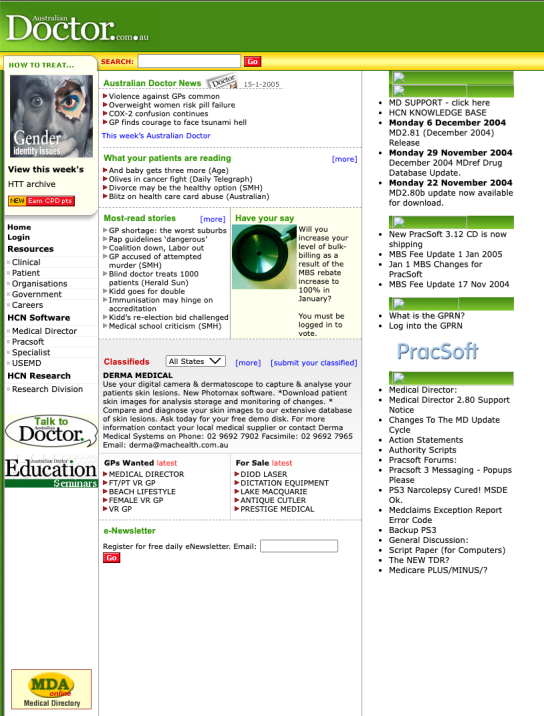
AusDoc, circa 2004, they didn’t really do news online then
This was a dynamic that worked across the old and the new company as we transitioned some of our businesses to the internet.
If an existing division was not prepared to have a go at “eating its own babies” to transition to online, we’d start something competitive in the evil online Tower 2, and before long we’d have both groups going at it and breaking barriers.
6minutes took off from day one. It couldn’t have done that without Australian Doctor and its people and data assets, but the fact that it did taught the group that they had better get their skates on from a digital point of view.
The good thing at the time was that Australian Doctor and its new upstart stable mate 6minutes, had for the first time since the horribly stressful readership battle between Australian Doctor and Medical Observer for readership started, a clear point of difference and advantage. Online
That lasted all of about one year.
MO weren’t dumb.
Within one year they had followed us into the daily digital media news game with a vengeance.
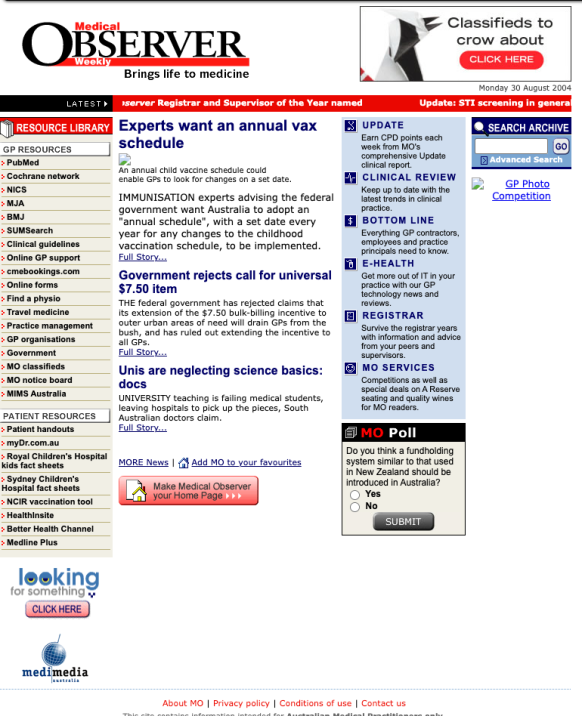
Medical Observer, circa 2005, pretty hopeless as well
And so was birthed daily GP news media in Australia.
Others followed.
Apologies to all GPs for the fact there ended up being so much.
But that’s online for you. It’s firehose or nothing generally, which means if you’re going to do daily news, you had better do stories that stand out as good, pretty quickly.
Of course, now the attention of GPs online is being diverted everywhere, in large part by social media. GPDU for instance, is a great peer to peer private Facebook group of about 14,000 users. Increasingly LinkedIn is getting on the act as well with a dose of Reddit thrown in here and there for the more odd characters.
So, MO and 6minutes are gone. Cue, one minute of silence.
Here’s very quickly what happened and I’m sorry to say it, but I might be, at least in part to blame here.
In 2014 Reed Elsevier, feeling that RBI was much more a media company than a data company, even though it had good online revenues, sold it all to private equity, along with Australian Doctor.
I was the CEO at the time and I went with the sale.
One of the things I did before I was fired 18 months later was buy MO off MIMs, which was also exiting media. Unknown to many, RBI owned the two giant weekly and daily news media groups for GPs.
You might imagine what private equity was eventually going to do that.
When we bought MO I told my old PE boss that whatever we did, we had to back both businesses equally to retain their characters and brand. If we let one dominate, then we’d get lazy and the quality of journalism could decline, among other client services.
I was fired maybe 10 months after giving that sage (or not) advice. I was fighting with them, in part about MO and Australian Doctor, but mostly I was tired, and they wanted someone with a better attitude, and digital skillset to take them to the promised land of being fully digital, and a much greater company value.
I wasn’t that guy.
But I needed a job.
The only thing I knew was publishing, and as far as I could tell my ex PE friends were going to integrate the back end of MO and Australian Doctor as fast as they could to take the enormous synergies, and profits, that were on offer.
The other dynamic here was that, quite smartly, the PE boss didn’t want much or any print in the portfolio because selling a business as wholly digital, and even, if you can really whip up a picture of the future, a data business, not an old model media business, then you are going to get a hell of a lot more money for it when you sell.
In that rapidly approaching semi-trailer sized hole opening in the market that was going to open up as Australian Doctor pursued the online only data dream , I decided to launch The Medical Republic, mainly at the beginning as a print newspaper (not much of a threat to start with there I’d guessed).
To do it I asked if the talented and much-loved Dr Kerri Parnell, who was the publisher of Australian Doctor at the time, might abandon that charging battleship for the little sailing boat that Medical Republic would start as.
She did and that’s one reason we got off to a great start.
The other reason was possibly covid, which made us convert to daily news big time quickly and altered our business to be more digital than not – but that’s another story too.
I figured that MO, in my view as good as Australian Doctor, which is great, would slowly go and there would be space for a quirky and fun upstart.
Within nine months of us launching Medical Republic in late 2015, MO was taken from a weekly newspaper to a monthly A4 and that gave us some breathing space.
A pesky ongoing problem for Australian Doctor’s PE owners was that the damned print products kept being quite profitable. But the ideal sale would be as an “all digital, data online company”. So they pressed on downsizing print a lot, which was lucky for us in the start.
To this end, Australian Doctor did some really interesting digital things over the past few years, including creating a data dashboard for their pharma clients called Access Plus, whereby they attempted to map GP behaviour for their clients in real time, and reinventing their user interface as something either thoroughly more modern and engaging, or, annoyingly just like Facebook (you choose).
So why ditch the iconic orange croc and ol’ MO as brands?
Strategy.
There’s the house of brands strategy and then there’s the single platform brand strategy.
Australian Doctor is likely doing its final consolidation to draw everything to that single big brand… and platform.
One website to rule them all?
We’ll see.
