

The models are already working. The funding moment is here. The test now is whether we move beyond announcements and embed what works at scale.
Over the past few years I have spent a lot of time in regional and remote Australia, sitting with clinicians, Aboriginal health workers and community leaders who are doing serious work in difficult conditions.
What stands out isn’t a lack of effort. It isn’t even a lack of funding. It’s the gap between what we build and what we sustain.
The federal government’s $144 million investment in Aboriginal Community Controlled Health Organisation infrastructure is welcome. It’s overdue. But if we are serious about Closing the Gap, we need to be honest: infrastructure is the beginning of the job, not the end of it.
We are very good at announcing new facilities and even better at celebrating capital commitments.
We are far less rigorous about measuring whether those investments translate into consistent access to care 12 months later.
In many communities, the issue is not the absence of a building. It’s whether that service is clinically, digitally and operationally connected to the wider health system.
A different kind of infrastructure
In 1857, my great-great-great-grandmother Emily Smale was born into the Yuggera nation near Warwick in Queensland.
She was a midwife and once famously swam a flooded river to deliver a baby, serving her community until 1942.
Her son Walter was the first Indigenous soldier to enlist in the Australian Army, dying at Gallipoli in 1917. Her grandsons later built roads and airstrips across northern Australia during World War II, connecting remote towns to hospitals and supply lines.
Across four generations, my family helped build the physical infrastructure that connected rural Australia.
Back then, distance was measured in rivers and red dirt roads, so they built roads. They built airstrips. They shortened the physical gap.
Distance is still the barrier today. It just looks different.
The modern gap is clinical distance.
It’s the distance between a nurse in a remote clinic and a GP who can guide a decision in real time. It’s the distance between an Aboriginal health practitioner and a specialist who can intervene before a condition escalates. It’s the distance between a diagnosis made locally and continuity of care that follows the patient.
Modern healthcare infrastructure is not just concrete and a few pieces of “kit”. It is connectivity, capability and continuity.
What’s working right now
This isn’t theory. The models already exist.
In Central Australia, Urapuntja Health Service Aboriginal Corporation supports communities where patients once travelled up to eight hours to see a GP.
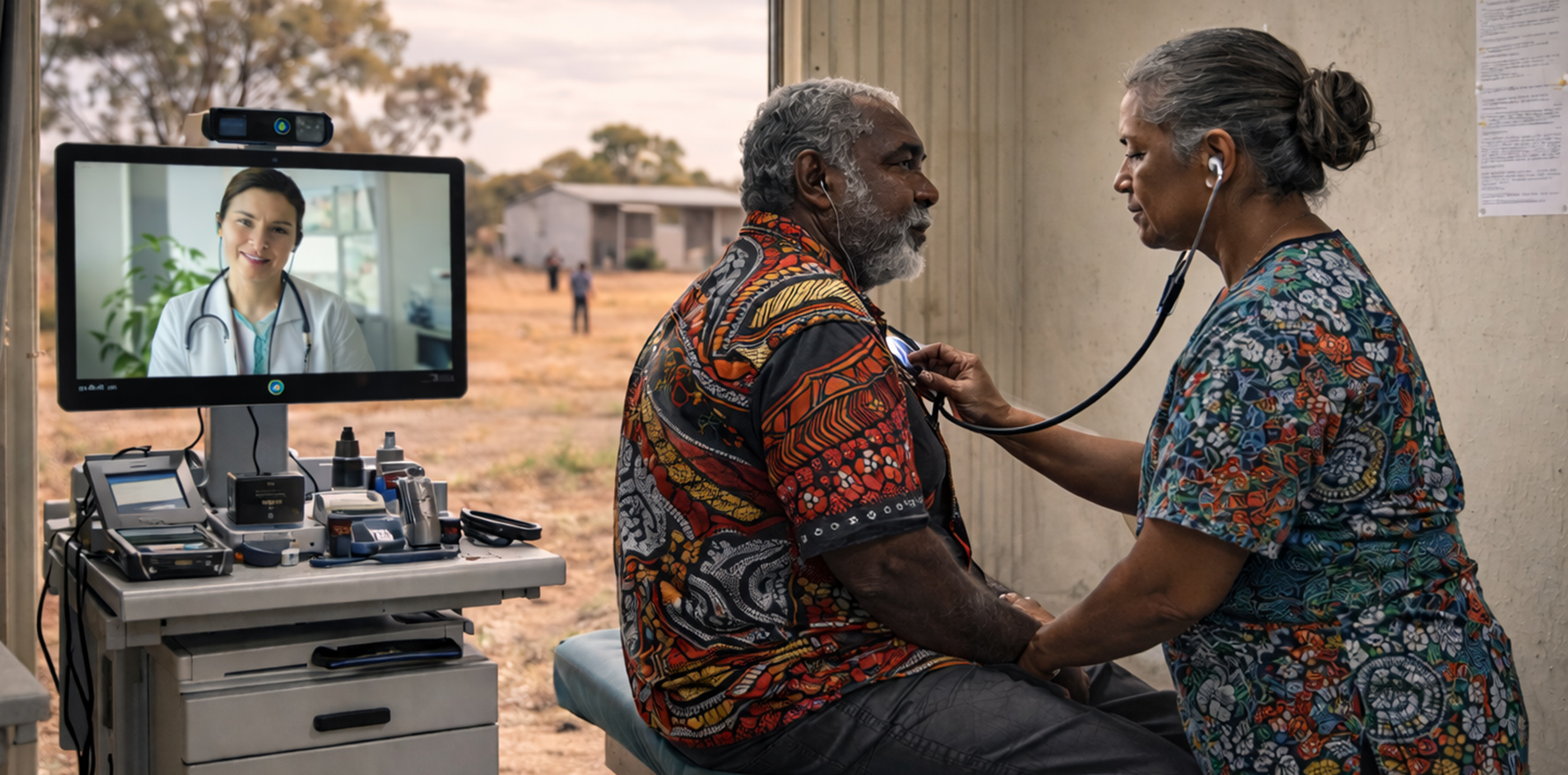
Today, local nurses lead assessments while remote doctors mentor and diagnose in real time. The service recently completed its first Medicare Indigenous Health Assessment virtually, unlocking funding that had previously gone unclaimed.
Urapuntja’s GP services are delivered in partnership with Aspen Medical, combining on-the-ground care with virtual clinical oversight. It is practical. It is operational. It is working.
In Western Australia, Kimberley Aboriginal Medical Services supports more than 100 communities across vast distances. Full remote examinations – heart, ears, wounds, ECG etc are conducted locally. Clinical decision-making stays close to community. Workforce capability is strengthened. Travel is reduced. Chronic disease is picked up earlier.
At Derby Aboriginal Health Service, Aboriginal health workers conduct virtual consultations linked directly to specialists in Broome and Perth. Cultural safety protocols were co-designed locally. The results are practical, not theoretical: fewer transfers, faster specialist input, earlier detection of serious conditions.
In Queensland, Cherbourg Regional Aboriginal and Islander Community Controlled Health Service is bringing diagnostics into people’s homes. Wireless ultrasound and ECG tools support in-home cardiac and chronic disease assessments backed by remote specialists. Aboriginal health workers lead engagement. Hospital transfers are down. Interventions occur earlier.
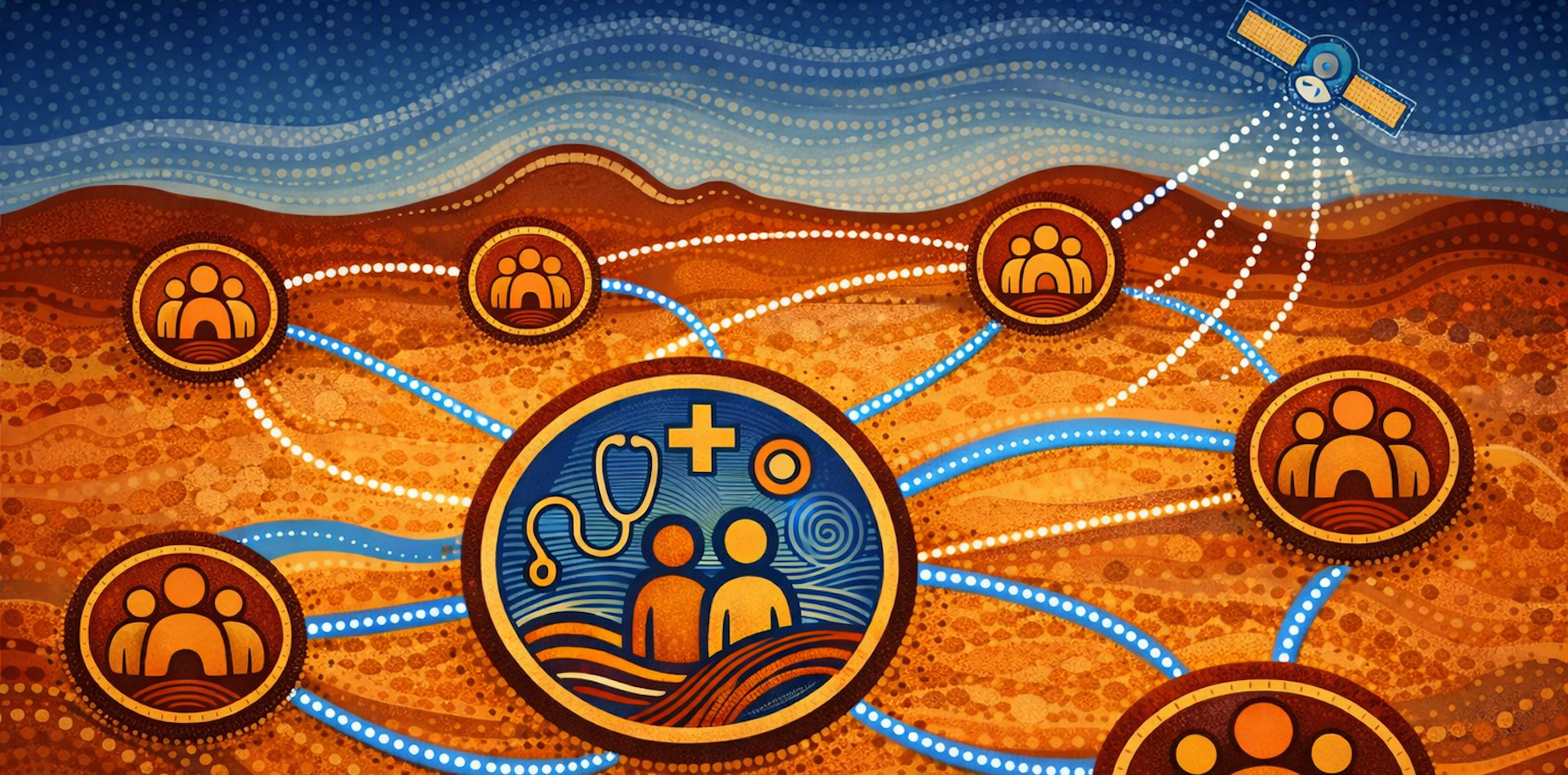
Across NSW and Queensland border towns, Indigenous Wellness Connect links communities such as Toomelah and Boggabilla to multidisciplinary teams using satellite-enabled virtual care. It is a collaboration between ACCHOs, PHNs and Local Health Districts overcoming cross-border fragmentation that has undermined care for years.
Related

These are not pilots. They are live services delivering measurable outcomes – reduced travel, earlier intervention, stronger local workforce capability, better continuity of care.
The capability exists. The evidence exists.
The real gap is alignment
If funding is flowing and working models are already operating, then innovation is not the constraint. Alignment is.
Too often, capital funding focuses on buildings or equipment without equal attention to workforce enablement, digital integration and service design.
Too often, communities and our sovereign healthcare industry (which is probably something you want to keep) move through lengthy EOI processes while patients continue travelling hundreds of kilometres for care that could be delivered differently today.
We have enough pilots to know what works. What we lack is the discipline to institutionalise it.
Closing the Gap does not stall because technology is immature. It stalls because accountability is diffused across Commonwealth programs, state systems, PHNs and Local Health Districts.
Everyone has a role. No one owns continuity.
The questions we should be asking
If connected, community-led care is demonstrably achievable, then the conversation has to move upstream.
- How do we ensure infrastructure funding strengthens ACCHO leadership instead of building parallel systems around it?
- Who is accountable for pairing capital investment with operational and service delivery funding?
- What commissioning mechanisms allow proven models to scale quickly rather than resetting every funding cycle?
- How do state virtual care programs integrate ACCHOs into specialist pathways instead of treating them as external providers?
- Who decides whether investment builds long-term community-controlled capacity or layers short-term programs on top?
These are not abstract policy questions. They determine whether a community has consistent access to care or not.
This generation’s job
My ancestors built roads because that’s what their time demanded. Ours demands something different.
Closing the Gap will not be achieved by capital announcements alone. Nor will it be achieved by purchasing equipment without redesigning how services connect and operate.
It will be achieved when community-controlled services are clinically supported in real time, digitally connected as standard practice, and structurally integrated into the broader health system.
The models are already working. The funding moment is here.
The test now is whether we move beyond announcements and embed what works at scale.
Distance is no longer just about kilometres. It’s about whether we have the will to close the operational gap.
And that’s something we can’t solve with another ribbon cutting.
Joshua Mundey is the managing director and CEO of Visionflex Group. He will join an expert panel in a one-hour webinar hosted by Health Services Daily and supported by Aspen Medical on 10 March at 2.30pm.The session will explore how Urapuntja Health Service, Aspen Medical, and Visionflex are working together to deliver a community-led digital primary health care model that strengthens access, continuity of care, and population health outcomes in remote communities. It also offers practical insights for those working in this sector across an integrated multidisciplinary team model. Register HERE.
