

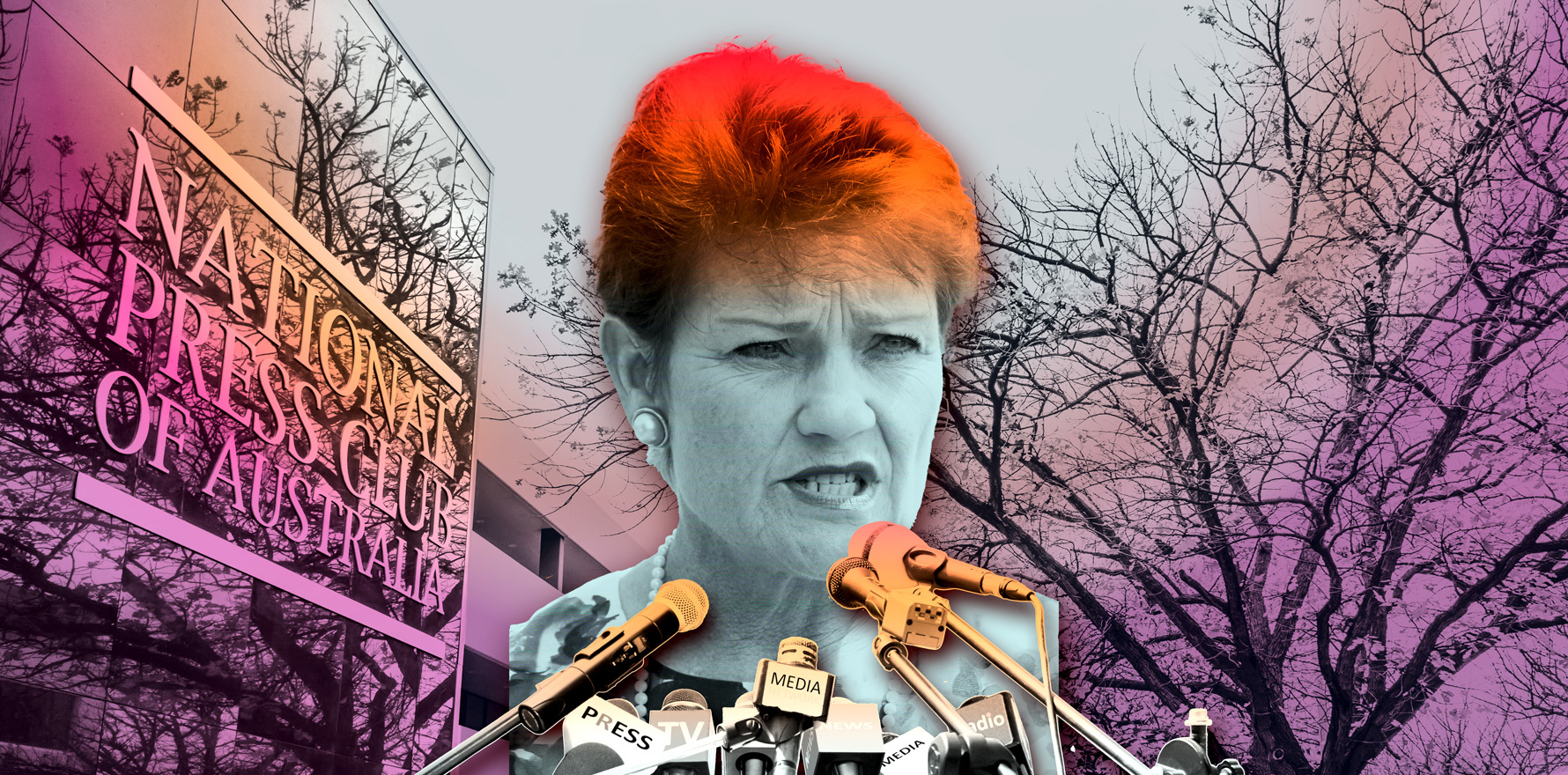
It was only when journalists – some of whom she’s banned – asked questions that the minor party leader mentioned her plans for health.
One Nation party leader Pauline Hanson fronted up to the National Press Club today. She didn’t mention health once during her address.
The only health-related statements – about rural Australia and abortion, respectively – came in relation to questions from journalists after the speech.
Criticising “sections of the Australian media” and later singling out individuals (calling one Guardian journalist “trashy”) she warned the club’s membership they didn’t have a “license to pile on” (don’t call us racist, she said).
In response to a question from The Australian about interest rates, Ms Hanson revealed her cost-cutting agenda.
“What the government has to do is pull their heads in with their spending. I’d get rid of the climate change department, the Aboriginal department, and also those duplication [sic] of some of those with education and the health departments that are duplicated with the states. We can cut a lot of spending.”
The only direct health-related question came from Anna Henderson at SBS, a broadcaster which Ms Hanson said would be disbanded under a One Nation government.
Ms Henderson asked Ms Hanson what she thought the gestational limit should be for abortion.
“It’s a discussion that needs to be held with the Australian people, but I can tell you, to abort a baby the day before birth is abhorrent and disgusting, and that’s what I oppose, and that’s what many, you know, common sense Australians believe,” Ms Hanson replied.
“So I’m not against, you know, people in circumstances, women that need to have an abortion for medical reasons, for some circumstance.
“I’d rather educate women to use contraceptives than to go through an abortion. Too many abortions in this country, anyway.”
Ms Henderson said that many US states banned abortion from four weeks.
“I’m not advocating the time at this stage, but I will tell you, even from 20 weeks, I think it’s too, too late to have an abortion. But definitely, you know, 39 weeks to have an abortion, that is clearly not humane.”
Listing their policies on their website, One Nation Party says it’s “Pro-Life”, promising to “roll back brutal and extreme abortion law so that both unborn babies and pregnant women will have a level of legal and medical protection once again”.
“We were horrified when State Governments passed legislation which legalised abortion up until birth for any reason. This law is one of the most extreme in the western world,” the web page says.
In fact, abortion is available at up to 22 weeks in Queensland, New South Wales, South Australia, and Western Australia, requiring the opinion of two doctors thereafter. In Victoria and the Northern Territory it is legal to 24 weeks and still needs two doctors to agree it’s appropriate.
In Tasmania, it’s up to 16 weeks before two doctors need to agree. It’s only in the ACT that there is no gestation limit, and abortions after 16 weeks will be considered by Canberra Health with a referral.
Ms Hanson raised One Nation’s idea for addressing the lack of doctors in regional and rural areas when asked about how she would spend the money she expected to save by disbanding SBS and making the ABC a subscription service.
“Can you imagine where we can spend that 50 billion a year in hospitals and schools? I’ve even got people out wanting beds in hospitals around the country. We can’t even get doctors out there.
“I’ve got a program that I’m looking at the moment, that we can get 600 weeks, extra weeks, out of doctors over a four year program of $10.4 million. Part of the money will go to that to get doctors in rural and regional areas,” she said.
Ms Hanson was most likely referring to the idea of introducing “three-year contracts for newly qualified medical professionals and in return pay their HECS-HELP loans in full”. (It’s the only thing under “health” in the policy section of their website).
MP Barnaby Joyce went into greater detail in the media in February, saying that getting a provider number should be contingent on doctors doing a regional stint after graduation.
“That’s problematic,” Grattan Institute health program director Peter Breadon told The Medical Republic.
“I think that would really risk some legal challenges, because without a provider number GPs couldn’t really work as GPs, and so you could quite likely fall afoul of the conscription clause in the Constitution. It would be, I think, risking a legal challenge on the basis of being forced to work in certain locations,” he said.
The problem of workforce spread was a real one, he said, but this was not the answer.
“This idea of getting more care into rural areas that need it is really important. It is good to see people drawing attention to that.
“It’s just you need a much more focused approach. We need more GPs in other parts of Australia too. So, there are parts of major cities, such as Perth, with too little GP care, and so if you force all new GPs to go to the bush, you certainly wouldn’t be fixing it. You might be making worse the shortages in some metropolitan areas,” said Mr Breadon.
“We’ve long argued that we need a much better policy, which actually focuses on the level of care in different communities relative to the need in different communities.
“Let’s focus on that gap in care, let’s focus on the GP deserts. Because even focusing on levels of rurality, the other problem with that is some of them are better served than others within the same levels of remoteness. It’s great to get GPs to where they’re needed most, but that’s not all parts of rural Australia.”
Others have criticised the plan, too, with research showing that doctors wouldn’t stay long once their compulsory period had passed.
The problems are structural and unlikely to be fixed by “a coercive rural service policy”, Charles Sturt University’s Hazel Dalton, a senior research fellow at the Rural Health Research Institute, and Karen Hayes, occupational health researcher and lecturer in the School of Allied Health, Exercise and Sports Sciences, wrote in the Conversation.
Forcing students to go rural entrenches the destination as undesirable, without a provider number, patients can’t be bulk billed, increasing costs to patients nationwide, and the policy could discourage people from becoming doctors at all, they wrote.
NITV asked Ms Hanson where the money from abolishing the Indigenous Affairs Portfolio would go, pointing out that those programs funded housing, infrastructure, water security, jobs, cost of living, and family and children’s safety services.
“What happens to those services if that money is taken out of that grant program? What happens to those Australians who live in remote communities?” journalist John Paul Janke asked.
While Ms Hanson said she agreed with his concerns, she questioned what effect the money had had on closing the gap and went on to say that the money would go into consolidated revenue.
“Where’s the education for these young Aboriginals, their health issues, their education, all this type of thing? And you can’t tell me that in the classroom, because you’re Aboriginal, you actually have, you know, you can have extra teaching in education, and you have your support, so everything is paid for, and the child beside them isn’t Aboriginal, but they’ve been in poverty as well. That’s what I want to cut out.”
