


A patient-centred MND platform is heading to clinical trials, recruitment is underway for a project for young adults with epilepsy, and a check in with the world’s most comprehensive ALS database.
To mark World MND Day this month, several projects have been highlighted for their contribution to understanding and combatting neurological conditions.
Let’s get into it.
New patient-led MND platform
“[Curalysis is] a lived-experience-led digital health platform designed to help people with MND and other neurological conditions track symptoms, function, interventions, and day-to-day changes over time,” said the platform’s co-founder Joseph Skewes.
The mobile app, founded by two Australians living with neurological conditions, recently began a pilot program with the MND Association of South Africa. The founders are seeking a clinical trial to gain formal ethics and regulatory approval for broader use in care and research settings.
Bec Francis, CEO, chief architect and lead developer from Far North Queensland, lives with refractory epilepsy. She found that by tracking and analysing her own health data, such as patterns across sleep, hormones, stress, weather, and daily life, she could identify correlations that had never surfaced through her standard care.
After her young daughter experienced what was believed to be her first focal seizure, Ms Francis decided to help people living with neurological conditions better understand their conditions, recognise patterns, and feel less isolated through structured day-to-day support.
Joseph Skewes is an Adelaide-based former technology specialist living with amyotrophic lateral sclerosis (ALS) – the most common and most aggressive form of motor neurone disease (MND).
“Bec has a seizure roughly every 12 days. I was diagnosed with ALS/MND at 40 and now use a wheelchair outside the house,” Mr Skewes told The Medical Republic.
“What started as a tool to track our own conditions has grown into something now used by more than 100 people across epilepsy and MND. Around 70% of patients have opted in to contribute their data toward research, which is well above typical participation rates [of roughly 20%].”
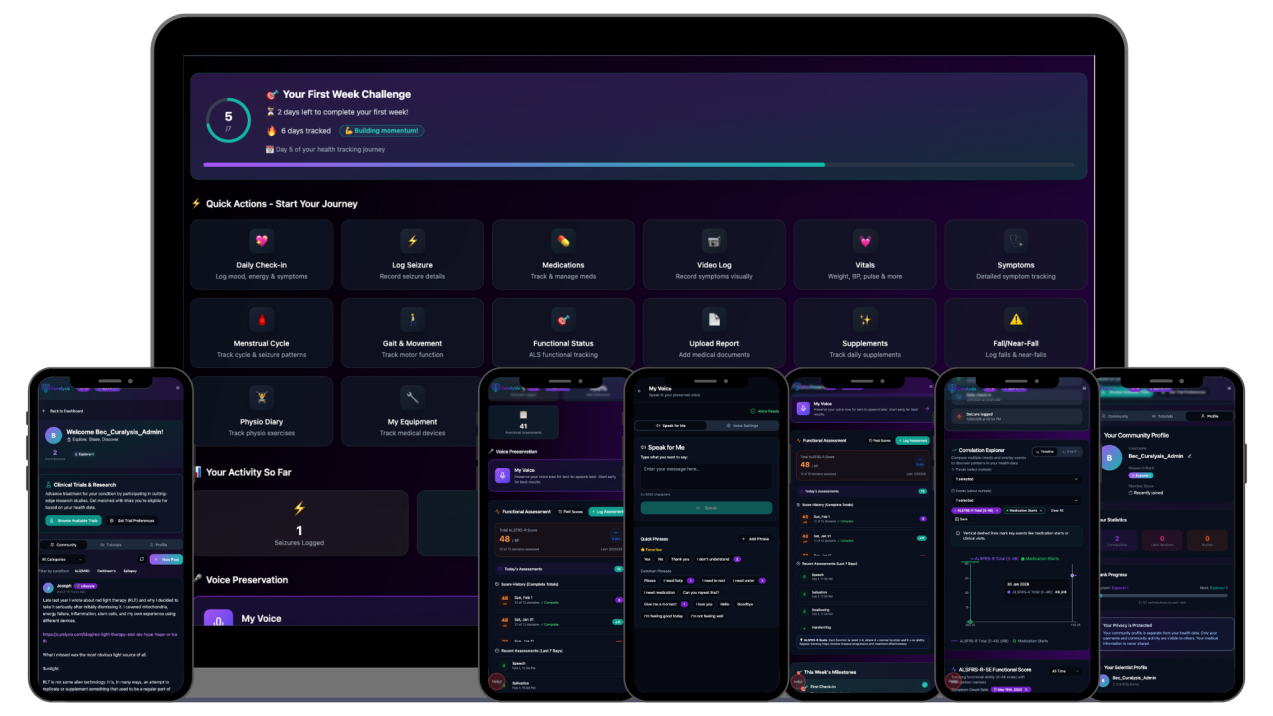
“Long term, the vision for Curalysis is to create tools that make navigating neurological conditions less overwhelming, while accelerating the path toward better care, stronger research, and eventually more effective treatments and cures,” he said.
They are also developing Compass, a prototype source of information, services, and supports for people living with MND, reducing the toll on patients researching scattered websites, PDFs, and resource lists.
The pair recently appeared on the Let’s Talk MND podcast to discuss their experiences, the platform, and the next steps for clinical trial preparation.
Mr Skewes believes the heightened public attention on MND in recent weeks, following the loss of Australian of the Year and FightMND co-founder Neale Daniher, underscores the importance of progressing the platform into clinical trials.
The experiences of young adults with epilepsy
A new research project at CQUniversity is recruiting participants from across Australia who were diagnosed with epilepsy between the ages of 18 and 26.
The goal is to expand understanding of patient experience and use their voices to shape future policy, support services, and guide inclusivity in healthcare settings, schools, universities, and workplaces.
A core focus of the project will be the deeply personal and often unseen decisions that patients face in deciding when and how to tell others about their condition, or whether to disclose it at all.
Related



CQUniversity social work researcher and lead investigator Madonna Lewis Chesham hopes to gain insight into how young people with epilepsy navigate work, study, friendships, relationships, and independence while learning to live with their lifelong condition.
“While many people focus on seizures and medical treatment, there’s often less attention given to the social and emotional side of living with epilepsy,” she said.
“This research is about understanding those quieter experiences – the moments where people are trying to work out who they can trust, how others might react, and how epilepsy shapes their identity and future planning.”
Ms Lewis Chesham has personally witnessed the broader emotional and social impacts of developing epilepsy in young adulthood – a period of major life transitions further complicated with the uncertainty and pressure of a diagnosis.
“Seeing someone navigate epilepsy opened my eyes to how much of the experience exists beyond the medical diagnosis,” she said. “That experience made me realise there are still gaps in understanding and support for young adults living with epilepsy.”
Patients wanting to learn more or express interest in participating should contact m.chesham@cqu.edu.au or (07) 4150 7119.
Australia’s MND database still going strong
Researchers and clinicians across Australia established the world’s most comprehensive unified patient data collection of ALS, enrolling more than 1800 patients between April 2016 and December 2024.
Stored at the University of Queensland, the database currently includes information and samples from nearly 1400 participants with ALS.
The latest study of the Strategic ALS Australia – Systems Genomics Consortium (SALSA-SGC) database reports age of symptom onset (mean 60.6 years) and median diagnostic delay (11.6 months), as well as regions of the body with first symptom onset and clinical phenotypes of participants.
International researchers have been able to use the biobanked samples of blood, tissue, and genetic material to validate drugs and develop targeted therapies, leading to some new findings about ALS, such as the contribution of metabolic, inflammatory, and cholesterol pathways in disease progression.
Associate Professor Shyuan Ngo, a neuroscientist and researcher at UQ’s Centre for Motor Neuron Disease Research, told media that the database had created a powerful tool that will hopefully lead to breakthroughs in earlier diagnosis and treatments, and improve survival rates.
ALS often leads to death within 3-5 years of diagnosis, and it is estimated that 0.3% of people will be affected by it in their lifetime. Professor Ngo described MND as “ruthless”, explaining that around 90% of cases seem to occur randomly in those with no family history.
“This database has [also] helped us understand more about these genetic markers and what the risk factors are, which has opened up new avenues for research,” said lead senior author Professor Naomi Wray, a complex trait geneticist and researcher at UQ’s Institute of Molecular Bioscience.
“MND is a condition that has a short life expectancy and has no cure. It is devastating for patients and their families, so the more we know the better,” said Professor Ngo.
“Establishing unified data collection across clinics nationally was incredibly complex, but neurologists from across Australia recognised the importance of having matched clinical and biological data which are key to better understanding disease progression.”
