


Enrico Coiera wants also wants to see more engagement from the ADHA when it comes to AI, and the development of sovereign AI.
One of the country’s leading experts on the use of AI in healthcare wants software vendors running AI scribes for clinicians to produce performance data.
Professor Enrico Coiera, director of the Centre for Health Informatics at the Australian Institute of Health Innovation, was speaking at the AIDH’s AI.Care conference in Brisbane on Monday.
“My plea to AI scribes companies is, please publish your performance data,” he said.
“I can buy a hi-fi and see all the technical specifications, but nobody reports the error rates, the hallucination rates [of AI scribes].
“I’d love to know more about that. Please do that. People will buy your product if you do that.”
This article originally ran on TMR’s sister site, Health Services Daily. TMR readers can sign up for a discounted subscription.
Professor Coiera also wanted to see more from the Australian Digital Health Agency on the use of AI.
“We have yet to see a national strategy or plan for AI,” he said.
“I am hopeful that will be forthcoming, soon.
“The only thing I can find [in terms of a plan] is the ADHA’s national digital health strategy which runs out to 2028.”
That strategy contains just one page that relates to AI, he pointed out.
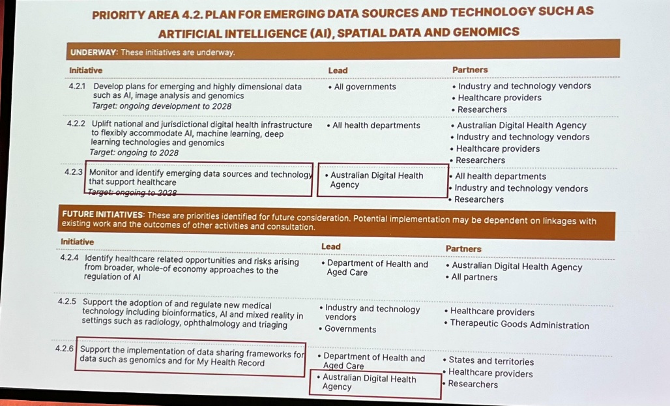
“As you’ll see, [the ADHA] sees AI as an emergent technology. Well, I’ve got to say, this year, it has emerged. It’s already here. It is a lot more present in front of face than even this roadmap suggests,” he said.
“You can see the ADHA sees its role very specifically in terms of access to data, data interoperability, etc.
“At least as far as this document is concerned, it’s not seeing itself as a major player in the AI space.
“I’m not sure long term that that is possible to be maintained, but it’ll be interesting to see how things change – whether that document, which is meant to run out in 2028 gets updated sooner.
“I’d love to see more active engagement in in the belly of the beast with AI from the ADHA, but maybe they have other major priorities.”
Professor Coiera emphasised the importance of Australia developing its own, sovereign AI for healthcare.
“Sovereign AI is a really important issue that we as a nation are starting to grapple with,” he said.
Related



“The issue essentially is, how much of our AI competence do we outsource to companies from overseas, and how much do we keep locally here in Australia?
“It’s fine for us to outsource when we have trusted partner relationships and there are no upsets.
“But we saw during covid, for example, that we didn’t have sovereign capacity for vaccines, and that meant there was a national delay in vaccine rollout until we could import the vaccines that we wanted, or we could start to make them here.”
“And when most of the large language models we’re dealing with come from a few very large west coast US companies and given that we live in increasingly unstable geopolitical times, the question really is, how much of that should we outsource?” he asked.
“It’s a nuanced question. I don’t have an answer myself, but it’s very clear that we can have sovereignty over some issues and outsource others.
“We’re not going to be making Nvidia chips. But we may well want to, if not, build our own large language models, we want to be able to at least make large language models our own, customise them locally and determine who gets to use them or not.
“We want to make sure that we have a workforce that is skilled and capable of doing what needs to be done locally, simply because we need to have those capabilities, and we need, therefore to have local R and D capacity.
“The emergence of [local companies Harrison.ai and Heidi Health] is the beginnings of that national capability, which is very exciting.”
Professor Coiera flagged that the Australian Alliance for Artificial Intelligence in Healthcare, of which he is a board member, would be releasing the third iteration of its National Policy Roadmap for AI in Healthcare in the first quarter of 2026.
This edition will focus tightly on what it means to safely and effectively implement AI within healthcare organisations.
“This whole central issue of safe and effective governance and practice is going to be front and centre of what we do,” he said.
“We have finished engaging with the membership of the Alliance, and have about 96 different organisational responses to the initial survey about what good implementation practice looks like and what the current barrier is after implementation.”
Professor Coiera said the first thing that “struck us, in a priority ranking of different topic areas, is that safety and quality still remains the number one concern of everybody involved”.
“We’re just not satisfied at the moment that this is something that is sorted, and we need it to be sorted,” he said.
“As before, data security and privacy still remains a major issue.”
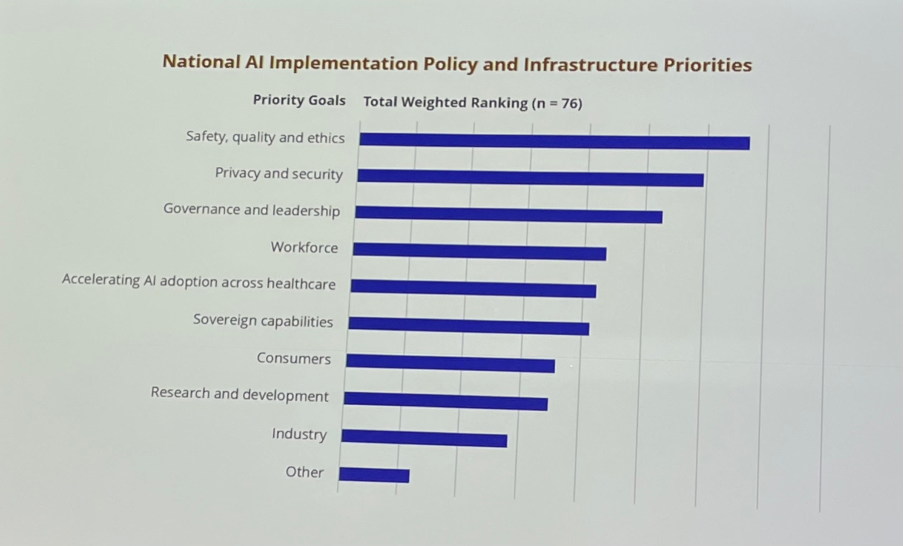
“What you see then is that there are a bunch of other issues, like workforce, governance, adoption and sovereign capability,” he said.
“To my surprise, consumers still don’t rate as highly as they should, given the concerns I’ve shared with you about the use of AI, and this is something that I’m trying to understand myself a bit more.”
Professor Coiera said the priority in 2026 would become governance of AI.
“What we’ve seen recently is industry trying to deal with the issue of regulation, and trying to be self-organising,” he said.
“We haven’t yet seen the voluntary code of conduct for AI launched by the Medical Software Industry Association and the Medical Technology Association of Australia, but I understand it will happen soon, and I look forward to seeing what that contains.
“The TGA is maturing rapidly, and its know-how in the area is exceptional, and they continue to impress me with what they’re doing.
“We still remain concerned about safety and effectiveness, and one of the things that still troubles me is that the basic research evidence about what is good and what is not good, is not there yet.”
Our enthusiasm for the technology has seen clinicians adopting AI technology ahead of the research evidence, Professor Coiera told the conference.
“Five years ago, it was hard to convince clinicians to even come to a talk on AI. Now, I’ve got to tell them to stop,” he said.
“Clinical governance really doesn’t exist in many places at all. I do know that there are, for example, some leading teaching hospitals in Victoria and in New South Wales at least, that I’m aware of that have governance committees and are trying to work out how they how they are put together, and what they should do.
“But it’s still early days.”
The Australasian Institute of Digital Health’s AI.Care conference is being held in Brisbane on Monday 24 November and Tuesday 25 November.
