

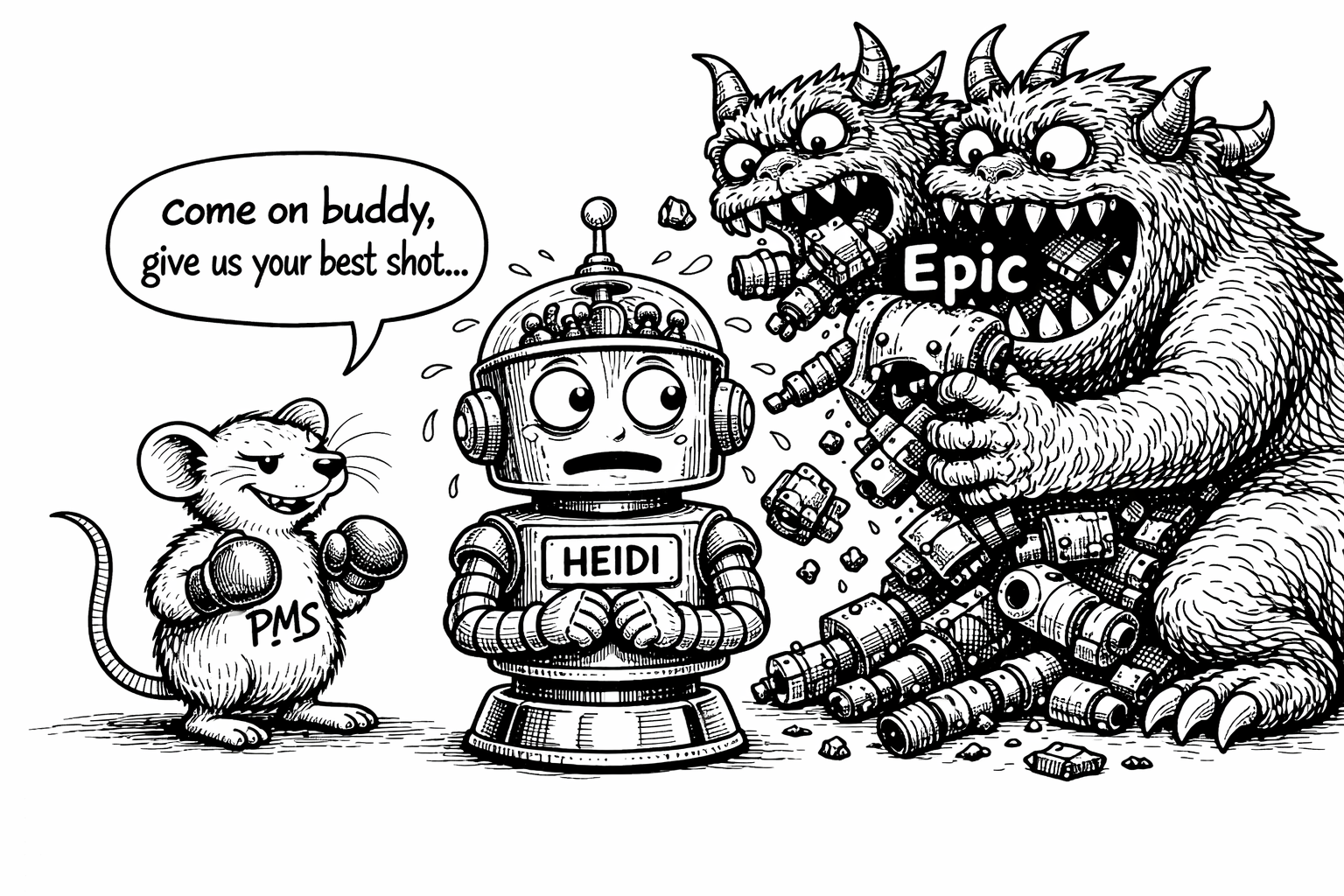
Impressive as it is, Heidi is stuck between a market it can’t afford to service and a market that eats start ups for breakfast
Heidi Health had about as good a big-bang start as health tech gets: a scribe that clinicians loved, adopted from the bottom up by doctors who found it themselves rather than IT departments mandating it.
But eighteen months on, the company feels like it doesn’t have a clear next act.
It’s caught between a small-to-medium practice market it’s discovering is too expensive to service properly for the kind of ambition it has, and an enterprise hospital market where it’s now going head-to-head with some of the biggest technology companies on earth.
The problem with being “just a scribe”
The scribe alone was never going to be a defensible long-term business, and Heidi knew this early on. Ambient documentation has become commoditised fast – DeepCura, Freed, Ambience, Nabla, Lyrebird, MBSPro and a dozen others now do a broadly comparable job, several of them cheaper and with fewer strings attached.
So Heidi quickly starting swimming upstream: Heidi Evidence for clinical decision support, and Heidi Comms. The latter is Heidi’s first real agentic AI product, handling live patient calls, bookings, reminders and follow-ups rather than just listening and writing.
Comms was the company’s test of whether it could become something stickier than a scribe.
But it’s already apparent that it’s not going to be economic for Heidi to pursue it’s agentic aspirations with SMEs.
Heidi restructured its entire pricing model in February 2026. The core paid tier previously around $90–99 a month under the old Pro/Together naming was rebranded “Clinician” and now costs $150 per user per month billed annually. Deeper EHR write-back, once bundled more accessibly, now sits behind the pricier Practice tier ($180/user/month) or a custom Enterprise contract.
Heidi Comms itself seems to have never had a public price. It isn’t available via self-serve sign-up: practices submit an interest form, wait three to five business days, and go through a sales call before receiving a quote, tailored per clinic based on size, region and use case.
After less than six months in market Heidi has ceased any support for the product for small practices and early adopters say they’re being told its only going to be available at the enterprise level moving forward.
Just what size “the enterprise level is” isn’t entirely clear yet but Heidi’s commercial energy has visibly shifted in the last few months to the hospital market.
Its Series B funding is explicitly earmarked for dedicated sales teams in the US, UK and Canada targeting large hospital systems. Beth Israel Lahey Health recently rolled Heidi out across its entire physician base. And surely Heidi is knee deep trying to win the current NSW health tender for 6000 physician scribes.
Small practices that actually used or have trialled Comms say that both support and pricing were becoming problematic.
$900 a month or about $12,000 a year for Comms alone, on top of another $5,000–6,000 annually for the scribe product at full price and practice owners were facing a price that was more expensive than their core EMR.
A Comms user pointed to the likely problem sitting underneath the price: “they’re having to do too much troubleshooting, and the setup is taking too long… they can’t deliver it at scale.”
A scribe is a contained problem. It listens, transcribes, and hands a clinician text to check.
An agentic front-desk product has to handle live calls, learn each practice’s specific scheduling quirks, escalate correctly when something goes wrong, and stay correctly configured as staff and systems change. That’s a fundamentally more expensive product to support across thousands of small, idiosyncratic clinics than across a handful of large hospital systems with dedicated IT teams to absorb the setup burden.
Small practices, in other words, were the wrong size to testing what turn out to be fairly complex agentic AI integrations.
If small-to-medium practices are too expensive to service properly, the obvious next move is hospitals: bigger contracts, dedicated IT teams, budgets that can absorb bespoke onboarding.
But for Heidi, taking their agentic AI aspirations and swimming upstream for market scale means walking into a much bigger fight
The hospital enterprise market isn’t a greenfield market waiting for an early mover and perhaps creative Australian scribe company to stake ground.
It’s literally occupied by some of the largest technology companies in the world.
Amazon is selling sophisticated agentic AI for enterprise hospital patient-contact workload through Amazon Connect Health, and is already live at scale at UC San Diego Health.
Salesforce is pushing its own health-cloud agentic layer into hospital call centres and patient engagement.
And sitting underneath all of it are the two companies that actually own the patient record in the big hospital sector – Epic and Oracle Health (Cerner). Each is building their own native AI documentation and communication tools directly into the EHR, on the – possibly getting old – idea that a hospital would rather buy one more module from its existing EMR vendor than integrate a fourth or fifth outside product.
Heidi’s core structural weakness in this fight hasn’t gone away just because it changed markets: it still doesn’t own an EMR. Being excluded from the PMS is perhaps a survivable handicap when you’re a scribe competing on being liked by individual doctors.
It’s a much bigger handicap when you’re trying to sell hospitals an agentic layer that needs deep, trusted, real-time access to the patient record to do anything useful, and Epic and Oracle can simply build the equivalent feature natively rather than grant a third party that access.
Is there a sweet spot though?
It’s a question with only two plausible answers.
The first is a genuine demonstration project, and Australia may be where it happens.
NSW Health’s Single Digital Patient Record project – a statewide, single Epic implementation covering 15 Local Health Districts – is exactly the kind of centralised, high-profile build where a locally headquartered vendor might have a real shot at forcing integration on its own terms, rather than being frozen out.
If Heidi could get genuinely embedded as the scribe layer sitting on top of Epic within SDPR – not bolted on, but actually integrated into workflow – that would be a powerful proof point to wave at every other health system in the world grappling with the same Epic-versus-everyone-else problem.
Although Heidi would be starting as the scribe and still have to compete on the agentic level, it’s a plausible path.
But a lot would depend on NSW Health and Epic actually wanting that outcome. Epic certainly won’t.
On the flip side this might be the kind of high-stakes, high-visibility bet that either makes Heidi’s enterprise case or exposes exactly how hard it is to get between a hospital provider and its EMR vendor.
The second is to aim below the giants rather than through them.
Not every hospital can afford Epic or Oracle Health’s enterprise pricing.
There are many thousands of small and mid-size hospitals globally, particularly outside the US, running on cheaper or legacy systems that will never be Epic customers.
That’s a less glamorous market than “beat Epic at the top,” but it’s one where Heidi’s existing multilingual, low-friction, doctor-loved scribe reputation might actually translate into an agentic layer smaller hospitals can afford and self-serve into, without needing the bespoke, expensive onboarding that broke Comms in the small-practice market.
Neither path is obviously the winning one.
And it’s entirely possible Heidi ends up doing a version of both simultaneously while it works out which one actually pays.
But if you look at the US LLM situation it’s almost certain the money for AI is going to get very scarce soon, so they had better start spending wisely.
What’s clear is that the company that built its name being everywhere, for everyone, cheaply, is now having to pick a narrower lane, one where the returns are much higher but so too are the risks.
